Independent comparisons. We may earn from shop links. More info

How to use a USB tester

Updated: October 2026

You have the meter in the packet and a charger that may or may not be the problem. The first job is one reading you can trust: a source, the meter, and a device that is allowed to draw current. This page is that first reading. It assumes you already own one of the inline meters in our [USB multimeter comparison](/hub/measuring-equipment/usb-multimeter). Peter F. used the amazon.co.uk extracts and public guides on 16 October 2026. We did not sit these five meters on a bench. A qualifying purchase can earn a commission at no extra cost to you.

You have the meter in the packet and a charger that may or may not be the problem. The first job is one reading you can trust: a source, the meter, and a device that is allowed to draw current.

Our top picks

YEREADW YEREADW KWS-2303C

Best overall

YEREADW YEREADW KWS-2303C
9.2/10about £11.97
YEREADW YEREADW 066C

Preis-Tipp

YEREADW YEREADW 066C
9.0/10about £9.27
Aideepen Aideepen TM962

Alternative

Aideepen Aideepen TM962
8.8/10about £8.79
On this page

Put the meter in the lead

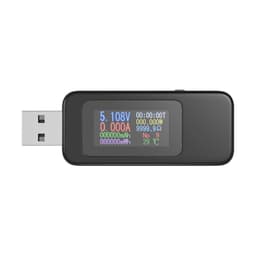
The meter is a pass-through. It is not a probe, and it is not a dummy load. None of the five listings documents a load-test button. Do not invent one. Put the charger or power bank on the supply side and the phone or board on the load side. If the screen stays blank, seat both ends, then try the other orientation of a USB-C plug. UK reviews include units that never lit. If a second known-good charger still shows nothing, treat the meter as the suspect. The 066C and the KWS-2303C say a double-click rotates the display. The Aideepen listing does not, and a UK review says this display cannot be turned. These meters are not for a BS 1363 socket. UK mains are 230 V. Shopping criteria stay on the buying guide.

Read volts, amps, and watts together

Write down volts, amps, and watts from the same moment. Watts are volts times amps. If the meter shows 15 V and 3 A, the power is 45 W. A single voltage, with no current, does not say the charger is healthy. USB-C often sits near 5 V until the device negotiates. iFixit’s ET920 guide shows a device asking for about 9 V at about 2 A, and a nearly full laptop close to 20 V while drawing little current. Those are that guide’s examples, not readings we took. A phone at 80 per cent drawing 12 W from a 30 W charger is a normal taper. Clear capacity and energy only for a cumulative test. That job is the power bank capacity page.
YEREADW YEREADW KWS-2303C

Testsieger

YEREADW YEREADW KWS-2303C
9.2/10about £11.97

Stop before you invent a fault

Stop if a plug gets hot, a pack swells or smokes, or the device resets when you insert the meter. One 066C review says the meter interfered with Samsung super-fast charging. If fast charge changes the moment the meter is in line, remove the meter. The reading is then evidence about the meter, not about the charger. One KWS-2303C review claims damage to a Steam Deck’s charging parts. That is a single report. Disconnect if anything behaves oddly. Do not short the power pins or attach a vacuum or a heater. One Aideepen review describes a power bank catching fire with a cordless vacuum on the lead. A surprising 5 V, with a device that should be negotiating, is the moment to change one part. That comparison is the cable or charger page.

Write the setup down before you unplug

Before you unplug, note the cable, the charger, and the device, and whether the phone was allowed to charge or was already full. That note is what makes the next swap fair. A meter that shows D+ and D−, as the 066C listing does, is still not a data-integrity test. One YOJOCK review mentions voltage with no data. The listing does not sell a data check.

Common questions

Which way do the plugs go?
The supply goes on one side and the device on the other. USB-C can be turned over. On the 066C and the KWS-2303C the listing says the screen shows current direction, and a double-click rotates the display. If the screen is blank, seat both ends before you blame the charger.
Why is the screen blank?
Both ends may be open, the plug may be barely touching, or the meter may be dead. UK reviews include units that never lit and a 066C connector that worked only when pushed hard. Try a known-good supply once. If it stays dark, stop. A blank meter cannot name a bad cable.
Why is a fast charger showing 5 V?
USB-C often stays near 5 V until a device requests 9 V, 15 V, or 20 V. iFixit’s ET920 guide uses those negotiated examples, including a full laptop drawing little current near 20 V. A meter with no load, or a full phone, will not show the headline wattage. Attach a device that is allowed to charge.
How do I get watts if the meter only shows volts and amps?
Multiply them. Watts equal volts times amps at the meter. 15 V at 3 A is 45 W. If the listing already prints power, use that figure and still note the voltage, because the same watts at 5 V and at 15 V are different currents.
What should I write down before I swap a cable?
Write the volts, amps, and watts, the cable, the charger, and how full the device was. Change one of those next time. A note that only says slow cannot separate a lead from a full battery. The cable-or-charger page compares those two notes.
Can I test a wall socket with multimeter probes?
No. These meters are inline USB instruments, not CAT-rated mains testers. UK sockets are 230 V with a BS 1363 plug. Probes do not belong in a USB port or in a wall socket for this job. The tester belongs in the lead, between the charger and the device.
When should I stop?
Stop if a connector gets hot, a pack smokes or swells, charging changes as soon as the meter is inserted, or the device resets. A swollen pack or a laptop port that has failed needs a competent person, not another discharge. These screens are not calibration certificates.

Related pages

Sources

Public UK sources named in the research digest: battery marking, retained capacity rules, the Northern Ireland common-charger instrument, the Great Britain common-charger response, and the USB-IF e-marker method. Shelf prices, stars and review counts are the amazon.co.uk lines in the five extracts dated 15 October 2026. Prices move.

  1. GOV.UK, batteries (retrieved 15 October 2026)
  2. Regulation (EU) No 1103/2010, capacity marking (retrieved 15 October 2026)
  3. Radio Equipment (Amendment) (Northern Ireland) Regulations 2024, SI 2024/1231 (retrieved 15 October 2026)
  4. GOV.UK, Northern Ireland radio equipment amendment guidance (retrieved 15 October 2026)
  5. GOV.UK, government response to the common charger call for evidence (retrieved 15 October 2026)
  6. USB-IF, e-marker testing method, revision 1.2 (retrieved 15 October 2026)
  7. Plugable, VAMETER3 range (retrieved 15 October 2026)
  8. Digital Toolbelt, USB-C power meter ceiling warning (retrieved 15 October 2026)