Independent comparisons. We may earn from shop links. More info

Non-contact voltage tester limitations

Updated: October 2026

The pen in your hand has just gone quiet on a cable you expected to be live, or it has beeped on the door frame. Non-contact voltage tester limitations run in both directions: a beep is not permission to touch the conductor, and silence is not proof the conductor is dead. Peter F. looked at the four pens in our [Voltage testers](/hub/measuring-equipment/voltage-tester) comparison, all amazon.co.uk listings checked on 15 October 2026, plus HSE guidance on what a voltage stick is for. There was no laboratory test. This page does not rank the two-pole rows and it does not repeat the lock-off sequence.

The pen in your hand has just gone quiet on a cable you expected to be live, or it has beeped on the door frame.

Our top picks

Aicevoos Aicevoos A1

Best overall

Aicevoos Aicevoos A1
9.2/10about £7.99
KAIWEETS Kaiweets HT100

Alternative

KAIWEETS Kaiweets HT100
9.0/10about £10.99
MUFASHA Mufasha T-02a

Alternative

MUFASHA Mufasha T-02a
8.8/10about £8.99
On this page

What the beep is actually sensing

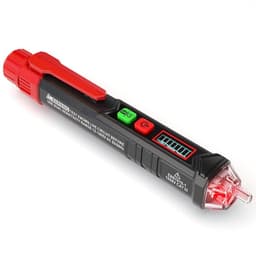
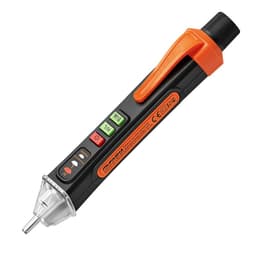
A non-contact pen senses an alternating field. It does not measure voltage between two probes, and none of these four states continuity or DC. Each states 12–1000 V AC and 48–1000 V AC. A stronger beep means you are closer to a field. Klein’s notes for this class of tool, a different brand, say it may miss a shielded wire or a user who is not grounded. GS38 allows a stick to identify live equipment. It does not allow a dead-circuit proof.

When it beeps and the cable is not the one you think

A beep can be an induced field from a neighbouring live cable. Volt Stick describes that ghost voltage as real, not as a broken pen. The higher range, often 48–1000 V, is the setting reviewers use so coupled fields drop out. One Mufasha review, on a 12 V camper circuit, said the pen lit on wood, metal and fabric. That is one text on a 4.4 from 31 ratings, not a class defect. An unsteady Aicevoos beep is a reason to stop. The dangerous case is no beep, and you unscrew the plate.
Aicevoos Aicevoos A1

Testsieger

Aicevoos Aicevoos A1
9.2/10about £7.99

When it stays quiet on a live cable

A Kaiweets buyer said the pen works through plastic conduit and not through armoured cable. Another returned a unit that missed a live wire. Those texts sit inside 4.5 from 16,240 reviews, and they matter if you trust quiet. A deep back box can hide the field as well. These pens warn below 2.5 V. Corroded Aicevoos cells and flat Venlab cells both imitate a dead cable. Prove the pen on a known live source first. That shows it is awake. It is not an isolation sequence.

The 12–1000 V line on these pens

The 12–1000 V line on these pens is AC. A car battery is DC, and a 12 V figure is not a vehicle test. A Kaiweets reviewer found 240 V mains clearer than 12 V on a car. Use the higher range on household mains, around 230 V, when the low range beeps on everything nearby. When you may touch a conductor, put the pen down. The steps are on how to prove a circuit is dead. A qualifying purchase through our amazon.co.uk links can earn a commission at no extra cost to you.

Common questions

Why does the pen beep when nothing should be live?
It may be sensing an induced field from a neighbouring live cable, or it may be on the more sensitive range. Volt Stick describes ghost voltage as a real field, not a broken pen. One Mufasha review also reported a light on wood, metal and fabric during a 12 V camper test, which is a reminder that a beep can appear on something that is not the circuit. Change to the higher range and, if you will touch a conductor, move to a proved two-pole tester.
Why is it quiet on a cable I think is live?
The cable may be armoured, in steel conduit, or too far from the tip, or the cell may be flat. A Kaiweets review reported no detection through armoured cable, and another return followed a missed live. These pens warn of a low battery under 2.5 V, and a flat cell looks the same as a dead cable if you skip the check on a known live source. Quiet means no field sensed, not safe to cut.
Will it see SWA or steel conduit?
Do not expect it to. A UK Kaiweets review says the pen works through plastic conduit and not through armoured cable. Volt Stick’s guidance for this kind of tool says the same about armour and an earthed metal cabinet. Steel wire armour and steel conduit are shields. A silent scan of SWA is a reason to use a contact tester on the conductors after isolation, not a reason to drill the armour.
Can I use the 12 V range on a car battery?
The 12–1000 V line on these pens is AC. A car battery is DC, and maker guidance for this class of pen excludes cars and DC. A Kaiweets reviewer found 12 V on a car harder to read than 240 V mains. A Mufasha reviewer trying a camper saw the pen light on wood, metal and fabric. Use a DC tester made for vehicles if you need the battery. Do not treat a beep on the bodywork as a voltage.
Does a flat battery look the same as a dead cable?
Yes, if you do not check the pen first. The bullets warn below 2.5 V. Reviews include corroded AAA cells in an Aicevoos box and flat cells in a Venlab. Auto shut-off after a few minutes can look the same. Prove the pen on a known live AC source before you trust a quiet stretch of flex. That check tells you the pen is awake. It does not prove a circuit dead.
When do I put the pen down and use the two-pole tester?
Put it down when you are about to touch a terminal, open a faceplate or cut a cable. GS38 allows the pen for identifying live equipment, and HSG85 says you do not prove dead with a volt stick. Take a two-pole tester, prove it, isolate and lock off, then test the conductors. A pen that has just beeped, or just gone quiet, is not a substitute for that order.

Related pages

Sources

Public UK sources on safe isolation, two-pole detectors and the danger threshold. Shelf prices, stars and review counts are the amazon.co.uk lines in the six listings dated 15 October 2026. Prices move.

  1. HSE GS38, electrical test equipment for use by electricians (retrieved 16 October 2026)
  2. HSE HSG85, electricity at work: safe working practices (retrieved 16 October 2026)
  3. Electricity at Work Regulations 1989, regulation 14 (retrieved 16 October 2026)
  4. HSE HSR25, memorandum of guidance on the Electricity at Work Regulations 1989 (retrieved 16 October 2026)
  5. BSI, BS EN 61243-3:2014, two-pole low-voltage detectors (retrieved 16 October 2026)
  6. SELECT, 10 steps to safe isolation (retrieved 16 October 2026)
  7. Martindale, VT28 voltage indicator page, VT12 row (retrieved 16 October 2026)
  8. HSE, electricity frequently asked questions (retrieved 16 October 2026)