Independent comparisons. We may earn from shop links. More info

Two-pole or non-contact voltage tester

Updated: October 2026

You have two tools that both get called a voltage tester, and the job in front of you only matches one of them. A two-pole or non-contact voltage tester choice is about contact. If you will touch the conductor, you use a two-pole tester. If you are only identifying a live cable among many, a pen is the tool HSE guidance allows. Peter F. split the six amazon.co.uk listings in our [Voltage testers](/hub/measuring-equipment/voltage-tester) comparison that way, using shelf prices from 15 October 2026. There was no laboratory test. Pen failure modes in detail stay on their own page, and the lock-off order stays on its own page.

You have two tools that both get called a voltage tester, and the job in front of you only matches one of them. A two-pole or non-contact voltage tester choice is about contact.

Our top picks

Aicevoos Aicevoos A1

Best overall

Aicevoos Aicevoos A1
9.2/10about £7.99
Martindale Martindale VT12

Rank 2

Martindale Martindale VT12
9.2/10about £33.48
KAIWEETS Kaiweets HT100

Alternative

KAIWEETS Kaiweets HT100
9.0/10about £10.99
On this page

What each tool is actually measuring

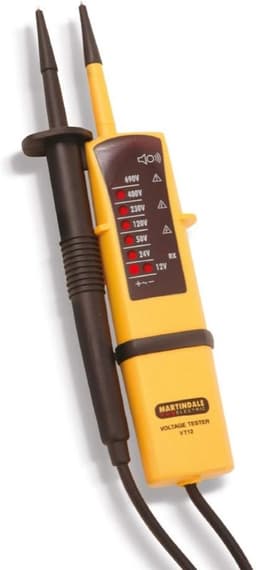
A two-pole tester puts a probe on each of two points. In this set that is the Martindale VT12 at £33.48, which states BS EN 61243-3:2014, and the Atuten UT15C at £35.69, which states an LCD and not that standard. UK mains are 230 V. A pen senses an alternating field and does not complete a circuit between probes. GS38 allows a stick to identify live equipment, and it prefers a two-pole detector for a yes-or-no test on the conductors. The wider checklist is the voltage tester buying guide.

When the pen is the right first look

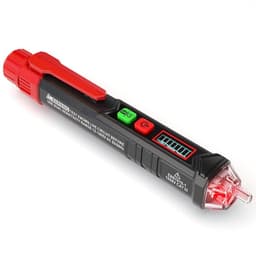
A pen is the first look when the conductors are still in their sheaths. GS38’s example is one live single in a trunking. You are not proving the quiet cores dead, and a quiet stretch of flex is not safe to cut. The best-value pen here is the Aicevoos A1 at £7.99. The Kaiweets, at £10.99, has the larger review count and a CAT line that does not change the job. The ways a pen misleads are on non-contact voltage tester limitations.
Aicevoos Aicevoos A1

Testsieger

Aicevoos Aicevoos A1
9.2/10about £7.99

When only the two-pole tester counts

Proving dead is a contact test after lock-off. For a faceplate or rose in this set, that listing is the Martindale VT12, the only row with BS EN 61243-3:2014 and GS38 caps. You still prove it before and after. The order is on how to prove a circuit is dead. The UT15C is the two-pole choice when you want an LCD, knowing the standard line is absent. A two-pole tester is a poor scanner for a bundle of singles. For tracing, the Aicevoos is the best-value pen. Neither pen for the dead test.

Neon screwdriver and multimeter

A neon screwdriver is not a small two-pole tester. The return path is through your body. Retire it rather than treating the glow as a test. A multimeter does not close the gap. HSG85 says you do not use one to prove dead. Keep it for a number after a suitable indicator has proved the circuit dead. A qualifying purchase through our amazon.co.uk links can earn a commission at no extra cost to you. If you will touch the conductor, use a two-pole tester. Silence from a pen is not proof.

Common questions

Can a pen prove a socket dead?
No. A pen can suggest a field is present near a socket. It cannot prove the terminals are dead. HSE GS38 and HSG85 both keep volt sticks out of the proving-dead step. In this set you use the Martindale VT12 or, with the standard-line gap in mind, the Atuten UT15C, and you prove that tester before and after. A quiet Aicevoos, Kaiweets, Venlab or Mufasha pen is not the result you unscrew a plate on.
When is a pen the better tool?
A pen is the better first look when you are sorting one live single out of a trunking, or tracing a break along a flex, and you will not touch the copper. The four pens here are built for that AC field. They are cheaper, from £7.99 to £10.99, and they do not give you continuity or a contact voltage. The moment the job becomes a terminal, the pen stops being the better tool.
Is a neon screwdriver closer to a pen or to a two-pole tester?
It is closer to a risk than to either. It needs your body as the return path, the glow is weak in daylight, and it is not built to GS38’s probe rules. A pen at least keeps your hand on the sheath. A two-pole tester puts the test current through the instrument. Retire the neon screwdriver rather than choosing which proper tool it resembles.
Will a two-pole tester find one single in a trunking?
It can only do that if you expose conductors and test between points, which is a poor way to scan a bundle. GS38 gives that scanning job to a voltage stick. Use a pen to see which core has a field, and remember the others are not proved dead. Armoured cable and steel conduit can hide the field from the pen, so a quiet scan of SWA is not a clear result either.
Which of these listings is which type?
Two-pole: Martindale VT12, £33.48, 4.6 from 1,408, BS EN 61243-3:2014 stated; Atuten UT15C, £35.69, 4.5 from 58, LCD and phase rotation, BS EN 61243-3 not stated. Pens: Aicevoos A1 £7.99, Mufasha T-02a £8.99, Venlab VD-200 £9.99, Kaiweets £10.99. All four pens are AC only, with a stated dual range and no continuity line.
Does a CAT mark on the Kaiweets or Venlab change the answer?
No. Both print CAT III 1000 V / CAT IV 600 V, and so does the Mufasha. The mark is an installation-category claim on a non-contact pen. It does not add a contact proof and it does not make the pen suitable for meter tails. The Aicevoos has no CAT line and is the same type of tool. The VT12’s amazon table leaves CAT blank.

Related pages

Sources

Public UK sources on safe isolation, two-pole detectors and the danger threshold. Shelf prices, stars and review counts are the amazon.co.uk lines in the six listings dated 15 October 2026. Prices move.

  1. HSE GS38, electrical test equipment for use by electricians (retrieved 16 October 2026)
  2. HSE HSG85, electricity at work: safe working practices (retrieved 16 October 2026)
  3. Electricity at Work Regulations 1989, regulation 14 (retrieved 16 October 2026)
  4. HSE HSR25, memorandum of guidance on the Electricity at Work Regulations 1989 (retrieved 16 October 2026)
  5. BSI, BS EN 61243-3:2014, two-pole low-voltage detectors (retrieved 16 October 2026)
  6. SELECT, 10 steps to safe isolation (retrieved 16 October 2026)
  7. Martindale, VT28 voltage indicator page, VT12 row (retrieved 16 October 2026)
  8. HSE, electricity frequently asked questions (retrieved 16 October 2026)