Independent comparisons. We may earn from shop links. More info

Voltage tester buying guide

Updated: October 2026

You are about to change a socket or a light switch, and the amazon.co.uk Voltage Testers list is full of pens that beep. A voltage tester buying guide has to decide the job before it compares stars. On 15 October 2026 the six listings in our [Voltage testers](/hub/measuring-equipment/voltage-tester) comparison were four non-contact pens from £7.99 to £10.99 and two two-pole testers at £33.48 and £35.69. Peter F. read those amazon.co.uk pages and public UK guidance from the Health and Safety Executive. There was no laboratory test. If you will touch a conductor, the instrument is a two-pole tester. A pen is for finding a live cable among others.

You are about to change a socket or a light switch, and the amazon.co.uk Voltage Testers list is full of pens that beep. A voltage tester buying guide has to decide the job before it compares stars.

Our top picks

Aicevoos Aicevoos A1

Best overall

Aicevoos Aicevoos A1
9.2/10about £7.99
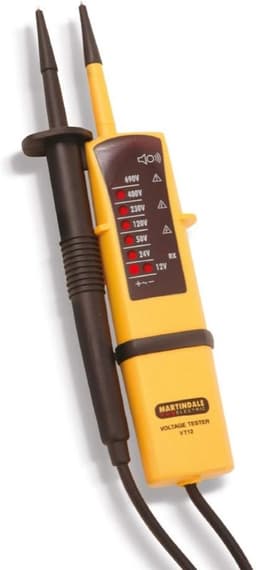
Martindale Martindale VT12

Rank 2

Martindale Martindale VT12
9.2/10about £33.48
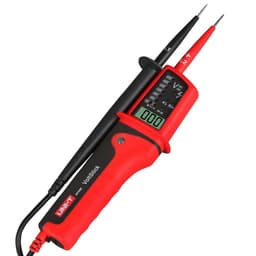
ATUTEN Atuten UT15C

Alternative

ATUTEN Atuten UT15C
9.0/10about £35.69
On this page

Pen or two-pole, before the price

GS38 treats a voltage stick as a way to identify live equipment, not as proof a circuit is dead. In this set the contact tools are the Martindale VT12 and the Atuten UT15C. The pens sense an AC field and do not touch the terminal. A faceplate needs those conductors dead before a screwdriver touches metal. A pen can beep on a neighbour, or stay quiet when the field is blocked. The split is on two-pole or pen.

The words that have to be on the listing

GS38 wants a finger barrier and no more than 4 mm of exposed metal, preferably 2 mm. It names BS EN 61243-3 for a new two-pole detector. The 2014 scope excludes rain and says these detectors are not measuring devices. A CE mark is not that standard. CAT IV on a pen is still a pen. The VT12 amazon table leaves CAT blank. Martindale’s page publishes CAT III 690 V / CAT IV 300 V, and this comparison does not treat that pair as an amazon specification.
Aicevoos Aicevoos A1

Testsieger

Aicevoos Aicevoos A1
9.2/10about £7.99

What these six listings actually print

The VT12 is the only kept row with both BS EN 61243-3:2014 and GS38 probe tip caps. Skip it for phase rotation or a numeric LCD. The UT15C states an LCD and phase rotation, and not that British Standard. IP 67 beside IEC 61010-1 is not a rain instruction. Kaiweets prints HT100 in the title and HT101 in the model field. Venlab and Mufasha print a CAT pair, and Mufasha names a class II laser under 1 mW. That mark does not make a pen a proving tool.

Price bands on amazon.co.uk

On 15 October 2026 the pens were £7.99 to £10.99 and the two-pole testers were £33.48 and £35.69. Buying the VT12 does not include a proving unit. The Aicevoos is the best-value pen, and it remains a pen. A qualifying purchase through our amazon.co.uk links can earn a commission at no extra cost to you. Decide the job, then contact or pen, then the standard, then stars inside one type. The named pick is on the best voltage tester page.

Common questions

Do I need a two-pole tester or will a pen do?
You need a two-pole tester if you will touch a conductor, for example when you change a socket or a ceiling rose. A pen is enough when you are only identifying which cable in a trunking is live, or tracing a break in a flex, and you will not treat silence as proof. In this set the contact listings are the Martindale VT12 and the Atuten UT15C. The other four are pens.
What does GS38 actually require on the probes?
GS38 wants a finger barrier and no more than 4 mm of exposed metal, preferably 2 mm, so a slip does not put your finger on a live part. The Martindale VT12 listing says it is GS38 compliant with probe tip caps. The other five listings do not state those caps. The guidance also prefers a test lamp or a two-pole detector for a yes-or-no voltage test, and it says a voltage stick is for identifying live equipment.
Is a CE mark the same as BS EN 61243-3?
CE is a conformity mark. BS EN 61243-3:2014 is the British Standard for a contact two-pole low-voltage detector, up to 1000 V AC or 1500 V DC, and BSI’s scope excludes rain and says the detector is not a measuring device. In this set only the Martindale VT12 states BS EN 61243-3:2014. The Aicevoos A1 states CE only. The Atuten UT15C states IEC 61010-1:2000-1, which is a different document.
What does CAT III 1000 V / CAT IV 600 V mean on a pen?
CAT III is the category HSE associates with distribution inside a building, and CAT IV with the origin of the installation. Kaiweets, Venlab and Mufasha print CAT III 1000 V / CAT IV 600 V on pens that sense an AC field. That mark describes a claimed installation category. It does not add probes, continuity or a dead-circuit proof. The Aicevoos listing has no CAT line at all. The VT12 amazon table also leaves CAT blank.
Does IP 67 on the UT15C mean I can use it in the rain?
The listing prints IP 67 next to IEC 61010-1:2000-1. It does not print a rain instruction, and it does not claim BS EN 61243-3. The scope of that British Standard, which this listing does not claim, excludes use in rain. Treat IP 67 as a mark on the page, and keep the tester in the dry and humid conditions a two-pole detector is described for. A wet accessory is a reason to stop, not a reason to trust the IP line.
Should I buy a proving unit in the same order?
GS38 says you prove the indicator immediately before and after the dead test. A proving unit is the preferred way. A known live source of similar voltage is the fallback, and only if you can do that without danger. None of these six listings is a proving unit. The VT12’s tip-to-tip beep, which reviewers describe, checks that the batteries can sound continuity. It does not prove the voltage ranges.

Related pages

Sources

Public UK sources on safe isolation, two-pole detectors and the danger threshold. Shelf prices, stars and review counts are the amazon.co.uk lines in the six listings dated 15 October 2026. Prices move.

  1. HSE GS38, electrical test equipment for use by electricians (retrieved 16 October 2026)
  2. HSE HSG85, electricity at work: safe working practices (retrieved 16 October 2026)
  3. Electricity at Work Regulations 1989, regulation 14 (retrieved 16 October 2026)
  4. HSE HSR25, memorandum of guidance on the Electricity at Work Regulations 1989 (retrieved 16 October 2026)
  5. BSI, BS EN 61243-3:2014, two-pole low-voltage detectors (retrieved 16 October 2026)
  6. SELECT, 10 steps to safe isolation (retrieved 16 October 2026)
  7. Martindale, VT28 voltage indicator page, VT12 row (retrieved 16 October 2026)
  8. HSE, electricity frequently asked questions (retrieved 16 October 2026)