Independent comparisons. We may earn from shop links. More info

How to prove a circuit is dead

Updated: October 2026

You have the faceplate screws in one hand and a tester in the other, and the dangerous shortcut is to trust a quiet tool. How to prove a circuit is dead is a fixed order: prove the two-pole tester, isolate and lock off, test every conductor pair you can reach, then prove the tester again. A silent pen is not that sequence. Peter F. set this out from HSE guidance and from the SELECT safe-isolation steps, against the six amazon.co.uk listings in our [Voltage testers](/hub/measuring-equipment/voltage-tester) comparison, checked on 15 October 2026. There was no laboratory test. This page assumes a two-pole tester.

You have the faceplate screws in one hand and a tester in the other, and the dangerous shortcut is to trust a quiet tool.

Our top picks

Aicevoos Aicevoos A1

Best overall

Aicevoos Aicevoos A1
9.2/10about £7.99
Martindale Martindale VT12

Rank 2

Martindale Martindale VT12
9.2/10about £33.48
ATUTEN Atuten UT15C

Alternative

ATUTEN Atuten UT15C
9.0/10about £35.69
On this page

What you need before you open anything

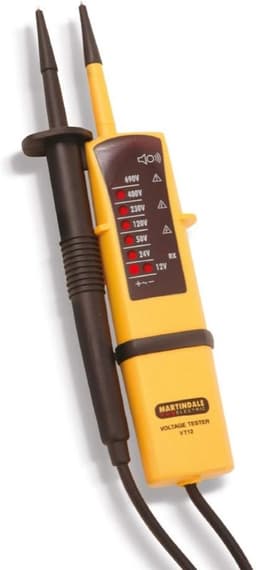
You need a contact indicator, a lock for the isolator, and a way to prove the indicator. In this set that is the Martindale VT12 at £33.48, which states BS EN 61243-3:2014 and GS38 caps, or the Atuten UT15C at £35.69, which does not state that standard. Neither box is a proving unit. The fallback is a known live source, only if you can use it without danger. UK mains are 230 V. A tip-to-tip beep on the VT12 is a battery check, not a voltage proof. If the proving check fails, you stop. The fork against a pen is on two-pole or non-contact.

The sequence, in order

SELECT’s steps run: find the isolator, prove the tester, switch off, lock off, post a warning, test the conductors, then prove the tester again. HSG85 says the lock should take a unique key. On a single-phase circuit test line to neutral, line to earth, and neutral to earth. A ceiling rose can hide a live conductor in a third terminal. If you cannot name the supply, stop. Prove the tester again after the conductors look dead. Continuity is not that voltage proof.
Aicevoos Aicevoos A1

Testsieger

Aicevoos Aicevoos A1
9.2/10about £7.99

Where a pen, a neon screwdriver, or a multimeter drops out

HSG85 says you do not use a multimeter or a volt stick to prove dead. A multimeter kept for electronics is the wrong lead set. The pens here, from the Aicevoos A1 at £7.99 to the Kaiweets at £10.99, are volt sticks. Silence is a reason to fetch a two-pole tester. What a pen gets wrong is on non-contact voltage tester limitations. A neon screwdriver uses your body as the return path. If the only tool is a pen, do not start the faceplate.

When you should not start

Stop if you are not competent to identify the isolator. Stop if you cannot lock it, if another supply can back-feed the circuit, or if the job is the consumer unit. Stop if either proving check fails, or if the accessory is wet. IP 67 on the UT15C is not a rain instruction. This page does not tell you a like-for-like change is non-notifiable. A qualifying purchase through our amazon.co.uk links can earn a commission at no extra cost to you.

Common questions

What is the order: lock off, or test first?
Prove the tester on a proving unit or a known live source first, then switch off, lock off and post a warning, then test the conductors, then prove the tester again. Testing the accessory before you isolate only tells you it was live. It does not make the later dead test optional. SELECT’s ten steps and HSE’s six checks use that order.
Which conductors do I test on a single-phase circuit?
Test line to neutral, line to earth, and neutral to earth, wherever you can reach those conductors at the point of work. A rose or a switch can hide a live conductor in a third terminal. Three-phase needs every combination. If you cannot name the supply, stop and use a competent person rather than sampling two terminals.
Can I prove the tester on a live socket instead of a proving unit?
GS38 allows a known live source of similar voltage when you can do it without danger, and it prefers a proving unit. A live socket on the same installation can be that fallback if you know it is live and you can reach it safely. None of the six listings here is a proving unit. You still repeat the proof after the dead test, on that same kind of source.
Does touching the VT12 probes together prove the voltage ranges?
No. Reviews describe a tip-to-tip beep as a check that the batteries can run the continuity sounder. The listing includes continuity as its own function. That beep does not show the 12 V to 690 V steps. The Martindale manual says indication above extra-low voltage can remain with flat batteries, which is a further reason to prove the tester on a real voltage source.
When do I stop and call an electrician?
Stop when you cannot lock the isolator, when another supply might back-feed the circuit, when the job is the consumer unit, or when the tester fails a proving check. Also stop when you do not know which breaker feeds the accessory, or when the result does not match what you expected and you cannot explain it. HSE’s advice is to ask someone who is competent rather than to carry on.
What if solar or another supply can back-feed the circuit?
Switching off one breaker is not isolation if an inverter, a generator or another board can still energise the cables. You need to identify every source and lock each one off, or you leave the job. Proving dead at the point of work is what shows the back-feed, and only if the tester itself has been proved. If you cannot see every source, do not open the accessory.

Related pages

Sources

Public UK sources on safe isolation, two-pole detectors and the danger threshold. Shelf prices, stars and review counts are the amazon.co.uk lines in the six listings dated 15 October 2026. Prices move.

  1. HSE GS38, electrical test equipment for use by electricians (retrieved 16 October 2026)
  2. HSE HSG85, electricity at work: safe working practices (retrieved 16 October 2026)
  3. Electricity at Work Regulations 1989, regulation 14 (retrieved 16 October 2026)
  4. HSE HSR25, memorandum of guidance on the Electricity at Work Regulations 1989 (retrieved 16 October 2026)
  5. BSI, BS EN 61243-3:2014, two-pole low-voltage detectors (retrieved 16 October 2026)
  6. SELECT, 10 steps to safe isolation (retrieved 16 October 2026)
  7. Martindale, VT28 voltage indicator page, VT12 row (retrieved 16 October 2026)
  8. HSE, electricity frequently asked questions (retrieved 16 October 2026)