Independent comparisons. We may earn from shop links. More info

CO2 detector comparison 2026

The best CO2 detectors, compared.

Top pick: GoHelmate MT29 15-in-1 Best value: GoHelmate MT29 15-in-1 – Value block 8, just above the Bekasa listing, once the top pick is already taken. Updated October 2026.

Peter F.
Peter F.Editor

A CO2 detector shows carbon dioxide in parts per million so you can judge how well a room is ventilated. That gas is a combustion poison and needs an alarm to BS EN 50291, which is a different product. Schools and nurseries decide when to open a window. The Health and Safety Executive names non-dispersive infrared as the portable sensor for workplace checks. Place the meter at head height, away from windows, doors and people, and read a trend while the room is occupied. The [CO2 detector buying guide](/hub/fire-protection/co2-detector/sub/co2-detector-buying-guide) covers the gas, the sensor and the 800 ppm and 1500 ppm bands. A CO2 meter does not detect carbon monoxide, and this page does not claim that any kept meter is to that standard.

A CO2 detector shows carbon dioxide in parts per million so you can judge how well a room is ventilated. That gas is a combustion poison and needs an alarm to BS EN 50291, which is a different product.

GoHelmate MT29 15-in-1

Best overall

GoHelmate MT29 15-in-1
3.3/10∼ £70

11 products checked · 52 hrs invested · +16,800 readers

3 of 3: Best CO2 detectors compared

Swipe for more

1-2 of 3
Best overall
GoHelmate MT29 15-in-1
BREATHE Airmonitor Plus Gen 2
Bekasa 5-in-1 carbon dioxide detector
3.3/10
6.8/10
3.1/10
∼ £70
∼ £100
∼ £17
5.0(1)
4.0(457)
3.1(199)
View offer
View offer
View offer

Personal buying guide

Question 1 of 2

What do you need the reading for?

The best CO2 detectors in detail

GoHelmate MT29 15-in-1

Rank 1

GoHelmate MT29 15-in-1

∼£70

Our view

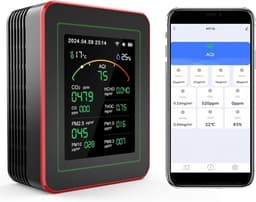
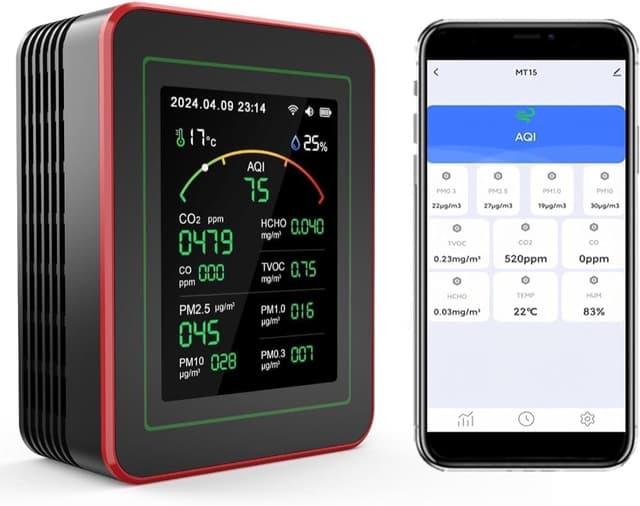
The GoHelmate MT29 is listed at £69.99 as a 15-in-1 that includes CO2, PM2.5, PM10, HCHO, TVOC, humidity, temperature and air pressure, with a colour screen and an audible alarm. amazon.co.uk shows 5.0 from 1 review, dated 6 October 2026: the buyer says it seems to work and mentions worry about fumes despite already owning carbon monoxide alarms. One review cannot show whether the CO2 figure tracks ventilation, and the listing does not name NDIR. The page says the device needs an internet connection and stores data in the cloud, so the app is not an offline log. Battery life is not stated, though power is given as battery and corded, and the unit is listed at 200 g. At this price you are above the £16.99 electrochemical listing and still short of a named NDIR sensor with a large review count. It carries the best-value mark only because the BREATHE listing already holds the top pick and this value block sits just above the Bekasa listing, which is a relative score, not a test of accuracy.

Pros

  • CO2 is on the measured list with particles, VOCs, humidity, temperature and pressure
  • Colour screen and an audible alarm
  • £69.99, below the named-NDIR listing in this set
  • Battery and corded power both stated

Cons

  • NDIR is not named
  • 5.0 from 1 amazon.co.uk review, with no ppm comparison
  • The listing says the app needs an internet connection
  • Battery life is not stated

Best for: You want a mid-price multi-reading screen and you accept that the sensor type is unstated and that a single review cannot show whether the CO2 number is real.

Less suitable: You need an NDIR claim you can check on the listing, or any decision that depends on more than one review.

Specifications

Model
GoHelmate MT29 15-in-1
Brand
GoHelmate
Price
∼£70
Customer rating
5.0/5(1)
Sensor type
Not stated
Measures
CO2, PM, VOC, pressure
Power
Battery and mains
App
Needs internet
Alarm
Audible
Weight
200 g
Dimensions
5 × 10 × 14 cm

Common questions

Does the listing name an NDIR sensor?

No. CO2 is in the measured list. The sensor technology is not stated.

Does the app work without internet?

The listing says the device requires an internet connection and that data is stored in the cloud.

How many amazon.co.uk reviews does it have?

The listing line is 5.0 out of 5 from 1 review. That review calls it a useful portable unit and does not give a ppm comparison.

BREATHE Airmonitor Plus Gen 2

Rank 2

BREATHE Airmonitor Plus Gen 2

∼£100

Our view

The BREATHE Airmonitor Plus Gen 2, model BTL40001, is listed at £99.99 and names NDIR carbon dioxide in the item highlight and the bullets, alongside PM1, PM2.5, PM10, TVOC, formaldehyde, temperature and humidity. On amazon.co.uk it is 4.0 from 457 reviews, checked on 19 October 2026, which is the largest review file in this comparison and the reason it is the top pick. The technical-details line also says sensor type TVOC, so the listing does not speak with one voice about the sensor. Of the first 50 written reviews, only three are marked United Kingdom: they mention Wi-Fi disconnects, an export that was daily rather than 15-minute points, a CO2 channel that failed after about 10 days and read high outdoors, and poor battery life against a listing claim of up to 6 hours. Reviewers outside the UK, who make up most of that sample, often praise the number of channels and describe night-time figures around 1000 ppm with the window shut, falling into the hundreds once a window or an extract fan is used. The app uses 2.4 GHz Wi-Fi, with up to 90 days of history claimed, and USB-C is the route for continuous use. It does not detect carbon monoxide, and a colour on this display is not the Department for Education scale unless the maker says so.

Pros

  • NDIR CO2 named in the highlight and the bullets
  • Also lists particles, TVOC, formaldehyde, temperature and humidity
  • 4.0 from 457 amazon.co.uk reviews
  • USB-C for continuous use; battery claimed at up to 6 hours
  • App alerts for CO2 and PM2.5, with history claimed

Cons

  • Technical details also say sensor type TVOC
  • UK reviews cite Wi-Fi drops, a failed CO2 channel and poor battery life
  • A UK review said export was daily aggregates, not 15-minute points
  • Most of the first 50 written reviews are not from the United Kingdom

Best for: You want a home, office or classroom trend from a listing that names NDIR, and you can leave it on USB-C when the battery claim of up to 6 hours is not enough.

Less suitable: You need a carbon monoxide alarm, a formal 15-minute log, or a meter whose UK reviews do not already describe a failed CO2 channel.

Specifications

Model
BREATHE Airmonitor Plus Gen 2
Brand
BREATHE
Price
∼£100
Customer rating
4.0/5(457)
Sensor type
NDIR; also TVOC line
Measures
CO2, PM, TVOC, HCHO
Power
USB-C and battery
App
Wi-Fi app
Alarm
App alerts
Battery life
Up to 6 hours
Weight
113 g
Dimensions
3.6 × 7.1 × 8.4 cm

Common questions

Does the listing say this uses an NDIR CO2 sensor?

Yes. The item highlight says professional NDIR sensor, and the bullets say NDIR CO2 measurement. A separate technical-details line says sensor type TVOC.

How long does the battery last?

The listing says up to 6 hours of portable use, and USB-C power for continuous monitoring. UK review text calls the battery life poor.

Does it need Wi-Fi?

The app connects on 2.4 GHz Wi-Fi. The listing names Android 6.0 or later and iOS 11 or later. Readings on the colour display are separate from the app.

Bekasa 5-in-1 carbon dioxide detector

Rank 3

Bekasa 5-in-1 carbon dioxide detector

∼£17

Our view

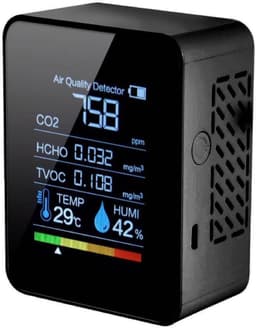
The Bekasa 5-in-1, model Culp-DS-ZXD0246-B, is listed at £16.99 with sensor type electrochemical, and the bullets say the CO2 figure comes from that reaction and that calibration is not required. On amazon.co.uk it is 3.1 from 199 reviews, and it ranked 3 in CO2 Detectors when the listing was checked, which is a sales rank rather than a sensor test. Of 20 UK reviews, the repeated complaints are inaccurate or stuck CO2 readings, units that disagree, readings that stay high after the meter is taken outside, and a response that reviewers compare to alcohol or solvent rather than carbon dioxide. Battery life is not in the spec table; those reviews mention about 3 hours, 6 hours, 27 hours or a couple of hours, and charging that fails unless the unit stays on USB power. A minority call the display clear or say it suits a campervan if it is left on mains. The Health and Safety Executive names NDIR, not an electrochemical cell, as the portable type for workplace CO2 checks. One buyer returned it because they wanted a carbon monoxide monitor and this listing is a carbon dioxide meter.

Pros

  • £16.99, the lowest shelf price in this set
  • Colour screen for CO2, temperature and humidity
  • 199 amazon.co.uk reviews, so the complaints are not a single anecdote
  • Visual alarm and no app to set up

Cons

  • Sensor type is electrochemical, which HSE does not recommend for this job
  • UK reviews dispute the CO2 channel, including stuck and outdoor-high readings
  • Battery life is absent from the spec table and reviews describe a few hours
  • The highlight also mentions TVOC and HCHO while the box list is narrower

Best for: You already know you are buying a cheap screen, you will keep it on USB power, and you accept that UK reviewers dispute the CO2 number.

Less suitable: You want a ventilation reading you can compare with 800 ppm and 1500 ppm, or a carbon monoxide alarm for a fuel-burning appliance.

Specifications

Model
Bekasa 5-in-1 carbon dioxide detector
Brand
Bekasa
Price
∼£17
Customer rating
3.1/5(199)
Sensor type
Electrochemical
Measures
CO2, temp, humidity
Power
Battery
App
No
Alarm
Visual
Weight
170 g

Common questions

What sensor does the listing specify?

Electrochemical. The bullets say the CO2 figure comes from that reaction and that calibration is not required. NDIR is not named.

Does it have an app?

No app is listed. The alarm field is visual.

What do the UK reviews say about the battery?

Reviewers describe a few hours of charge, including figures around 3, 6 or 27 hours, and say it needs to stay on USB power. The spec table does not state battery life.

How we compared

Three amazon.co.uk listings were scored on 19 October 2026 from the shelf price, the star line, the sensor claim and the review notes already on file. This is not a laboratory gas-accuracy test, and a score is not a claim that one meter is the best CO2 monitor in the UK. The three weights below sum to 100.

1

Amazon evidence

40%

Start from the star rating divided by 5, then times 30. Add 8 when the listing has 100 or more reviews. A 5.0 from one review is capped at 8. Repeated complaints that the CO2 channel sticks, reads high outdoors or fails come off this block, as do documented Wi-Fi and battery complaints.

2

Sensor fit

35%

NDIR named for carbon dioxide scores highest in this block. A sensor type that is not stated scores less, and an electrochemical listing scores least for this job. Channels should match the title. Battery life or a stated continuous-power route, and an app or log you can interpret, sit here too.

3

Value

25%

Shelf price in GBP against a sensor claim you can check and a review count that can support it. The lowest price does not win when UK reviews dispute the CO2 channel. A named-NDIR listing under the Aranet4 Home shelf price scores higher than an unnamed sensor with one review.

Independent review
Last updated: October 2026
8 sources checked

CO2 detector buying guide

The three listings are a named-NDIR multi-sensor, a multi-sensor that does not name NDIR, and an electrochemical budget screen. Price alone does not pick the meter. A dedicated NDIR example outside this set, the Aranet4 Home, sat at about £176 to £189 on amazon.co.uk the same day and is not one of the cards. Households still need a carbon monoxide alarm if they burn fuel.

What is a CO2 detector?

A CO2 detector on amazon.co.uk is an indoor meter that shows carbon dioxide in parts per million so you can judge how well a room is ventilated. Carbon dioxide here is exhaled air. Carbon monoxide is a different gas, a combustion poison, and it needs an alarm to BS EN 50291. A CO2 meter does not detect carbon monoxide, and this page does not claim that any kept meter is Kitemarked to that standard.

Best for

  • Households who want a carbon dioxide number and still fit a CO alarm if they burn fuel
  • Schools and nurseries in England following the 800 ppm and 1500 ppm actions
  • Employers checking meeting-room ventilation with the HSE method

Not ideal for

  • Anyone who needs a carbon monoxide alarm for a boiler or other fuel-burning appliance
  • A formal COSHH file for process carbon dioxide, such as cellars, dry ice or gas dispensing
  • A buyer who wants a lab-tested accuracy claim or a Kitemark to BS EN 50291

Mistakes to avoid

  1. 1

    Buying a carbon monoxide alarm by mistake

    Carbon dioxide is a ventilation clue. Carbon monoxide is a combustion poison and needs an alarm to BS EN 50291. A CO2 meter will not smell a boiler leak, and none of these three listings is that alarm.

  2. 2

    Trusting eCO2 or one breath

    Estimated CO2 from VOCs is not an NDIR carbon dioxide reading. Holding the sensor in your breath, or acting on a single number, is not a ventilation check. Take several occupied readings at head height.

  3. 3

    Trying to lower CO2 with a purifier

    Air cleaners do not remove carbon dioxide. Open the window or use the extract. If a room stays over 1500 ppm with windows already open, or the gas is process CO2, call a professional.

What to weigh up

Gas and sensor

High

The first check is the gas. A CO2 detector measures carbon dioxide, the gas you exhale, as a clue to how well a room is ventilated. It does not measure carbon monoxide. Carbon monoxide is a combustion poison, and the alarm for that job is a different product, made to BS EN 50291. None of the three listings here should be treated as that alarm, and this page does not claim a Kitemark to BS EN 50291. The second check is the sensor.

Bands, logging and placement

High

What you do with the number matters as much as the hardware. Use ventilation bands, about 800 ppm and 1500 ppm. Do not use the workplace exposure limits, 5000 ppm over eight hours and 15000 ppm over 15 minutes, as a comfort target. Under 5000 ppm is not evidence that a room is well ventilated. HSE treats about 1000 ppm as roughly 10 litres per second per person. Consistent readings above 1500 ppm mean poor ventilation and you should act.

Which option suits you?

Three typical situations, each with a recommendation from this comparison.

A home, office or classroom trend

You want a listing that names NDIR, and you can leave the meter on USB-C when a battery claim of up to 6 hours is not enough. The BREATHE Airmonitor Plus Gen 2 is 4.0 from 457 reviews at about £99.99. UK reviews still report a failed CO2 channel, Wi-Fi drops and poor battery life.

A mid-price multi-reading screen

You want CO2 listed with particles, VOCs, humidity, temperature and pressure, and you accept that the sensor type is unstated. The GoHelmate MT29 is about £69.99 with 5.0 from 1 review. One review cannot show whether the CO2 figure tracks ventilation.

The lowest shelf price

You already know you are buying a cheap screen, you will keep it on USB power, and you accept that UK reviewers dispute the CO2 number. The Bekasa 5-in-1 is about £16.99, states an electrochemical sensor, and is 3.1 from 199 reviews.

Common questions about CO2 detectors

Which CO2 detector is the top pick in this comparison?
The top pick is the BREATHE Airmonitor Plus Gen 2, about £99.99, score 68. The listing names an NDIR carbon dioxide sensor and shows 4.0 from 457 amazon.co.uk reviews. A technical-details line also says sensor type TVOC, and UK reviews report a failed CO2 channel, Wi-Fi drops and poor battery life. The score is not a laboratory accuracy test.
How much does a CO2 detector cost on amazon.co.uk?
On 19 October 2026 the three amazon.co.uk listings in this comparison were about £16.99 (Bekasa), about £69.99 (GoHelmate MT29) and about £99.99 (BREATHE Airmonitor Plus Gen 2). A named NDIR portable outside the set, the Aranet4 Home, was about £176 to £189 the same day and was not scored. The lowest price does not win when UK reviews dispute the CO2 channel. Shelf prices move, so check the live listing before you buy.
What should you check before you buy a CO2 detector?
Check the gas first: the meter must measure carbon dioxide, not carbon monoxide. Then check the sensor. The Health and Safety Executive names NDIR for portable workplace checks, and it does not recommend an electrochemical cell for this job. Use ventilation bands around 800 ppm and 1500 ppm, not the 5000 ppm workplace exposure limit, as your comfort target. Confirm you can power the meter for repeat readings, and that any app export is the interval you actually need.
Does a CO2 detector detect carbon monoxide?
No. A CO2 detector shows carbon dioxide, which you exhale, as a ventilation clue. Carbon monoxide is a combustion poison and needs an alarm made to BS EN 50291. None of the three meters here is presented as that alarm, and this page does not claim a Kitemark to BS EN 50291. If you burn fuel, fit a separate CO detector. Call a professional if you suspect carbon monoxide rather than relying on a ventilation meter.
What CO2 reading means poor ventilation?
Consistent carbon dioxide above 1500 ppm means poor ventilation and you should act. HSE treats about 1000 ppm as roughly 10 litres per second per person. In England, education guidance calls under 800 ppm good, 800 to 1500 ppm adequate, and over 1500 ppm poor. The workplace limits of 5000 ppm and 15000 ppm are not those targets. Under 5000 ppm does not mean the room is well ventilated.
Where should you place a CO2 monitor?
Place it at head height, away from windows, doors and air inlets, and more than 50 cm from people. Take several readings while the room is occupied, not a snapshot in your breath. One monitor is enough for a typical classroom. Do not wedge fire doors. These meters are a poor tool in halls, corridors, kitchens, toilets and rooms with gas burners. A meter that reads high outdoors is telling you about the sensor.
Is the £16.99 Bekasa suitable for a classroom?
The Bekasa listing states an electrochemical sensor, is 3.1 from 199 reviews, and costs about £16.99. UK reviews dispute the CO2 channel, including stuck readings and figures that stay high outdoors. HSE does not recommend an electrochemical cell for this job, and a colour LED is not the Department for Education scale unless the maker says so. The listing that names NDIR is the BREATHE Airmonitor Plus Gen 2. That is not a lab-tested school instrument.
Will an air purifier lower the CO2 reading?
No. Air cleaners do not remove carbon dioxide, so they are not a reason to skip ventilation. Open a window or use the extract, and read the meter as a trend at head height while people are in the room. If a school room stays over 1500 ppm with the windows already open, or you are dealing with process CO2, call a professional. Do not file one screenshot as a COSHH assessment.

Our verdict

The top pick is the BREATHE Airmonitor Plus Gen 2, score 68, at about £99.99. It leads because the listing names NDIR and shows 4.0 from 457 reviews, with the evidence block cut for a technical-details line that also says TVOC and for UK reviews that report a failed CO2 channel, Wi-Fi drops and poor battery life. The best value is the GoHelmate MT29, score 33, at about £69.99, only because its value block is 8 against the Bekasa listing's 6 once the top pick is taken. The Bekasa 5-in-1 at about £16.99 states an electrochemical sensor, and UK reviews dispute the CO2 channel. None of these scores is a lab test.

Best overall
GoHelmate MT29 15-in-1

GoHelmate MT29 15-in-1

View offer
Best value
GoHelmate MT29 15-in-1

GoHelmate MT29 15-in-1

Value block 8, just above the Bekasa listing, once the top pick is already taken.

View offer

Editorial

Peter F. - Editor
Editor
DIY & toolsamazon.co.uk listingsPublic UK sources

Peter F. is the editor for DIY & tools at productscompared.co.uk. Comparisons in this category are checked against amazon.co.uk listings, review evidence and public UK sources.

Updated: October 2026
8 sources checked

Guides to CO2 detectors

Guides on what to look for, how to use a product, and common mistakes.

Related comparisons

Sources

Public UK sources and amazon.co.uk listings from the research digest, checked on 19 October 2026.

  1. HSE: Using CO2 monitors (retrieved 19 October 2026)
  2. HSE: Carbon dioxide health hazards (retrieved 19 October 2026)
  3. HSE: EH40/2005 workplace exposure limits (retrieved 19 October 2026)
  4. GOV.UK: Ventilation and air quality in education and childcare settings (retrieved 19 October 2026)
  5. Department for Education: CO2 how-to guide (2023) (retrieved 19 October 2026)
  6. Building Bulletin 101: ventilation, thermal comfort and indoor air quality in schools (retrieved 19 October 2026)
  7. Shared Health Foundation: How to use a CO2 monitor (retrieved 19 October 2026)
  8. amazon.co.uk: BREATHE Airmonitor Plus Gen 2 listing (retrieved 19 October 2026)

This page contains affiliate links to amazon.co.uk with the tag pcuk26-21. If you buy through them, we may earn a commission at no extra cost to you. Prices, stars and review counts are the UK listing lines from 19 October 2026. We did not run a lab test.