Independent comparisons. We may earn from shop links. More info

CO2 vs carbon monoxide detector

Updated: 20 October 2026

You searched for a detector because of a boiler or a stuffy bedroom, and you need to know which device does which job. CO2 vs carbon monoxide detector is not a contest between two brands. It is two gases. A carbon dioxide monitor tells you whether a room is getting fresh air. A carbon monoxide alarm is there to warn you of a combustion poison. Our [CO2 detector](/hub/fire-protection/co2-detector) comparison only kept meters that advertise carbon dioxide. This page does not review carbon monoxide alarms. A qualifying purchase can earn a commission at no extra cost to you.

You searched for a detector because of a boiler or a stuffy bedroom, and you need to know which device does which job. CO2 vs carbon monoxide detector is not a contest between two brands. It is two gases.

Our top picks

On this page

Two gases

Carbon dioxide is the gas you exhale. It climbs when outdoor air is poor, which is why a meter in parts per million can be a ventilation clue. The Health and Safety Executive treats a consistent indoor reading above 1500 ppm as a reason to improve ventilation, and the reading is not proof of a safe level. Carbon monoxide is produced when fuel does not burn completely. Boilers, gas fires, wood stoves, cookers and vehicle exhaust are the domestic sources people mean when they say fumes. For carbon dioxide the workplace exposure limits are 5000 ppm over eight hours and 15000 ppm over 15 minutes. For carbon monoxide the table extract used in this research shows 20 ppm long-term and 100 ppm short-term. A room at 1200 ppm of CO2 is a ventilation conversation.

What each device is for

A CO2 monitor is a ventilation tool. You place it at head height and watch a trend while the room is occupied. The actions that go with 800 ppm and 1500 ppm are on the how to use a CO2 monitor page. An air purifier does not remove CO2. A carbon monoxide alarm is a life-safety device for fuel-burning appliances. A UK CO alarm should be sold against BS EN 50291. None of the three CO2 listings kept in this comparison is described as Kitemarked to that standard. The sensor HSE prefers for a portable CO2 ventilation check is non-dispersive infrared, NDIR. The Bekasa CO2 listing uses electrochemical for a claimed carbon dioxide channel. Read the gas in the title before you read the sensor chemistry.
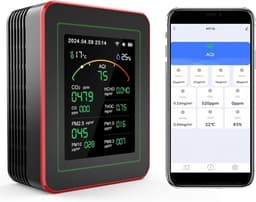
GoHelmate GoHelmate MT29 15-in-1

Testsieger

GoHelmate GoHelmate MT29 15-in-1
3.3/10about £69.99

Standards and numbers that get mixed up

BS EN 50291 is the standard you should see on a carbon monoxide alarm listing. It is not a standard we are claiming for the BREATHE, GoHelmate or Bekasa meters. If a page says NDIR and carbon dioxide, you are buying a ventilation meter. Ventilation bands used by HSE and by GOV.UK education guidance sit at about 800 ppm and 1500 ppm of carbon dioxide. The EH40 exposure limits for carbon dioxide sit at 5000 ppm and 15000 ppm. The EH40 row for carbon monoxide is in the tens and low hundreds of ppm. Using a CO2 meter to clear a boiler makes a dangerous room look like a ventilation project. The CO2 monitor buying guide keeps the NDIR check for the ventilation purchase.

Which one you need

If the question is a stuffy room, a home office, a bedroom with the door shut, or a classroom, you are in the market for a carbon dioxide monitor, and you should prefer a listing that names NDIR. If the question is a combi boiler, a gas fire, a wood burner, an oil stove or any other fuel-burning appliance, you need a carbon monoxide alarm to BS EN 50291, whether or not you also buy a CO2 meter. Many homes need both. If you suspect carbon monoxide now, leave the space and get fresh air. A CO2 number says nothing useful about carbon monoxide. One gadget does not do both jobs because a listing mentions fumes or air quality. Those words are not BS EN 50291.

Common questions

Does a CO alarm tell me the room is stuffy?
No. A carbon monoxide alarm is looking for CO from incomplete combustion. It is not an NDIR ventilation meter, and it will not show you 800 ppm or 1500 ppm of carbon dioxide. A shut bedroom can be stale with no CO present. You would need a CO2 monitor for that question, placed at head height and read as a trend, not as a single breath on the sensor.
What standard applies to a UK carbon monoxide alarm?
Look for BS EN 50291 on the alarm you buy for a fuel-burning appliance. Which? discusses that standard and the Kitemark in its CO detector guidance. This page does not repeat a Which? test and does not score CO alarm brands. A CO2 meter that never mentions EN 50291 has not met that bar by being sold in the same Amazon search.
I have a combi boiler. Which device do I need?
You need a carbon monoxide alarm. The boiler is a combustion appliance, and a CO2 monitor will not warn you of carbon monoxide. You may also want a CO2 meter if a bedroom or office feels unventilated, and that is a second purchase with a different sensor. Fit the CO alarm for the boiler first. Do not let a multi-sensor air-quality listing replace it.
Is electrochemical always a carbon monoxide sensor?
No. Electrochemical cells are the usual sensor in a CO alarm, and HSE prefers NDIR for a portable CO2 ventilation meter. The Bekasa listing still says electrochemical for a claimed CO2 channel. Read the gas the product says it measures. The chemistry word on its own does not tell you whether you have bought boiler protection or a disputed carbon dioxide screen.
What do I do if I suspect carbon monoxide right now?
Leave the room and get everyone into fresh air. Do not wait to see what a CO2 monitor does, and do not treat a normal-looking CO2 number as an all-clear. Seek urgent help if anyone is unwell, and do not use the appliance again until a competent person has checked it. A ventilation meter cannot clear a suspected carbon monoxide incident.

Related pages

Sources

Public UK sources and amazon.co.uk listings from the research digest, checked on 19 October 2026.

  1. HSE: Using CO2 monitors (retrieved 19 October 2026)
  2. HSE: Carbon dioxide health hazards (retrieved 19 October 2026)
  3. HSE: EH40/2005 workplace exposure limits (retrieved 19 October 2026)
  4. GOV.UK: Ventilation and air quality in education and childcare settings (retrieved 19 October 2026)
  5. Department for Education: CO2 how-to guide (2023) (retrieved 19 October 2026)
  6. Building Bulletin 101: ventilation, thermal comfort and indoor air quality in schools (retrieved 19 October 2026)
  7. Shared Health Foundation: How to use a CO2 monitor (retrieved 19 October 2026)
  8. amazon.co.uk: BREATHE Airmonitor Plus Gen 2 listing (retrieved 19 October 2026)