Independent comparisons. We may earn from shop links. More info

How to use a CO2 monitor

Updated: 20 October 2026

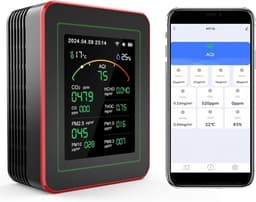
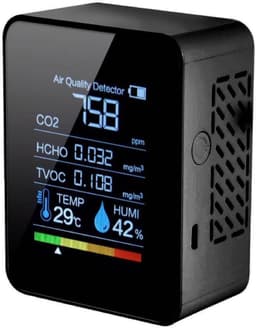
You have a carbon dioxide meter on the desk, the number has already jumped, and you are not sure whether to open a window or to blame the gadget. This is how to use a CO2 monitor so the figure describes the room rather than your breath or a draught. The steps below follow the Health and Safety Executive and, where the room is a classroom, the Department for Education. They apply to the meters in our [CO2 detector](/hub/fire-protection/co2-detector) comparison and to any other NDIR unit you already own. Products Compared did not calibrate these meters. A qualifying purchase through our links can earn a commission at no extra cost to you.

You have a carbon dioxide meter on the desk, the number has already jumped, and you are not sure whether to open a window or to blame the gadget.

Our top picks

On this page

Put the monitor in the air people actually breathe

Place the meter at head height, in the air the occupants are breathing, and keep it more than 50 cm from people. HSE also says to keep it away from windows, doors and air inlets, because a draught of outdoor air makes the room look fresher than it is. One sensor is enough for a typical classroom. If you hold it, or lean over the screen to read it, you are measuring exhaled air. Outdoors, the reading should sit near ordinary outside air, around 425 to 430 ppm in the Shared Health Foundation guide. The buying choice, if you do not own a meter yet, is on the CO2 monitor buying guide.

Wait, then read a trend

HSE asks for several readings through an occupied day, with a note of how many people were there and how the room was ventilated. DfE says wait about five minutes before you act on a swing, so a brief spike can settle. Five minutes is a pause, not the whole afternoon. Write down occupancy and the ventilation you actually used. Window on latch, three people, 40 minutes is a useful line. High is not. BREATHE's listing claims up to 90 days of app history, and a UK review said the export was daily aggregates rather than 15-minute points. Air cleaners do not remove carbon dioxide.
GoHelmate GoHelmate MT29 15-in-1

Testsieger

GoHelmate GoHelmate MT29 15-in-1
3.3/10about £69.99

What to do with the number

GOV.UK education guidance calls under 800 ppm good ventilation. From 800 to 1500 ppm the same guidance calls ventilation adequate and asks you to consider opening windows or doors further. A consistent reading over 1500 ppm is poor ventilation. Increase outdoor air where you can. DfE says a consistent value over 1500 ppm does not mean you must stop using the room. About 1000 ppm is the HSE rule of thumb for roughly 10 litres per second of fresh air per person. Do not prop or wedge a fire door to chase a lower number. Ignore 5000 ppm and 15000 ppm as action lines on this page. Those are EH40 workplace exposure limits, not comfort targets.

When the meter itself is the problem

If the number leaps when you breathe on the sensor, move it back beyond half a metre, wait the five minutes, and read it again. If the number is high indoors and still high when you take the meter outside, stop using it for decisions. Ordinary outdoor air is not several thousand ppm. Several UK reviews on the Bekasa listing, and one UK review on the BREATHE listing, describe figures that stay high outdoors. Those are listing complaints, not a fault-find we reproduced.

When to stop and call someone

Leave the space if you suspect carbon monoxide, because this meter is the wrong instrument. The split is on the CO2 versus carbon monoxide alarm page. Get a competent person for process carbon dioxide, such as dispensed gas, dry ice or a cellar, and when a room stays over 1500 ppm with windows already open. Another screen from the same search does not replace that step.

Common questions

How long do I wait before acting?
Wait about five minutes after a spike before you treat it as the room, which is the DfE settle time. Then take several readings while people are actually there, and note how many people and how the room is ventilated. A single glance at an empty room, or a glance while you are breathing on the sensor, is not the trend HSE asks for.
What do I do at 800 ppm and at 1500 ppm?
Under 800 ppm, education guidance calls ventilation good, and you may ease windows in the cold if you keep watching. Between 800 and 1500 ppm it calls ventilation adequate, so consider opening more. Over 1500 ppm, consistently, it calls ventilation poor: increase outdoor air. You do not have to abandon the room on that figure alone. Do not wedge a fire door to force the number down.
Why does the number jump when I lean over it?
You are exhaling on the sensor. Carbon dioxide from your breath will lift the reading within seconds if the meter is close to your face. Set it back beyond half a metre, wait about five minutes, and read it from a short distance. If it only misbehaves when someone stands over it, the placement is the fault.
The number is high outside as well. What now?
Do not use that meter to decide whether the room needs air. Outdoor air is about 425 to 430 ppm in the Shared Health Foundation guide, not a figure in the thousands. UK reviews on the Bekasa listing, and one UK review on the BREATHE listing, describe units that stayed high outdoors. Charge and placement checks will not repair a channel that cannot see fresh air.
Should I follow the colour or the ppm?
Follow the ppm, and use the bands above. A red or amber lamp on a consumer meter may turn at a threshold the maker chose, which DfE warns can differ from the monitors supplied to schools. Unless the listing states the colour points in ppm, the number is the part you can compare with 800 and 1500. A lamp without a number is not a DfE result.

Related pages

Sources

Public UK sources and amazon.co.uk listings from the research digest, checked on 19 October 2026.

  1. HSE: Using CO2 monitors (retrieved 19 October 2026)
  2. HSE: Carbon dioxide health hazards (retrieved 19 October 2026)
  3. HSE: EH40/2005 workplace exposure limits (retrieved 19 October 2026)
  4. GOV.UK: Ventilation and air quality in education and childcare settings (retrieved 19 October 2026)
  5. Department for Education: CO2 how-to guide (2023) (retrieved 19 October 2026)
  6. Building Bulletin 101: ventilation, thermal comfort and indoor air quality in schools (retrieved 19 October 2026)
  7. Shared Health Foundation: How to use a CO2 monitor (retrieved 19 October 2026)
  8. amazon.co.uk: BREATHE Airmonitor Plus Gen 2 listing (retrieved 19 October 2026)