Independent comparisons. We may earn from shop links. More info

Classroom CO2 monitor

Updated: 20 October 2026

You are standing in a classroom during period two with a carbon dioxide meter on a desk, and you need to know whether the number means open a window or close the school. A classroom CO2 monitor, used in England under Department for Education guidance, is a ventilation check while the room is occupied. This page follows GOV.UK education guidance, the DfE how-to from 2023, and Building Bulletin 101 as a design standard. Scotland, Wales and Northern Ireland are not given the same documents as if they were their building regulations. Product cards stay on our [CO2 detector](/hub/fire-protection/co2-detector) comparison. A qualifying purchase can earn a commission at no extra cost to you.

You are standing in a classroom during period two with a carbon dioxide meter on a desk, and you need to know whether the number means open a window or close the school.

Our top picks

On this page

What a classroom monitor is for

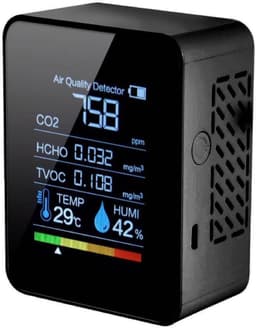
People in the room breathe out carbon dioxide. If fresh air is poor, the concentration rises, and that rise is a proxy for ventilation, not a medical test. DfE's how-to says to use monitors in rooms occupied for about an hour or more. GOV.UK asks schools and childcare settings to prefer NDIR monitors, the non-dispersive infrared type. A colour lamp on a consumer meter is not the DfE colour scale unless the maker says the thresholds match. Which listing names NDIR is on the CO2 monitor buying guide. The meter does not replace a carbon monoxide alarm where the site has boilers. The split is on the CO2 versus carbon monoxide alarm page.

Where to put one monitor

GOV.UK says one monitor is enough for a typical classroom. Put it at seated head height, at least half a metre from the nearest person, and away from windows, doors and supply air. A windowsill reads the incoming draught and flatters the room. If the building already logs CO2 on a building-management system, the DfE how-to says you do not need a handheld as well in that space. Skip the tool in sports halls, corridors, kitchens, toilets, and rooms with Bunsen burners or gas cookers.
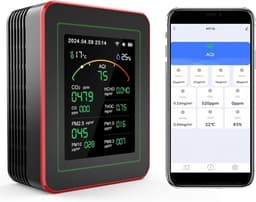
GoHelmate GoHelmate MT29 15-in-1

Testsieger

GoHelmate GoHelmate MT29 15-in-1
3.3/10about £69.99

800 ppm and 1500 ppm on a school day

Under 800 ppm, ventilation is described as good. From 800 to 1500 ppm, ventilation is described as adequate. Over 1500 ppm, ventilation is described as poor. Increase outdoor air where you can. DfE says there is no need to stop using the room because the value is over 1500 ppm. You are not evacuating for a CO2 spot reading. Do not prop or wedge a fire door to chase a lower number. If the windows are already open and the number stays over 1500 ppm through occupied time, that pattern is a building and facilities question.

Design figures are a different job

Building Bulletin 101 sets design performance for teaching spaces. It is not a handheld pass or fail for a parent or a teacher with one meter at the end of a lesson. For mechanical ventilation, BB101 says the daily average CO2 during the occupied period should be less than 1000 ppm, and not above 1500 ppm for more than 20 consecutive minutes each day. For natural ventilation, the daily average should be less than 1500 ppm, and not above 2000 ppm for more than 20 consecutive minutes each day. A glance is not a daily average. Refurbished buildings are given a higher design figure of 1750 ppm for most of the occupied time.

What to do on a school day in England

Use one monitor at seated head height, read a consistent ppm figure against 800 and 1500, and leave fire doors shut. If the number stays over 1500 ppm with the windows already open, hand the record to facilities staff rather than buying a second screen. BB101 averages are for the people who size the system, not a reason to evacuate a lesson.

Common questions

The light is red but the number is 1200 ppm. Which do we follow?
Follow 1200 ppm against the bands: that sits in the adequate range, so consider more fresh air and keep watching. A red lamp may be the maker's own threshold. DfE warns that monitors it did not supply can change colour at a different point from the department's scale. Unless the product states that its colours match those bands, the ppm figure is the one you can defend.
Does a high reading mean we evacuate?
No. DfE says a consistent value over 1500 ppm is an indicator of poor ventilation and that there is no need to stop using the room. Open what you can, short of fire doors, and continue. Evacuate for fire, or leave for a suspected carbon monoxide incident, which is a different gas and a different alarm. A CO2 spot reading is not that signal.
Is a parent's meter a BB101 test?
No. BB101 design standards use daily averages and limits on how long a peak may last, measured at seated head height across the occupied day. One reading at home time is not a daily average and it is not a 20-minute test. It can still be a fair reason to ask the school what they see on a normal morning. It cannot, by itself, pass or fail the building bulletin.
Should a sports hall or a kitchen have one?
DfE's how-to says not to rely on these monitors in sports halls, atriums, corridors, kitchens, toilets, one- or two-person offices, or rooms with Bunsen burners or gas cookers. Those spaces are a poor match for the classroom bands. A kitchen or a practical room with gas needs the right controls for combustion, including carbon monoxide protection where fuel is burned, not a CO2 comfort chart alone.
What if the windows are open and the number stays high?
Treat that as a building issue. More consumer meters will not add outdoor air the windows are already admitting. Facilities staff, and the ventilation design if there is one, are the next step, especially if you want a comparison with BB101 averages. Keep a simple record of time, occupancy and window position so the conversation is about a trend, not a single photograph of the screen.

Related pages

Sources

Public UK sources and amazon.co.uk listings from the research digest, checked on 19 October 2026.

  1. HSE: Using CO2 monitors (retrieved 19 October 2026)
  2. HSE: Carbon dioxide health hazards (retrieved 19 October 2026)
  3. HSE: EH40/2005 workplace exposure limits (retrieved 19 October 2026)
  4. GOV.UK: Ventilation and air quality in education and childcare settings (retrieved 19 October 2026)
  5. Department for Education: CO2 how-to guide (2023) (retrieved 19 October 2026)
  6. Building Bulletin 101: ventilation, thermal comfort and indoor air quality in schools (retrieved 19 October 2026)
  7. Shared Health Foundation: How to use a CO2 monitor (retrieved 19 October 2026)
  8. amazon.co.uk: BREATHE Airmonitor Plus Gen 2 listing (retrieved 19 October 2026)