Independent comparisons. We may earn from shop links. More info

CO2 monitor buying guide

Updated: 20 October 2026

You are on amazon.co.uk because a bedroom, a home office or a classroom feels stale, and the results mix carbon dioxide meters with carbon monoxide alarms. This CO2 monitor buying guide shows which line on the listing is the sensor, which number you will act on, and which extras can wait. The three listings in our [CO2 detector](/hub/fire-protection/co2-detector) comparison were checked on 19 October 2026: Bekasa at about £16.99, GoHelmate at about £69.99 and BREATHE at about £99.99. Products Compared did not run a gas test. Star lines and prices are that day's amazon.co.uk shelf, and a qualifying purchase can earn a commission at no extra cost to you.

You are on amazon.co.uk because a bedroom, a home office or a classroom feels stale, and the results mix carbon dioxide meters with carbon monoxide alarms.

Our top picks

On this page

Carbon dioxide, not carbon monoxide

Carbon dioxide in this search is the gas people breathe out. When a room stays occupied and fresh air is poor, the concentration rises, and the Health and Safety Executive uses that rise as a broad guide to ventilation. Carbon monoxide is a combustion poison. An alarm for that gas is a different product, built to BS EN 50291, and none of the three meters kept here is described as Kitemarked to that standard. If anything in the home burns fuel, you still need a carbon monoxide alarm. The full split is on the CO2 monitor versus carbon monoxide alarm page.

Insist on NDIR

HSE says the appropriate portable monitors for workplace checks are non-dispersive infrared meters. The Department for Education says the most effective CO2 monitors are NDIR monitors. On a product page you want those letters next to carbon dioxide, not a display that only offers eCO2, estimated carbon dioxide worked out from volatile organic compounds. The BREATHE Airmonitor Plus Gen 2, at about £99.99, names NDIR CO2 in the bullets, and the technical-details line says sensor type TVOC. GoHelmate's MT29, at about £69.99, lists CO2 and never says NDIR. Bekasa, at about £16.99, states sensor type electrochemical. HSE does not recommend that type for a CO2 ventilation check. Who each listing is for sits on the best CO2 monitor page.
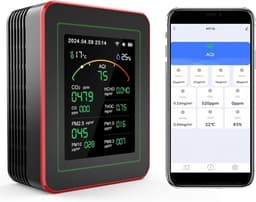
GoHelmate GoHelmate MT29 15-in-1

Testsieger

GoHelmate GoHelmate MT29 15-in-1
3.3/10about £69.99

Which number you are buying the meter to read

You are buying the meter to watch ventilation bands, not the workplace exposure limits. HSE treats a consistent reading above 1500 ppm in an occupied room as the point where ventilation is poor and you should act. Under 800 ppm is the band GOV.UK education guidance calls good ventilation, 800 to 1500 ppm adequate, and over 1500 ppm poor. EH40 sets carbon dioxide workplace exposure limits at 5000 ppm over eight hours and 15000 ppm over 15 minutes. A reading of 1800 ppm is not fine because it is under 5000 ppm.

Power, app and what the export really is

A useful check is a trend while people are in the room, not a single glance as you walk past. BREATHE claims up to six hours on the battery and USB-C for continuous use, plus up to 90 days of history. UK review text says an export was daily aggregates rather than 15-minute points. GoHelmate states an app that needs an internet connection. Bekasa lists battery power, a visual alarm, and no app. Air cleaners do not remove carbon dioxide.

A checklist before you open a listing

Prefer a listing that says NDIR and carbon dioxide in the same breath. If it says eCO2, or electrochemical, or it never names the sensor, do not promote it with a star rating or a bestseller badge. For a home, an office or a classroom in use, the numbers are the ventilation bands around 800 ppm and 1500 ppm. A named NDIR portable outside this set, the Aranet4 Home, was about £176 to £189 on amazon.co.uk the same day. It is a price anchor, not a fourth card.

Common questions

Should I buy NDIR or is any CO2 detector fine?
Buy a meter whose listing names NDIR carbon dioxide. HSE and the Department for Education both point to that sensor for ventilation checks. A listing that says electrochemical, eCO2, or nothing about the sensor is a weaker buy, even when the price is about £16.99 and the sales rank looks strong. This comparison did not lab-test any of the three units, so the NDIR line is a listing claim you can read, not a certificate from us.
What is eCO2?
eCO2 means estimated carbon dioxide, usually derived from volatile organic compounds rather than measured as carbon dioxide. The Shared Health Foundation guide tells buyers to avoid a display that only shows that estimate. It will not track fresh air the way an NDIR meter is meant to. If the listing never shows a real CO2 channel, skip it for this job.
Is under 5000 ppm a good result?
No. Five thousand ppm is the eight-hour workplace exposure limit for carbon dioxide in EH40, and 15000 ppm is the 15-minute limit. They are not comfort targets. HSE treats a consistent reading above 1500 ppm in an occupied room as poor ventilation. A stuffy room can be far under 5000 ppm and still need more outdoor air.
Do I need an app and a log?
You need a log if someone will ask for a record: a school, an employer, a landlord. A screen is enough for a home trend you will watch yourself. BREATHE claims up to 90 days of history, and a UK review said the export was daily rather than 15-minute points. GoHelmate's listing says the app needs the internet. Read that limit before you rely on the file.
Does the meter need to show outdoor air near 400 to 430 ppm?
Yes, before you trust it indoors. Outdoor air sits around that band in the guides used here, higher in some polluted spots. If the number stays in the thousands after you take the meter outside, the indoor reading is not a ventilation decision. That fault shows up in Bekasa UK reviews and in one BREATHE UK review, so check a new meter outdoors before you rearrange the room around it.

Related pages

Sources

Public UK sources and amazon.co.uk listings from the research digest, checked on 19 October 2026.

  1. HSE: Using CO2 monitors (retrieved 19 October 2026)
  2. HSE: Carbon dioxide health hazards (retrieved 19 October 2026)
  3. HSE: EH40/2005 workplace exposure limits (retrieved 19 October 2026)
  4. GOV.UK: Ventilation and air quality in education and childcare settings (retrieved 19 October 2026)
  5. Department for Education: CO2 how-to guide (2023) (retrieved 19 October 2026)
  6. Building Bulletin 101: ventilation, thermal comfort and indoor air quality in schools (retrieved 19 October 2026)
  7. Shared Health Foundation: How to use a CO2 monitor (retrieved 19 October 2026)
  8. amazon.co.uk: BREATHE Airmonitor Plus Gen 2 listing (retrieved 19 October 2026)