




Mains gas at home
You want an alarm you can leave powered for natural gas and methane, high in the room rather than at the skirting. A five-minute pen will not do that job. The corded ABUS is the listing in this set that claims EN 50194-1.
The best gas detectors, compared.
Top pick: TopTes S2 Multi Best value: Firlarm BRJ-502 – Highest score after the top pick, at about £18.66, with 4.5 from 2,810 reviews and a stated 3% LEL threshold. Updated October 2026.

You can smell a gas leak only if the odourant reaches you. A gas detector is the extra warning when you are on mains gas, on in a caravan, or you cannot rely on smell. On amazon.co.uk the name covers more than one tool. This set mixes battery sniffers, plug-in and corded alarms, one handheld that states combustible gas and carbon monoxide, and one oxygen monitor. A pen that switches off after about five minutes is a check for a joint or a hose. A plug-in or a corded alarm is for leaving on. It does not stop a leak, and it does not replace 0800 111 999 or a Gas Safe registered engineer. This gas detector comparison puts 16 listings in one table: the job, the gases named, the power, and the review file. The [gas detector buying guide](/hub/fire-protection/gas-detector/sub/gas-detector-buying-guide) sets out which claims to ignore, including a percent figure that does not match ppm.
You can smell a gas leak only if the odourant reaches you. A gas detector is the extra warning when you are on mains gas, on in a caravan, or you cannot rely on smell. On amazon.co.uk the name covers more than one tool.
56 products checked · 62 hrs invested · +21,400 readers
Swipe for more
1-2 of 16


Personal buying guide
Question 1 of 2
Do you want it left on?
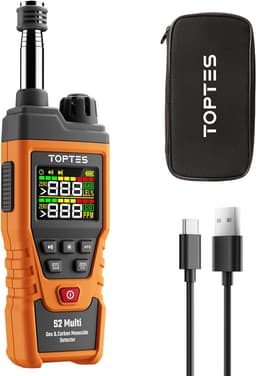
The TopTes S2 Multi is a handheld at about £79.99 that the listing says reads combustible gas from 0.1 to 20% LEL and carbon monoxide from 0 to 999 ppm, on a 16.5 cm (6.5 inch) probe. It is the only row here with a carbon monoxide channel marked yes. The page describes a rechargeable cell, a mute button, a high or low backlight, and an auto-off you can disable, plus a case and a charging cable, at 340 g. It is 4.8 from 78 amazon.co.uk reviews. Amazon reviews say reviewers traced a leak and used it in a caravan. They also record warm-up beeps, battery complaints, a cheap feel, and poor instructions. Seventy-eight reviews and no named alarm standard are a thin base at this price, and the power line on the listing is blank even though the bullet says the cell is rechargeable.
Pros
Cons
Best for: You want one handheld that the listing says covers both combustible gas and carbon monoxide, and you will treat 78 reviews as a limit.
Less suitable: You want an EN 50194 mains alarm, or a carbon monoxide claim backed by a much larger UK review file.
Specifications
Common questions
What job is this listing for?
It is a gooseneck handheld. The listing states combustible gas and a carbon monoxide range on a 16.5 cm probe.
Does it detect carbon monoxide?
Yes, on this listing: 0 to 999 ppm, beside 0.1 to 20% LEL for combustible gas. There is no named alarm standard, and the review file is 78.
Can I leave it on overnight?
Not as a room alarm you walk away from. The listing describes an auto-off you can disable, and you would still need to stay with a handheld.
The TopTes PT177 is a pocket pen with a clip, two AAA cells, and a storage bag, at 120 g. After a 30-second auto-calibration the listing says it alarms in 0.5 to 3 seconds, using five red LEDs and a 75 dB sound that both step up with concentration. It switches itself off after five minutes without use or a gas reading, and the power light flashes below 2.4 V. It is about £19.99 with 4.7 from 3,895 amazon.co.uk reviews. Amazon reviews say reviewers traced a leak and named National Gas or the emergency line, including on caravan checks. The recurring complaints are a cheap feel and poor instructions. There is no ppm range and no carbon monoxide channel on the page.
Pros
Cons
Best for: You want a cheap, heavily reviewed pen for a short sweep and you do not need a number in ppm.
Less suitable: You want a printed detection range, a leave-on alarm, or a carbon monoxide reading.
Specifications
Common questions
What job is this listing for?
It is a pocket sniffer for LPG, methane, propane, butane, and natural gas, used for a few minutes at a time.
Does it detect carbon monoxide?
No. The page has no carbon monoxide channel and no ppm figure.
Can I leave it on overnight?
No. It switches off after five minutes without use or a gas reading.
The TopTes PT210S is a pen with a four-inch probe (the spec line says 10 cm) that shows combustible gas as a two-digit percent LEL. The bullet states a range of 100 ppm to 5,000 ppm, also written there as 1% LEL to 10% LEL, with a 75 dB buzzer and a screen that turns red. High and low sensitivity are switchable, two AAA cells are included, and it switches off after five minutes, with a low-battery flash below 2.5 V. It weighs 66.7 g and is about £29.99 with 4.7 from 1,494 amazon.co.uk reviews. Amazon reviews praise leak tracing, caravans, and barbecue or LPG checks. The same reviews list warm-up beeps, battery complaints, a cheap feel, poor instructions, faulty returns, and units that did not work for some buyers. A four-inch neck will not reach as far as the 17-inch PT520A, and there is no carbon monoxide channel.
Pros
Cons
Best for: You want a light pen that shows percent LEL for a barbecue, bottle, or short pipe run.
Less suitable: You need a long neck, a unit reviewers did not report as dead on arrival, or an overnight alarm.
Specifications
Common questions
What job is this listing for?
It is a short gooseneck pen that shows combustible gas as percent LEL. The probe on the spec line is 10 cm.
Does it detect carbon monoxide?
No. It names natural gas, methane, propane, and butane.
Can I leave it on overnight?
No. It switches off after about five minutes.
The TopTes PT199 is a 59 g pocket pen for methane, LPG, propane, and butane, sold with two AAA cells, a 30-second warm-up, and an auto-off at about five minutes. The listing claims a visual and audible alarm from about 0.5 seconds, with the screen turning red as the bar graph rises. It is about £22.99 with 4.6 from 8,415 amazon.co.uk reviews, the largest file in this set. Amazon reviews say reviewers found or traced a leak, named the gas emergency service, and used it in a caravan. The same reviews record false alarms from cooking or fumes, warm-up beeps, a cheap feel, poor instructions, and units returned as faulty. It does not detect carbon monoxide, and a five-minute shut-off means you cannot leave it on overnight.
Pros
Cons
Best for: You want a widely reviewed pocket pen to sweep a hob, bottle, or caravan gas joint for a few minutes.
Less suitable: You need a detector that stays on overnight, a carbon monoxide reading, or a stated alarm standard.
Specifications
Common questions
What job is this listing for?
It is a pocket sniffer for a few minutes around a hob, bottle, or caravan joint.
Does it detect carbon monoxide?
No. There is no carbon monoxide channel and no stated ppm range.
Can I leave it on overnight?
No. It powers off after about five minutes.
The TopTes PT520A is a gooseneck sniffer with a 17-inch flexible probe (the spec line says 43.5 cm), a methane range of 50 to 10,000 ppm, and a 75 dB buzzer. The listing asks for 30 seconds of warm-up and claims a response in 0.5 seconds, with seven coloured bars that rise with concentration. You can mute the sound, and you can cancel auto-off; if you cancel it, the unit still shuts down after 10 minutes of inactivity. The box includes three AAA cells and a case, and the unit weighs 510 g. It is about £39.99 with 4.6 from 4,139 amazon.co.uk reviews. Amazon reviews praise leak tracing, caravan checks, and the included batteries. They also record battery complaints, a cheap feel, and units returned as faulty. It will not watch a room overnight, and it does not detect carbon monoxide.
Pros
Cons
Best for: You want a long flexible probe to reach a fireplace, tank, or van locker, and you can accept a battery tool that times out.
Less suitable: You need an alarm that stays on through the night, or a carbon monoxide reading.
Specifications
Common questions
What job is this listing for?
It is a gooseneck sniffer for combustible gas, with a 43.5 cm probe. You use it to reach a tight spot, then it times out.
Does it detect carbon monoxide?
No. The stated range is 50 to 10,000 ppm of methane, not carbon monoxide.
Can I leave it on overnight?
No. Even if you cancel auto-off, the listing says it still shuts down after 10 minutes of inactivity.
This Neoteck listing groups NTK165, NTK184, and NTK203 as one pocket pen: two AAA cells, a clip, a 30-second warm-up, and auto-off after five minutes. High sensitivity is given as 50 to 500 ppm and low as 500 to 3,000 ppm, with an overall methane range of 50 to 3,000 ppm. The listing says the screen turns red as a bar graph climbs, and the low-battery mark is 2.4 V. It is about £19.99 with 4.6 from 1,320 amazon.co.uk reviews, the same count stored on the separate NTK184 and NTK203 rows. Amazon reviews say reviewers traced a leak and used it in a caravan, and the only recurring complaint is poor instructions. It still shuts off if you set it down, and it has no carbon monoxide channel.
Pros
Cons
Best for: You want a pen around £19.99 with a printed ppm band for a short leak sweep, and you will read the instructions carefully.
Less suitable: You need a single named model, a night alarm, or a review file you can treat as separate from the other Neoteck pens.
Specifications
Common questions
What job is this listing for?
It is a pocket sniffer. The title groups more than one Neoteck model name on a single listing.
Does it detect carbon monoxide?
No. The gases named are combustible gases such as methane, LPG, propane, and butane.
Can I leave it on overnight?
No. It switches off after about five minutes.
The Neoteck NTK203 is the 50 to 3,000 ppm version of this pen family, at about £18.99 and 100 g. High sensitivity is listed as 50 to 500 ppm and low as 500 to 3,000 ppm, with two AAA cells, a 30-second warm-up, a 2.4 V low-battery mark, and auto-off after five minutes. The listing claims an alarm from about 0.5 seconds and a screen that turns red. It is 4.6 from 1,320 amazon.co.uk reviews, matching the count on the NTK184 and the grouped Neoteck row. Amazon reviews say reviewers traced a leak and used it for caravan checks. Poor instructions are the only recurring complaint. You still cannot leave it running, and carbon monoxide is outside the gases it names.
Pros
Cons
Best for: You want a named Neoteck pen with a 3,000 ppm ceiling for a short methane or LPG sweep.
Less suitable: You need a review sample that is clearly separate from the other Neoteck listings, or an alarm that stays on.
Specifications
Common questions
What job is this listing for?
It is a named pocket pen, the NTK203, for a short combustible-gas sweep.
Does it detect carbon monoxide?
No. The printed band is 50 to 3,000 ppm of combustible gas.
Can I leave it on overnight?
No. Auto-off is about five minutes.
The Neoteck NTK184 is a pocket pen at about £17.09, with two AAA cells, a clip, a storage bag, and auto-off after five minutes. The listing puts high sensitivity at 50 to 500 ppm and low at 500 to 3,000 ppm, then also states a methane range of 50 to 10,000 ppm, which is wider than the NTK203 line. Warm-up is about 30 seconds, the low-battery point is 2.4 V, and the screen is said to turn red as concentration rises. It is 4.6 from 1,320 amazon.co.uk reviews, the same count as the other Neoteck pen rows. Amazon reviews say it traced leaks and suited caravan checks. The only recurring complaint is poor instructions. It is still a five-minute tool, not a night alarm, and it does not detect carbon monoxide.
Pros
Cons
Best for: You want the Neoteck pen whose listing prints a range out to 10,000 ppm, for a short sweep.
Less suitable: You need one consistent ppm ceiling, a separate review file, or a detector that stays armed overnight.
Specifications
Common questions
What job is this listing for?
It is a pocket pen for a short methane or LPG sweep. The listing prints more than one ppm ceiling.
Does it detect carbon monoxide?
No. Carbon monoxide is not among the gases named.
Can I leave it on overnight?
No. Auto-off is about five minutes.
The YOJOCK HT60 is a 60 g pocket pen at about £13.99, sold with two AAA cells and a bag. The listing says it alarms visually and audibly within 0.5 seconds on LPG, methane, propane, and natural gas, after a 30-second warm-up, then switches off after five minutes idle. It is 4.6 from 303 amazon.co.uk reviews. Amazon reviews praise leak tracing, caravan use, and a quick response. They also say the instructions are poor and that it did not work for some buyers. No ppm or LEL figure is printed, and there is no carbon monoxide channel. An item-type line that mentions CO or smoke is not the same as a feature in the bullets. Do not read that line as a carbon monoxide detector.
Pros
Cons
Best for: You want the lowest shelf price in this set for a short caravan or home sweep, and you can return a unit that stays silent.
Less suitable: You need a printed detection range, a large fault-free review file, or an alarm that stays on.
Specifications
Common questions
What job is this listing for?
It is a pocket sniffer for LPG, methane, propane, and natural gas, at the lowest price in this set.
Does it detect carbon monoxide?
No. The bullets do not state a carbon monoxide or smoke channel. Ignore an item-type line that suggests otherwise.
Can I leave it on overnight?
No. It switches off after five minutes of inactivity.
The Neoteck NTK261 is a gooseneck with a 12-inch probe, a stated methane range of 300 to 10,000 ppm, and a 70 dB buzzer. The listing asks for 30 seconds of preheating and says it reacts within five seconds, with a three-colour bar. Auto-off can be switched; left active, it cuts out after 10 minutes idle, and a mute button kills the sound. Three AAA cells are in the box and the unit weighs 333 g. It is about £24.69 with 4.6 from 142 amazon.co.uk reviews. Amazon reviews praise leak tracing and the included batteries, and they record warm-up beeps, battery complaints, and poor instructions. The floor of the stated range is 300 ppm, so a very small weep may sit below what the page claims to show, and there is no carbon monoxide channel.
Pros
Cons
Best for: You want a mid-length gooseneck with a mute button and you will treat 142 reviews as a modest sample.
Less suitable: You are hunting a seep the listing’s 300 ppm floor may miss, or you need a carbon monoxide reading.
Specifications
Common questions
What job is this listing for?
It is a gooseneck sniffer with a 12-inch probe for methane, natural gas, and propane.
Does it detect carbon monoxide?
No. The stated range is 300 to 10,000 ppm based on methane.
Can I leave it on overnight?
No. With auto-off left on, it cuts out after 10 minutes idle. It is not a room alarm.
The TopTes Guard-756 is an oxygen monitor, not a methane or LPG sniffer. The carbon monoxide channel is no. The listing describes a sensor that alarms within 0.5 seconds at a preset oxygen threshold, a 2,000 mAh pack that charges in four hours and runs up to seven days, and a log of up to 999 records. Light, vibration, and sound are the three alarms, the sensor sits at the top for use when the unit is held or worn, and a low-battery alert starts below 10%. It is about £79.99 with 4.6 from 81 amazon.co.uk reviews. Amazon reviews include a note that someone found or traced a leak, which does not match an oxygen meter, plus battery complaints, a cheap feel, poor instructions, and units returned as faulty. Buy it only if you want an oxygen reading you can carry. It will not locate a joint on a gas pipe.
Pros
Cons
Best for: You want a portable oxygen reading with a stated multi-day battery, not a search for methane or LPG.
Less suitable: You are looking for a gas leak on a pipe, hob, bottle, or boiler.
Specifications
Common questions
What job is this listing for?
It is an oxygen monitor, with a stated range of 0 to 30% volume. It is not a combustible-gas sniffer.
Does it detect carbon monoxide?
No. It does not detect carbon monoxide, natural gas, or LPG.
Can I leave it on overnight?
The listing claims a battery runtime of up to seven days. That still does not make it a leak alarm for methane or LPG.
The Firlarm BRJ-502 is a plug-in alarm that the listing says sounds at 85 dB once methane, propane, butane, or coal gas goes over 3% LEL. It is about £18.66 with 4.5 from 2,810 amazon.co.uk reviews. Amazon reviews praise caravan checks, easy use, a quick response, and the price, and they record no strong recurring complaint. Warm-up is two to three minutes and the stated draw is 2 W. It cannot detect carbon monoxide, and the page does not state a BS 1363 plug. You leave it in a socket, so it will not pinpoint one union. It is the best value here when you want a cheaper leave-on combustible alarm with a large review file.
Pros
Cons
Best for: You want a plug-in methane, propane, and butane alarm you can leave in a socket, at a lower price than the EN-listed mains unit.
Less suitable: You need to trace one fitting, a carbon monoxide channel, or a plug the listing names as BS 1363.
Specifications
Common questions
What job is this listing for?
It is a plug-in combustible-gas alarm for methane, propane, butane, and coal gas. You leave it in a socket. It will not trace one joint.
Does it detect carbon monoxide?
No. The listing says it cannot detect carbon monoxide.
Can I leave it on overnight?
Yes, in the sense of a fixed alarm you leave powered. Allow two to three minutes of warm-up, and the page does not state a BS 1363 plug.
The ABUS GWM100ME is a corded 220–240 V alarm for natural gas and methane, with an 85 dB sound, a test button, and an end-of-life signal at five years. It draws under 4 W, so there is no cell to swap, and the listing claims EN 50194-1:2009. Across 720 amazon.co.uk reviews it sits at 4.5. Amazon reviews call it useful when you are tracing a suspected leak, and they record no strong recurring complaint. It does not detect carbon monoxide, and the page does not state a British plug. A wall unit will not follow a joint the way a gooseneck does. It is the top pick when you want a leave-on methane alarm rather than a handheld search.
Pros
Cons
Best for: You want a mains natural-gas and methane alarm you can leave on, with EN 50194-1 on the listing.
Less suitable: You need to sniff a joint, a carbon monoxide reading, or a stated BS 1363 plug.
Specifications
Common questions
What job is this listing for?
It is a corded mains alarm for natural gas and methane, meant to stay powered. It is not a pen you walk along a joint.
Does it detect carbon monoxide?
No. The listing is for natural gas and methane, and it has no carbon monoxide channel.
Can I leave it on overnight?
Yes. It is a 220–240 V alarm with a test button and a five-year end-of-life signal. The plug type is not stated.
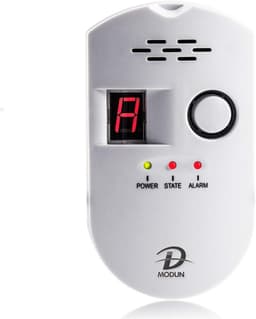
The D MODUN unit is a plug-in with a British plug stated, a draw under 2 W, and an 85 dB alarm once the reading passes 3% LEL. The display is meant to sit on 0, then move through 1 to 9 and A as combustible gas rises, after a two to three minute warm-up. It is about £15 with 4.4 from 158 amazon.co.uk reviews. Amazon reviews praise caravan use and a quick response, and they also record false alarms from cooking or fumes, battery complaints, and poor instructions. The page itself says dust, oil smoke, and water vapour can cause false alarms, and it cannot detect carbon monoxide or CO2. The bullets describe a socket unit you do not carry along a pipe.
Pros
Cons
Best for: You want a socket alarm around £15 with a British plug stated, away from a steamy hob.
Less suitable: You need a pen to trace a joint, or a kitchen full of cooking fumes where this listing expects false alarms.
Specifications
Common questions
What job is this listing for?
It is a plug-in alarm with a British plug stated, for natural gas, LPG, and city gas.
Does it detect carbon monoxide?
No. The listing says it cannot detect carbon monoxide or CO2.
Can I leave it on overnight?
Yes, as a socket alarm, after two to three minutes of warm-up. Keep it away from oil smoke and steam, which the page says can cause false alarms.
The BOBOVAV BBA010 is a battery sniffer with a nine-inch gooseneck, a high and low sensitivity switch, and alarms by sound, vibration, and a bar graph. The listing claims sensitivity under 50 ppm for methane and propane, while the title also prints 300 to 10,000 ppm, so those two lines do not agree. Warm-up is 30 seconds with a ready beep, and auto-off is after five minutes, with two AAA cells in the box. It weighs 181 g and costs about £19.99. The amazon.co.uk file is 4.3 from 43 reviews. Amazon reviews say some buyers traced a leak and found it easy to use, and that it feels cheap. Forty-three reviews can show a first impression, and they are too few to show how often that cheap feel becomes a failed sensor. It is not a leave-on alarm, and carbon monoxide is not among the gases stated.
Pros
Cons
Best for: You want vibration as well as a beep on a short gooseneck, and you will treat 43 reviews as a small sample.
Less suitable: You need a review file in the hundreds, or a detector that stays armed after you walk away.
Specifications
Common questions
What job is this listing for?
It is a short gooseneck sniffer with sound, vibration, and a bar graph. The title says nine inches.
Does it detect carbon monoxide?
No. The gases stated are combustible gases such as methane and propane.
Can I leave it on overnight?
No. Auto-off is about five minutes.
The LLCHB BRJ-502 is described as a plug-in that waits two to three minutes until the display shows 0, then gives an 85 dB sound and a visual signal if the reading hits its preset. The bullets name LPG, natural gas, and coal gas, and they do not state a BS 1363 plug. It is about £15.29 with 4.2 from 239 amazon.co.uk reviews, the lowest star rating in this set. Amazon reviews say some buyers named the gas emergency service and found it easy and quick. They also record battery complaints, a cheap feel, poor instructions, and units returned as faulty. There is no carbon monoxide channel and no EN 50194 line. Treat it as a socket alarm, not as a pen, even where a short job label says otherwise.
Pros
Cons
Best for: You want a cheap plug-in for LPG and natural gas and you will test it after the two to three minute warm-up.
Less suitable: You want the stronger plug-in review file, a stated British Standard plug, or a handheld sniffer.
Specifications
Common questions
What job is this listing for?
It is a plug-in socket alarm for LPG, natural gas, and coal gas, not a pen you carry along a pipe.
Does it detect carbon monoxide?
No. There is no carbon monoxide channel.
Can I leave it on overnight?
It is a plug-in you leave in a socket, after a two to three minute warm-up. BS 1363 is not stated, and no numeric threshold is printed.
Shelf prices, stars, and review counts are the amazon.co.uk figures for the 16 listings on this page. There is no lab test. The score runs from 0 to 100 in four parts: stars, the size of the review sample, any stated standard and detection range, and how well the product fits a householder’s job. The highest total is the top pick. The highest total that is not the top pick is the best value.
Stars
30%The amazon.co.uk star rating, scaled so five stars would score 30. A 4.5 star listing scores 27.
Review sample
25%Five hundred reviews or more score 25. Smaller files score less: 18 from 200 to 499, 12 from 40 to 199, 7 from 15 to 39, and 3 under 15. The three Neoteck pen rows each store 1,320, which is one parent figure.
Standard and range
25%EN 50194-1 on a fixed combustible-gas alarm scores 25. A plug-in with 85 dB and a stated 3% LEL threshold scores 16. A printed ppm, percent LEL, or sensitivity figure on a probe scores 12. A pocket pen with a ppm band and no standard scores 8. A pen with gases named but no ppm scores 5. An oxygen monitor scores 2.
Fit for a householder
20%A leave-on mains alarm scores higher than a five-minute pen. False alarms, faulty returns, missing plug detail, and a thin review file pull the score down. An oxygen monitor is a poor fit in a leak set.
Choose the job and the gas before the star rating. A detector warns you. It does not stop a leak, and it does not replace 0800 111 999 or a Gas Safe registered engineer.
A gas detector in this comparison is any amazon.co.uk listing that claims to sense combustible gas, or that sits in the same batch beside those listings. The batch is not one appliance. Pocket sniffers run on batteries and switch off after about five minutes. Plug-in and corded alarms are meant to stay powered. One handheld, the TopTes S2 Multi, states a carbon monoxide channel beside combustible gas. The TopTes Guard-756 is an oxygen monitor. It does not find a natural-gas leak.

A carbon monoxide alarm to BS EN 50291 does not see unburnt natural gas or LPG. HSE describes it as a back-up, not a substitute for a yearly service. In this set, only the S2 Multi states a carbon monoxide channel beside combustible gas.
Natural gas rises. A socket at skirting level is a poor place for that alarm, which UK reviews say on the Firlarm and D MODUN listings. LPG vapour sinks, so a low point is the LPG case, not the methane case.
Pocket pens in this set switch off after about five minutes. That is a sweep of a joint or a hose. It is not cover while you sleep. If you smell gas, stop the search and call 0800 111 999 in Great Britain.
Name the job before you compare stars. A pen that switches off after about five minutes is a check tool for a joint, a hob, a bottle, or a caravan hose. The PT199, the PT177, the YOJOCK HT60, and the Neoteck pens sit in that group. You cannot leave them on overnight. A plug-in or a corded alarm is the leave-on job. The ABUS GWM100ME is corded at 220–240 V. The Firlarm BRJ-502, the D MODUN unit, and the LLCHB BRJ-502 are plug-ins. An oxygen meter is a third job. The Guard-756 reads oxygen.
Percent LEL and ppm on these pages are listing text. They are not a lab scale you can rank across brands. The PT210S bullet writes 100 ppm to 5,000 ppm and also 1 percent LEL to 10 percent LEL. A usual methane lower explosive limit is about 5 percent by volume, so 1 percent LEL is about 500 ppm. That mismatch is a rule of thumb against the listing, not a test of the sensor. A lower ppm figure is not evidence of a better sensor. The plug and any named standard come before the star rating.
Three typical situations, each with a recommendation from this comparison.
You want an alarm you can leave powered for natural gas and methane, high in the room rather than at the skirting. A five-minute pen will not do that job. The corded ABUS is the listing in this set that claims EN 50194-1.
You are checking hoses, or you want a plug-in you can leave on a low point because LPG vapour sinks. The Firlarm states a 3% LEL threshold and an 85 dB sound, with a large review file, and it does not detect carbon monoxide.
You want to trace a joint, a fireplace, or a locker for a few minutes, then put the tool away. The PT520A has a 43.5 cm probe and a stated 50 to 10,000 ppm range. It still times out, and it is not an overnight alarm.
If you want a leave-on alarm for natural gas and methane, the ABUS GWM100ME is the top pick: corded mains, 85 dB, a test button, a five-year end-of-life signal, and EN 50194-1 on the listing. If you want a cheaper plug-in combustible alarm with a large review file, the Firlarm BRJ-502 is the best value, at about £18.66, and it still cannot see carbon monoxide. A five-minute pen is for tracing a joint, not for overnight cover. The Guard-756 is an oxygen monitor and does not find a natural-gas leak.

Firlarm BRJ-502
Highest score after the top pick, at about £18.66, with 4.5 from 2,810 reviews and a stated 3% LEL threshold.
Editorial

Peter F. is the editor for DIY & tools at productscompared.co.uk. Comparisons in this category are checked against amazon.co.uk listings, review evidence and public UK sources.
Guides on what to look for, how to use a product, and common mistakes.
Safety rules and standards are from the public sources below. Prices, stars, and review counts are from the amazon.co.uk listings. Last checked 20 October 2026.
This page contains affiliate links to amazon.co.uk. If you buy through them, we may earn a commission at no extra cost to you. Star ratings and review counts come from those listings. This is not a lab test.