Independent comparisons. We may earn from shop links. More info

Gas detector vs carbon monoxide alarm

Updated: 20 October 2026

You are in a kitchen that smells of gas, and the carbon monoxide alarm on the wall has stayed quiet. A gas detector vs carbon monoxide alarm comparison is about two hazards, not two names for one box. Unburnt natural gas or LPG is fuel that has not burned. Carbon monoxide comes from incomplete combustion, and it has no smell of its own. The Products Compared editorial team checked amazon.co.uk listing text and public UK sources for this page on 20 October 2026. We did not run a lab test. A qualifying purchase can earn us a commission at no extra cost to you. The plug-ins, pens, and monitors sit on the [gas detector](/hub/fire-protection/gas-detector) comparison.

You are in a kitchen that smells of gas, and the carbon monoxide alarm on the wall has stayed quiet. A gas detector vs carbon monoxide alarm comparison is about two hazards, not two names for one box.

Our top picks

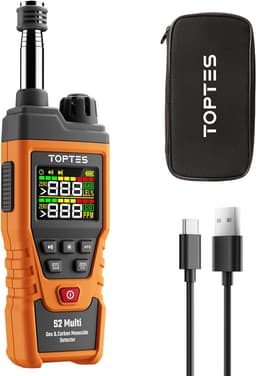
TopTes TopTes S2 Multi

Best overall

TopTes TopTes S2 Multi
6.4/10about £79.99
Firlarm Firlarm BRJ-502

Best value

Firlarm Firlarm BRJ-502
8.3/10about £18.66
ABUS ABUS GWM100ME

Rank 3

ABUS ABUS GWM100ME
9.5/10about £53.45
On this page

Two hazards, and why one alarm stays quiet

Natural gas and LPG are the unburnt fuel in the pipe or the cylinder. Carbon monoxide is what can form when a flame does not burn that fuel completely. Safelincs, on 30 November 2023, stated the split: a carbon monoxide alarm responds to carbon monoxide from incomplete combustion and does not detect natural gas or LPG. The odourant in mains gas and in LPG is why you can smell a leak while that alarm stays quiet. A carbon monoxide alarm to BS EN 50291 is the usual UK name for that second job. The Health and Safety Executive points households towards a British or European approval mark such as a Kitemark, and that mark does not mean the unit sees methane, propane, or butane. If you cannot smell the odourant, a quiet carbon monoxide alarm does not cover that gap. The Cadent path for people who cannot smell is on the gas detector buying guide. Take a boiler cupboard. The carbon monoxide alarm is there because a flame can go wrong with no gas smell. A loose joint is a different failure, and the same alarm can sit silent while the room smells. If you smell gas, or anyone feels dizzy or sick, use the stop rule on how to check a gas leak, which also holds 0800 111 999.

What this batch actually states

Read the bullets, not the category heading above them. The TopTes S2 Multi at about £79.99 is the only model in this set whose bullets state combustible gas and carbon monoxide together. That is a listing claim about two channels, not a star ranking, and not a BS EN 50291 alarm for a landlord to leave on the wall. Skip it when a few minutes at a joint is the whole job. The Firlarm plug-in at about £18.66 says it cannot detect carbon monoxide. If you wanted a carbon monoxide warning, this is the wrong job, though it costs far less than the S2 Multi. The YOJOCK HT60 at about £13.99 puts carbon monoxide and smoke on the item-type line only. The bullets do not, so this page does not treat the HT60 as a carbon monoxide alarm or a smoke alarm. It is a low-cost pen for a short check. The TopTes Guard-756 at about £79.99 is oxygen only and finds neither hazard.
TopTes TopTes S2 Multi

Testsieger

TopTes TopTes S2 Multi
6.4/10about £79.99

What the England rules require

From 1 October 2022, a relevant landlord in England must fit a carbon monoxide alarm in any room used as living accommodation that contains a fixed combustion appliance other than a gas cooker. Smoke alarms are a separate duty, on each storey with living accommodation. The duty does not require a combustible-gas detector, a natural-gas alarm, or an LPG alarm. The 2022 amendment described here is the England rule. Scotland, Wales, and Northern Ireland need their own sources. Approved Document J guidance from the same date, for installing a fixed combustion appliance, also names a carbon monoxide alarm to BS EN 50291 and leaves out appliances used solely for cooking. A landlord who fits only the Firlarm has not met the carbon monoxide duty. The duty leaves the yearly service of the appliance as its own job.

A back-up, not a yearly service

The Health and Safety Executive strongly recommends a carbon monoxide alarm to BS EN 50291, with a British or European approval mark such as a Kitemark, as a precaution beside regular maintenance by a Gas Safe registered engineer. HSE’s guide L56 places carbon monoxide alarms outside the Gas Safety (Installation and Use) Regulations 1998. Buying either alarm does not carry out that gas work. If the boiler has not been serviced, a new alarm does not repair a poor flame, a blocked flue, or a loose connection. Compared with leaving the appliance unchecked, the alarm is an extra warning after something has already gone wrong. When the clue is the smell of unburnt gas, a combustible-gas detector matches that hazard, and the carbon monoxide alarm still matches incomplete combustion when there is nothing to smell. In this set, only the S2 Multi bullets state both, and those bullets do not discharge the England landlord duty.

Common questions

Will a carbon monoxide alarm go off if I smell gas?
No. It responds to carbon monoxide from incomplete combustion, and Safelincs noted on 30 November 2023 that it does not detect natural gas or LPG. The odourant is what you smell, so the alarm can stay silent. If you smell gas, phone 0800 111 999 in Great Britain, and do not keep sweeping the pipe.
Will a combustible-gas detector warn me about carbon monoxide?
Only when its bullets say so. The TopTes S2 Multi at about £79.99 is the only listing in this amazon.co.uk set whose bullets state combustible gas and carbon monoxide together. The Firlarm at about £18.66 says it cannot detect carbon monoxide. If the bullets never name carbon monoxide, the unit stays quiet about it. That S2 Multi line is a listing claim, not a landlord alarm to BS EN 50291.
What does a landlord in England have to fit?
From 1 October 2022, a relevant landlord in England must fit a carbon monoxide alarm in any room used as living accommodation that contains a fixed combustion appliance other than a gas cooker. A smoke alarm is required on each storey with living accommodation. The alarm in that duty is a BS EN 50291 carbon monoxide alarm. This is the England rule. Scotland, Wales, and Northern Ireland need their own sources.
Does that duty include a natural-gas or LPG detector?
No. The England landlord duty names a carbon monoxide alarm and, separately, smoke alarms. It does not name a combustible-gas detector, a natural-gas alarm, or an LPG alarm. Approved Document J guidance from 1 October 2022 also names a carbon monoxide alarm to BS EN 50291 when a fixed combustion appliance is installed, and it leaves out appliances used only for cooking. A natural-gas or LPG detector does not meet that carbon monoxide duty on its own.
Which listing in this set actually states both hazards?
The TopTes S2 Multi at about £79.99. Its bullets state combustible gas and carbon monoxide. The Firlarm at about £18.66 says it cannot detect carbon monoxide. The YOJOCK HT60 at about £13.99 mentions carbon monoxide and smoke only on the item-type line. The TopTes Guard-756 at about £79.99 is an oxygen monitor and states neither hazard. Those S2 Multi bullets are not the landlord alarm.
Is a carbon monoxide alarm a substitute for a yearly service?
No. The Health and Safety Executive recommends a carbon monoxide alarm to BS EN 50291, with a mark such as a Kitemark, as a back-up to maintenance by a Gas Safe registered engineer. L56 places these alarms outside the Gas Safety (Installation and Use) Regulations 1998. The alarm does not service the boiler. A combustible-gas detector does not inspect the appliance either.

Related pages

Sources

Safety rules and standards are from the public sources below. Prices, stars, and review counts are from the amazon.co.uk listings. Last checked 20 October 2026.

  1. National Gas emergency contacts (retrieved 20 October 2026)
  2. HSE domestic gas FAQs (retrieved 20 October 2026)
  3. Gas Safety (Installation and Use) Regulations 1998 (retrieved 20 October 2026)
  4. HSE L56, safety in the installation and use of gas systems and appliances (retrieved 20 October 2026)
  5. GOV.UK smoke and carbon monoxide alarm booklet for landlords (retrieved 20 October 2026)
  6. BSI BS EN 50194-1:2023, flammable gases in household premises (retrieved 20 October 2026)
  7. Cadent, sense of smell (retrieved 20 October 2026)
  8. Safelincs: will a carbon monoxide alarm detect gas leaks? (retrieved 20 October 2026)