Independent comparisons. We may earn from shop links. More info

Fence tester comparison 2026

The best Fence testers, compared.

Top pick: FenceMate SX-03-UK duo meter Best value: Rutland Essentials neon tester – Strongest price-for-evidence row that is not the top pick: about £14.72, a ground spike, and 4.5 from 240 ratings. Updated October 2026.

A fence tester is the handheld check for a pulsed electric fence on a UK paddock, horse tape, poultry net or garden boundary. You use it to see whether the live wire still has a useful pulse, instead of touching the wire. A neon or LED bar gives coarse steps. Reading types are in the [fence tester buying guide](/hub/fencing-and-wire/fence-tester/sub/fence-tester-buying-guide). A fault finder adds current or an arrow so you can walk toward a short. Hotline’s catalogue says a beeper is not enough for fault finding.

A fence tester is the handheld check for a pulsed electric fence on a UK paddock, horse tape, poultry net or garden boundary.

FenceMate SX-03-UK duo meter

Best overall

FenceMate SX-03-UK duo meter
7.3/10∼ £36

38 products checked · 64 hrs invested · +22,100 readers

11 of 11: Best Fence testers compared

Swipe for more

1-2 of 11
Best overall
FenceMate SX-03-UK duo meter
Hotline 47KV10 LED tester
Best value
Rutland Essentials neon tester
M MINGYA 8 kV LED tester
Fieldmate FMFF-01 fault finder
Honiwu 8-neon fence tester
M MINGYA 7 kV neon tester
M MINGYA 15 kV digital fault finder
M MINGYA beeper with switch
FenceMate SX-01 digital meter
M MINGYA fence beeper
7.3/10
8.6/10
8.0/10
3.5/10
3.6/10
4.8/10
5.7/10
3.9/10
2.7/10
6.1/10
1.8/10
∼ £36
∼ £28
∼ £15
∼ £10
∼ £35
∼ £11
∼ £16
∼ £70
∼ £11
∼ £30
∼ £10
4.7(20)
4.5(497)
4.5(240)
4.5(2)
4.3(5)
4.2(14)
4.0(17)
4.0(5)
4.0(1)
3.8(16)
–
View offer
View offer
View offer
View offer
View offer
View offer
View offer
View offer
View offer
View offer
View offer

The best Fence testers in detail

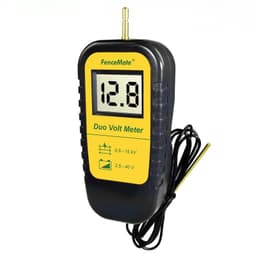
FenceMate SX-03-UK duo meter

Rank 1

FenceMate SX-03-UK duo meter

∼£36

Our view

The FenceMate SX-03-UK is an LCD the listing places at 0.5–15 kV on the fence and 2.5–40 V on a battery, 180 g, at about £35.99, with a 9 V cell and an earth rod described on a black lead. Across 20 amazon.co.uk ratings it sits at 4.7, the highest stars in this set on a modest count. Reviewers use the clear digits for line faults and for a battery check on the same meter, including a short cattle-stop fence. One reviewer had to supply their own ground pin, and the included-components field says the body, so the rod in the bullets is not a guarantee. The build is called cheap, and one reviewer keeps it to dry weather. A line that says it meets unspecified accuracy standards is not a calibration certificate. Twenty reviews are not the Hotline’s 497.

Pros

  • 0.5–15 kV and 2.5–40 V on one LCD
  • 4.7 from 20 ratings at about £35.99
  • 9 V cell included, with automatic switch-on
  • Claims wire, rope, braid, tape and energiser terminals

Cons

  • Twenty reviews is a modest sample next to the Hotline
  • One reviewer supplied their own ground pin
  • Build is described as cheap, and one note limits it to dry weather
  • No current reading and no direction arrow

Best for: You want a number you can compare week to week, including a check on a 12 V battery.

Less suitable: You need an arrow, a stake-free fob, or a review count in the hundreds.

Specifications

Model
FenceMate SX-03-UK duo meter
Brand
FenceMate
Price
∼£36
Customer rating
4.7/5(20)
Tester type
Digital meter
Reading
LCD number
Voltage range
0.5–15 kV; to 40 V
Earth method
Earth lead
Batteries
9 V included
Fault direction
No
Current reading
No
Weight
180 g

Common questions

Can it test a 12 V battery as well as the fence?

The listing says fence output from 0.5 to 15 kV and battery voltage from 2.5 to 40 V. Reviewers use the same meter for a line fault and a battery check.

Does it need an earth connection?

The bullets describe an earth rod on a black wire. One review says you may need to supply your own ground pin. The included-components field names the body.

What battery powers the meter?

A replaceable 9 V battery, included, with automatic on/off when a pulse or a battery is detected. Twenty ratings is a modest sample beside the Hotline.

Hotline 47KV10 LED tester

Rank 2

Hotline 47KV10 LED tester

∼£28

Our view

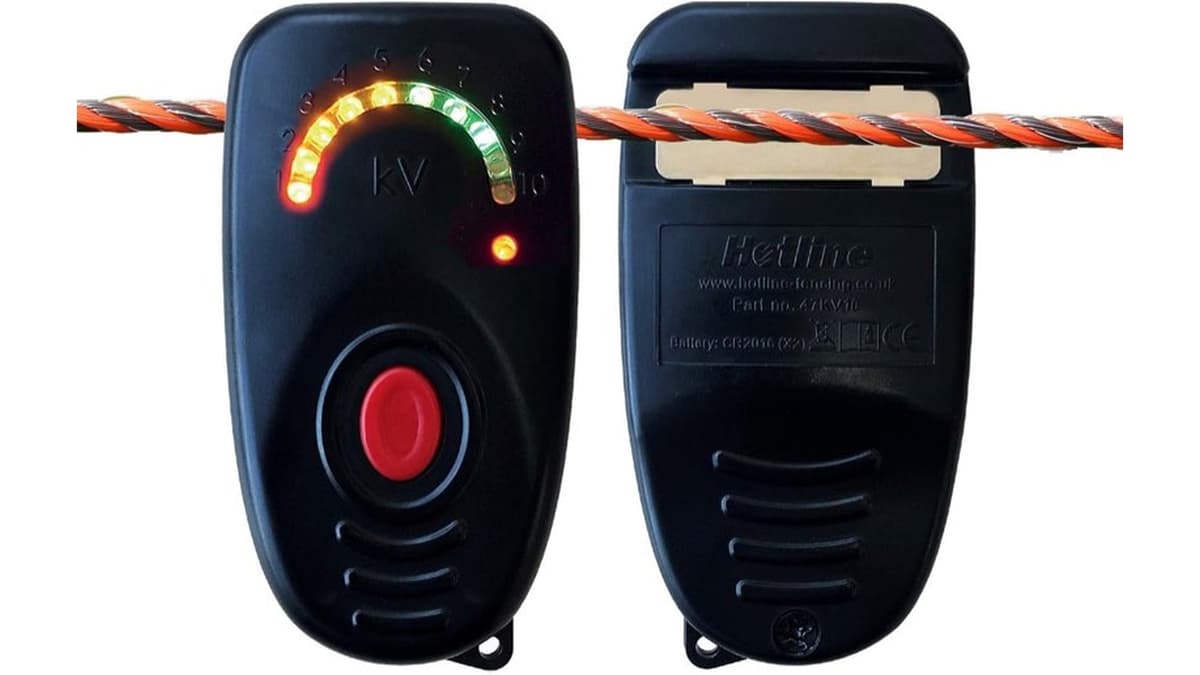
The Hotline 47KV10 is the top pick here. It is a 50 g self-earthing LED bar that steps from 1 kV to 10 kV, so a pocket check on horse tape or poultry wire needs the contact on the wire and no spike in the soil. Across 497 amazon.co.uk ratings it sits at 4.5, at about £27.99, which is the largest sample in this set. Reviewers praise the key-ring size and a scale that shows strength, and several of them can read the LEDs in sunshine. The supplied cells sometimes arrive flat, and the reading stays on the bar only briefly. The body is narrow for ribbon or thick tape. One reviewer estimates an over-read of about 1 kV and still uses it because the offset stays consistent. Units that read zero, or that stop after months, while the fence still shocks, are in the same notes.

Pros

  • 4.5 from 497 amazon.co.uk ratings, the largest sample here
  • 1 kV LED steps to 10 kV, 50 g, with no earth stake
  • Batteries included at about £27.99
  • Reviewers use it on tape and poultry wire

Cons

  • Supplied batteries sometimes arrive flat
  • Narrow body on ribbon or thick tape
  • Some readers cannot see the LEDs in bright sun
  • Units that die or read zero while the fence still shocks

Best for: You want a pocket LED check without a soil spike, and you want the longest amazon.co.uk review record in this set.

Less suitable: You need an earth-stake test, a number you can log, or a wide contact on thick tape.

Specifications

Model
Hotline 47KV10 LED tester
Brand
Hotline Electric Fencing
Price
∼£28
Customer rating
4.5/5(497)
Tester type
LED bar
Reading
10 LEDs, 1 kV steps
Voltage range
1–10 kV
Earth method
No earth stake
Batteries
Included
Fault direction
No
Current reading
No
Weight
50 g

Common questions

Does the Hotline 47KV10 need an earth stake?

The listing says no earth stake is required. You touch the fence and the tester uses its own earth path. That is faster on the wire. It is not Gallagher’s earth-stake test.

What voltage does it show?

The listing says it measures up to 10 kV in 1 kV steps with LED indicators. The minimum operating voltage is given as 1 kV. It does not log a precise number.

Does it come with batteries?

Yes. The listing says batteries are included. Some reviews say those cells arrived flat, so check them before you rely on a first reading.

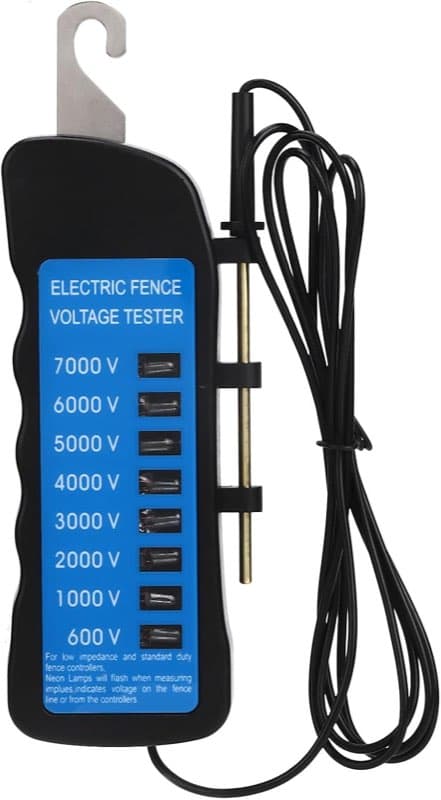
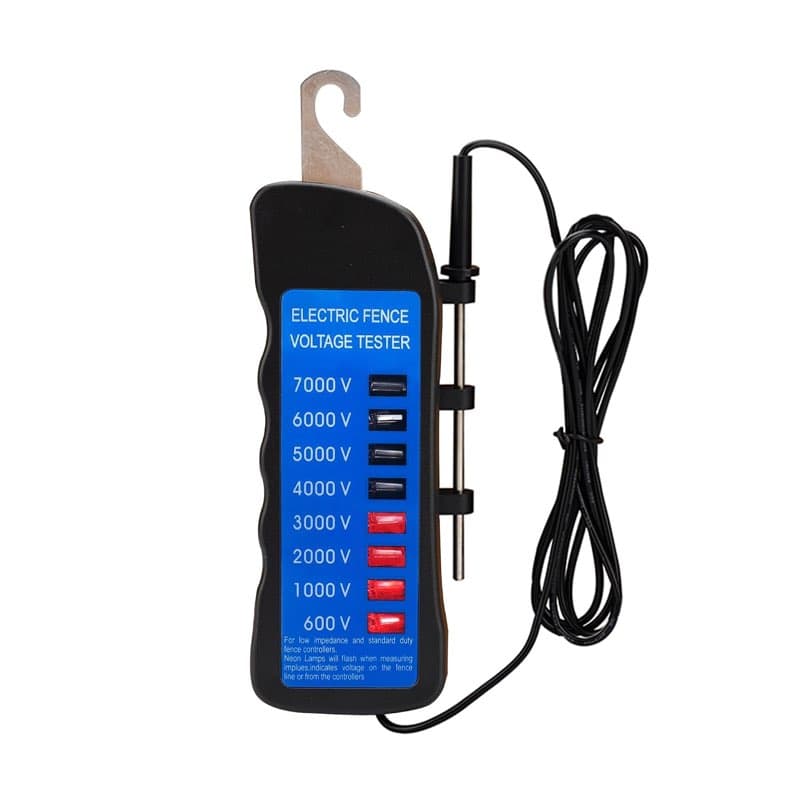
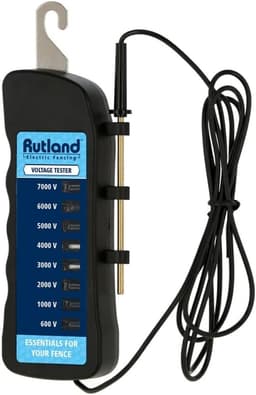
Rutland Essentials neon tester

Rank 3

Rutland Essentials neon tester

∼£15

Our view

The Rutland Essentials tester is the best value here. It is the Kerbl 428173 neon, with eight lights and a ground spike, at about £14.72. Across 240 amazon.co.uk ratings it sits at 4.5. You hook it on the wire and put the spike in the soil, which reviewers use on horse, sheep and poultry fences, and a drop in the lights is how they spot a short. The listing does not state the kilovolt each light stands for. UK reviews say the neon is hard to see in daylight unless you shade the lamps. The earth probe pulls out of its wire in those notes, and one handle detached on first use. One unit failed after about a week. The IEC 61010-1 line is the seller’s text, not a certificate in the file.

Pros

  • 4.5 from 240 ratings at about £14.72
  • Ground spike included, with a carry slot
  • Reviewers use the light drop to spot a short
  • Used on horse, sheep and poultry fences

Cons

  • Kilovolt per light is not stated
  • Neon is hard to see in daylight unless you shade it
  • Earth probe pulls out, and one handle detached on first use
  • IEC 61010-1 on the specification line is a seller claim

Best for: You want a cheap earth-referenced neon with a long review record and you can shade the lamps.

Less suitable: You need a logged number, a daylight reading without shading, or a stake-free pocket fob.

Specifications

Model
Rutland Essentials neon tester
Brand
Kerbl
Price
∼£15
Customer rating
4.5/5(240)
Tester type
Neon probe
Reading
8 lights
Earth method
Ground spike
Fault direction
No
Current reading
No
Weight
100 g

Common questions

Does the Rutland tester include an earth spike?

Yes. The bullets say a ground spike is included. You hook the tester on the wire and put the spike in the soil. Reviews say that probe can pull out of its wire.

How many lights does it have?

Eight. The listing does not state the kilovolt each light stands for, so there is no numeric range to quote. A drop in the lights is how reviewers spot a short.

What standard is named?

The specification line says IEC 61010-1 and NIST traceable. That is the seller’s line, not a certificate in the file. Do not treat it as a calibration we have seen.

M MINGYA 8 kV LED tester

Rank 4

M MINGYA 8 kV LED tester

∼£10

Our view

The M MINGYA MLD-002A4 is a battery-free LED probe listed at about 1,000 V to 8,000 V, 140 g, at about £9.99. Across 2 amazon.co.uk ratings it sits at 4.5. Both notes describe a quick check: no batteries, and lights that climb as the voltage rises. An earth method is not stated, so you cannot tell from the file whether this references the soil. Two ratings cannot show how long the LEDs last, and the reviewers themselves call it a basic check. An 8 kV top still sits on its last light once the energiser is hotter than that. Leave this row when you need a review record you can actually read.

Pros

  • About £9.99, with no batteries claimed
  • About 1,000–8,000 V on the listing
  • LED indication rather than a neon flash
  • Reviewers say the lights climb as voltage rises

Cons

  • 4.5 from only 2 ratings
  • Earth method is not stated
  • 8 kV ceiling on the listing
  • The two reviews call it a basic check

Best for: You want the lowest shelf price for an LED indication and you can live with two reviews.

Less suitable: You need a review pool, a stated earth method, or a number you can log.

Specifications

Model
M MINGYA 8 kV LED tester
Brand
M MINGYA
Price
∼£10
Customer rating
4.5/5(2)
Tester type
LED probe
Reading
LED indicators
Voltage range
1–8 kV
Batteries
None
Fault direction
No
Current reading
No
Weight
140 g

Common questions

Does it need batteries?

The listing says no batteries are required. That is the seller’s claim. Only two amazon.co.uk ratings sit behind it, so the claim is lightly checked.

What range is on the listing?

The title and bullets put the working range at about 1,000 V to 8,000 V. An energiser hotter than 8 kV still sits on the last light.

How many reviews are there?

The listing shows 4.5 from 2 ratings. That is too few to judge how long it lasts. The method does not give the value award to a two-review row.

Fieldmate FMFF-01 fault finder

Rank 5

Fieldmate FMFF-01 fault finder

∼£35

Our view

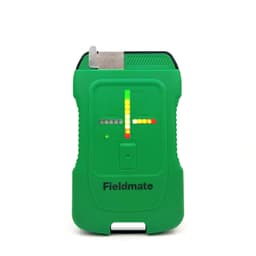
The Fieldmate FMFF-01 is a directional LED finder, 173 g, at about £34.99, that claims no ground stake and arrows so you can walk toward a short. Across 5 amazon.co.uk ratings it sits at 4.3. A positive review wants the volt reading plus direction, and the button stays active for about 30 seconds, which is longer than a press-and-hold fob. The same thin set says it did not fully meet expectations on a hen fence that shorts in rain, and that it behaves differently from the reviewer’s other tester. The bullets say 0 kV to 10 kV, and the specification line says a maximum operating voltage of 10 volts. A current figure is not stated, so this is not an amp meter. Five reviews cannot carry a fault finder on a weedy line.

Pros

  • Directional LEDs at about £34.99
  • No ground stake claimed, with one-touch operation
  • Button stays active for about 30 seconds in a review
  • Instructions are listed in the box

Cons

  • Bullets say 0–10 kV and the spec line says 10 volts
  • Current is not stated
  • 4.3 from only 5 ratings
  • One hen-fence review says it fell short when the fence shorted in rain

Best for: You want arrows without a stake, and you have read both voltage lines on the listing.

Less suitable: You need a consistent kilovolt figure, an amp reading, or a larger review set.

Specifications

Model
Fieldmate FMFF-01 fault finder
Brand
Fieldmate
Price
∼£35
Customer rating
4.3/5(5)
Tester type
Directional finder
Reading
LEDs and direction
Voltage range
0–10 kV; spec 10 V
Earth method
No ground stake
Batteries
Type not stated
Fault direction
Yes
Weight
173 g

Common questions

Does the Fieldmate need a ground stake?

The bullets say no ground stake and one-touch operation. That is the seller’s claim. The amazon.co.uk line is 4.3 from 5 ratings, which is a thin sample for a fault finder.

Is the range 10 kV or 10 V?

The bullets say 0 kV to 10 kV. The specification line says maximum operating voltage 10 volts. Both are on the listing. Do not quote one and drop the other.

Does it show fault direction?

Yes. The listing says directional LEDs show which way to walk. A current figure is not stated, so this is not an amp meter.

Honiwu 8-neon fence tester

Rank 6

Honiwu 8-neon fence tester

∼£11

Our view

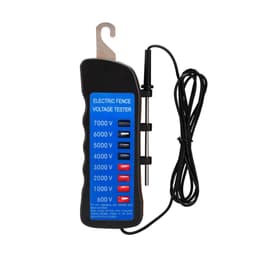
The Honiwu listing is an eight-neon tester stated at 600 V to 7,000 V, 70 g, at about £11.39. Across 14 amazon.co.uk ratings it sits at 4.2, and the written sample is a few short notes rather than a durability record. Those notes call the display bright and light enough for a pocket, and one reviewer restates the voltage band. An earth method is not stated, and the included-components field only says “inc”. The specification line says CE and waterproof, which stays a seller claim. The part number in the file, Honiwuuo8zxdsrcy, reads like a marketplace placeholder. A 7 kV ceiling still cannot separate a hotter pulse from the last lamp.

Pros

  • About £11.39, the lowest neon price in this set
  • Eight lamps stated at 600–7,000 V
  • 70 g, with a hanging point in the reviews
  • Reviewers call the display bright

Cons

  • 4.2 from 14 ratings, with only a few written reviews
  • Earth method and batteries are not stated
  • CE and waterproof are seller claims
  • The part number looks like a placeholder

Best for: You want the cheapest eight-lamp listing and you accept a missing earth line.

Less suitable: You need a stated spike, a review record you can read, or a scale above 7 kV.

Specifications

Model
Honiwu 8-neon fence tester
Brand
Honiwu
Price
∼£11
Customer rating
4.2/5(14)
Tester type
Neon
Reading
8 neon lamps
Voltage range
0.6–7 kV
Fault direction
No
Current reading
No
Weight
70 g

Common questions

What voltage range is listed?

The title and a review restate 600 V to 7,000 V, shown on eight neon lamps. A pulse above 7 kV still sits on the last lamp. The written review sample is short.

Is it waterproof?

The specification line says CE and waterproof. No certificate is in the listing, so that remains a seller claim. Do not treat the line as a test we have seen.

Does the listing say it needs an earth stake?

An earth method is not stated. The compatible-devices field only says default. A missing earth line is not the same as a self-earthing claim.

M MINGYA 7 kV neon tester

Rank 7

M MINGYA 7 kV neon tester

∼£16

Our view

The M MINGYA MLD-0027 is an eight-lamp neon the listing places from 600 V to 7 kV, at about £15.99 and 70 g, with a copper ground probe and no batteries. Across 17 amazon.co.uk ratings it sits at 4.0. You can hang it on the wire with the probe in the soil, and the probe clips on the side. A scale that stops at 7 kV shows its last lamp once the pulse is above that. Reviews that returned it call the plastic flimsy and the neon hard to see in sunlight, and one buyer then bought a Hotline. The pack had no instructions in those notes. There is no current reading and no direction arrow.

Pros

  • Stated scale from 600 V to 7 kV on eight lamps
  • Ground probe, no batteries, 70 g
  • Probe clips on the side so it can hang on the wire
  • Claims wire, rope and tape

Cons

  • 4.0 from 17 ratings, a short sample beside the Rutland neon
  • Scale stops at 7 kV
  • Reviews call the plastic flimsy and the neon hard to see
  • No direction arrow and no current reading

Best for: You want a battery-free probe neon with a printed 7 kV ceiling and you can shade the lamps.

Less suitable: You need a scale above 7 kV, a large review pool, or a case reviewers call sturdy.

Specifications

Model
M MINGYA 7 kV neon tester
Brand
M MINGYA
Price
∼£16
Customer rating
4.0/5(17)
Tester type
Neon probe
Reading
8 neon lamps
Voltage range
0.6–7 kV
Earth method
Ground probe
Batteries
None
Fault direction
No
Current reading
No
Weight
70 g

Common questions

Does this neon tester need batteries?

No. The listing says it is self-powered and that you do not add batteries. That claim is the seller’s line. The review sample is 4.0 from 17 ratings.

How do you take a reading?

The listing says you push the copper probe into the ground and hook the top on the wire or tape. The probe clips on the side so the tester can hang on the wire.

What is the top of the scale?

The listing states 600 V to 7,000 V. It will not show a figure above 7 kV. Once the pulse is hotter than that, the last lamp is all you see.

M MINGYA 15 kV digital fault finder

Rank 8

M MINGYA 15 kV digital fault finder

∼£70

Our view

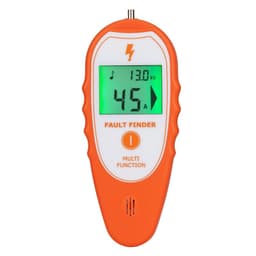
The M MINGYA MLD-004A-NEW is a backlit LCD listed from 200 V to 15,000 V that claims voltage, current and direction, at 200 g and about £69.99. Across 5 amazon.co.uk ratings it sits at 4.0. The useful review describes those three readings on the backlight, plus a belt clip and a holster. The power-source line says Manual, and neither a battery nor an earth method is named, so both stay unconfirmed. Another review says the screen failed after about two months and calls it not durable. Five reviews and that failure put it in a different risk band from the Hotline fob at about £27.99. It is the only row in this set that claims a current figure beside an arrow.

Pros

  • Backlit LCD claimed for voltage, current and direction
  • Listed from 200 V to 15,000 V
  • Claims steel, aluminium, polywire, rope, tape and braid
  • A review mentions a belt clip and a holster

Cons

  • About £69.99 with 4.0 from 5 ratings
  • Screen failed after about two months in a review
  • Earth method and battery are not stated
  • Heavier than a pocket fob, at 200 g

Best for: You want current and an arrow on one screen and you accept a five-review record.

Less suitable: You need a stated earth method, a long review record, or the cheaper FenceMate number.

Specifications

Model
M MINGYA 15 kV digital fault finder
Brand
M MINGYA
Price
∼£70
Customer rating
4.0/5(5)
Tester type
Digital fault finder
Reading
Backlit LCD
Voltage range
0.2–15 kV
Fault direction
Yes
Current reading
Yes
Weight
200 g

Common questions

Does the screen show more than voltage?

The listing says the backlight LCD shows voltage, current and current direction. That is a seller claim. The amazon.co.uk line is 4.0 from 5 ratings, and one review says the screen failed after about two months.

What range is listed?

200 V to 15,000 V pulse voltage. Weight is 200 g. The listing does not name an earth method, so you cannot tell from the file how the reading is referenced.

Is a battery specified?

The power source line says Manual. A battery is not named, so treat that as not stated. Do not assume it is battery-free.

M MINGYA beeper with switch

Rank 9

M MINGYA beeper with switch

∼£11

Our view

The switched M MINGYA beeper is the same 30 g proximity idea with an on/off switch, at about £10.99, so it does not keep sounding in a pocket. Across 1 amazon.co.uk rating it sits at 4.0. That review describes a pocket size of about 8 cm plus the key-ring, used on a garden fence and on walks past farm fences. The listing says no battery is required, and the same review says a battery was in the pack and is fiddly to change. There is still no kilovolt scale and no earth path. One review cannot settle whether the switch is worth the extra pound over the unswitched beeper. A beep still only means a live wire is near the unit.

Pros

  • On/off switch so it stays quiet in a pocket
  • 30 g at about £10.99
  • The single review confirms pocket size on a garden fence

Cons

  • 4.0 from 1 rating
  • Listing says no battery; the review found one and called the change fiddly
  • No voltage scale and no earth path
  • A beep cannot show a drop along the line

Best for: You want a beeper you can switch off in a coat pocket on a garden wire.

Less suitable: You need kilovolts, or a battery story that matches the listing.

Specifications

Model
M MINGYA beeper with switch
Brand
M MINGYA
Price
∼£11
Customer rating
4.0/5(1)
Tester type
Beeper
Reading
Sound only
Earth method
No ground wire
Batteries
Review found one
Fault direction
No
Current reading
No
Weight
30 g

Common questions

Why is there a switch?

The listing says the on/off switch stops the beeper sounding in a pocket. There is one amazon.co.uk rating, at 4.0, so that claim is a single comment plus the seller’s line.

Does it need a battery?

The listing says no. The only review says a battery was included and is fiddly to change. Those two lines do not agree.

Does it show a voltage?

No kilovolt scale is stated. It is a proximity beep. A beep is not a kilovolt reading and it will not show a drop along the line.

FenceMate SX-01 digital meter

Rank 10

FenceMate SX-01 digital meter

∼£30

Our view

The FenceMate SX-01 is an LCD meter listed up to 15,500 V, 170 g, at about £29.99, with a 9 V battery and a ground lead for the line, the charger or the earth system. Across 16 amazon.co.uk ratings it sits at 3.8, the lowest star line among tools here with more than a handful of ratings. Reviewers praise the clear screen, the wide range and automatic on/off. The included 9 V cell arrived low in the review notes, and an earth-rod wire fixing broke within two days. You re-earth the lead as you walk a break, which is how a probe meter works. One review mentions 19.9 kV, which the listing does not state, so the figure to use is 15.5 kV. There is no direction arrow and no current reading.

Pros

  • LCD listed up to 15,500 V
  • Ground lead included, 170 g, at about £29.99
  • Automatic on/off, with a clear screen in the reviews
  • Claims chargers, lines and the earth system

Cons

  • 3.8 from 16 ratings
  • The included 9 V cell arrived low
  • Earth-rod wire fixing broke within two days
  • No arrow and no current reading

Best for: You want a number up to 15.5 kV and you will replace a weak 9 V cell.

Less suitable: You also want a 12 V battery range, or you need a sturdier earth lead than the reviews describe.

Specifications

Model
FenceMate SX-01 digital meter
Brand
FenceMate
Price
∼£30
Customer rating
3.8/5(16)
Tester type
Digital meter
Reading
LCD number
Voltage range
Up to 15.5 kV
Earth method
Ground lead
Batteries
9 V included
Fault direction
No
Current reading
No
Weight
170 g

Common questions

What battery does it use?

One 9 V zinc-carbon battery, included. A review says that cell arrived low. Replace it before you treat a low fence reading as a fault on the line.

Does it include an earth lead?

Yes. The title says grounding is included, and reviews describe an earth rod on a wire. One note says the wire fixing broke within two days.

What is the listed range?

Up to 15,500 V (15.5 kV), with automatic on/off. One review mentions 19.9 kV, which the listing does not state. Use 15.5 kV.

M MINGYA fence beeper

Rank 11

M MINGYA fence beeper

∼£10

Our view

The unswitched M MINGYA beeper is a 30 g proximity unit, 9 × 6 × 2.5 cm, at about £9.99, that sounds when it is near a live wire and lists no kilovolt scale. The listing has no customer-review line, so the amazon.co.uk rating is not available. The listing says batteries are not required and that there is no grounding wire. Hotline’s catalogue treats a beeper as presence only, which is the right description of this row. Without a UK review you cannot check the no-battery claim against someone who opened the pack. It will not tell you whether the far end has dropped, and it will not point you toward a short.

Pros

  • 30 g at about £9.99
  • No grounding wire claimed
  • A beep for presence, with no scale to misread as kilovolts

Cons

  • No amazon.co.uk customer-review line
  • No kilovolt reading
  • The no-battery claim is untested by a UK review in the file
  • Cannot separate a weak fence from a live one

Best for: You only want a beep that a wire is live, and you do not need star ratings to decide.

Less suitable: You need volts, an earth check, or any buyer comments on this listing.

Specifications

Model
M MINGYA fence beeper
Brand
M MINGYA
Price
∼£10
Tester type
Beeper
Reading
Sound only
Earth method
No ground wire
Batteries
None claimed
Fault direction
No
Current reading
No
Weight
30 g

Common questions

Does the beeper show kilovolts?

No scale is listed. It beeps when it detects a live wire. Do not read that sound as a kilovolt figure, and do not use it to decide whether the far end has dropped.

Does it need a battery or an earth stake?

The listing says batteries are not required and that there is no grounding wire. There is no customer-review line on this listing, so a UK buyer has not checked that claim in the file.

Are there reviews?

This listing has no customer-review line, so the amazon.co.uk rating is not available. A star row is not invented for this product.

How we compared

Eleven amazon.co.uk fence testers were scored from the listings and review notes stored for this set. Shelf prices are those printed figures, not a live re-check on 19 October 2026. This is not a laboratory test. A star row is amazon.co.uk’s figure. A voltage range, an earth method and a battery line are the seller’s claim unless a UK review contradicts them. A CE, waterproof or IEC 61010-1 line stays a seller claim. The four weights below sum to 100. The top pick is the highest score. The best value is the strongest price-for-evidence row that is not the same product. A £9.99 row with two reviews, or none, does not take that award.

1

Amazon evidence

30%

Star rating on amazon.co.uk, then the size of the sample. 4.5 from 497 ratings is stronger evidence than 4.7 from 20, and stronger than 4.5 from 2. No customer-review line scores zero on this block.

2

Spec fit

25%

A stated reading, a stated voltage range and a stated earth method. A scale that stops at 7 kV or 8 kV loses points against a higher pulse. A missing earth method, a missing battery line, and a file that says both 10 V and 0–10 kV lose points. A beeper with no kilovolt scale is an honest presence tool and still scores low, because it cannot show strength. This is not a calibration score.

3

Review outcome

25%

UK comments that describe a usable check score higher when the sample is large enough to read. Flat batteries, neon you must shade, a probe that pulls out, a screen that failed, and units that die are deductions. One or two reviews cannot fill this block. No UK review text keeps it low.

4

Value

20%

Shelf price in GBP against the job, only when UK reviews exist and the tool states what it reads. The lowest price among listings with a long review pool and a stated earth spike wins this block. The highest score is not also the value award.

Independent review
Last updated: October 2026
8 sources checked

Fence tester buying guide

Match the tester to the job before you compare the shelf price. A beep, a lamp, a number and an arrow answer different questions. These eleven amazon.co.uk listings are not a laboratory test, and a star row is not proof the fence is safe. Stored shelves run from about £9.99 to about £69.99. There is no single correct fence voltage in the sources below.

What is a fence tester?

A fence tester is the handheld check for a pulsed electric fence. You use it on a UK paddock, horse tape, poultry net or garden boundary to see whether the live wire still has a useful pulse, instead of touching the wire or a blade of grass. A beeper only says the fence is on. A neon or LED bar gives coarse kilovolt steps. A digital meter gives a number. A fault finder adds current or an arrow so you can walk toward a short. Hotline’s catalogue says a beeper is not enough for fault finding.

Best for

  • A pocket check on tape or poultry wire, if you can accept LED steps
  • An earth-referenced neon you can shade, or a number you can log

Not ideal for

  • Reading a beep as a kilovolt figure
  • Passing an earth stake with a self-earthing fob

Mistakes to avoid

  1. 1

    Reading a beep as kilovolts

    A proximity beep only means a live wire is near the unit. Hotline’s catalogue treats a beeper as presence, not fault finding. It will not show whether the far end has dropped, and it will not point you toward a short.

  2. 2

    Trusting neon in full sun

    UK reviews of the Rutland neon say the flash is faint in daylight unless you shade the lamps. The Mingya 7 kV neon draws the same comment. An LED bar or an LCD avoids that flash. Shade the lamp before you call the fence dead.

  3. 3

    Testing only at the energiser

    A reading at the unit does not show a short, weeds or a weak earth further along the line. Buying a bigger energiser before you check weeds and earth is the wrong order. A self-earthing fob cannot pass Gallagher’s earth-stake test.

What to weigh up

Reading type and earth method

High

The first split is what the tool shows. A beep is presence only. Light steps are coarse. Digits are a number you can compare week to week. An arrow is for walking a short, and only when the listing states it. The Hotline 47KV10 is a self-earthing LED bar from 1 kV to 10 kV in 1 kV steps. The Rutland neon has eight lights and does not state the kilovolt each light stands for. The FenceMate SX-01 is listed up to 15,500 V. The SX-03-UK also reads 2.5–40 V on a battery.

Daylight, power and evidence

High

Daylight decides whether you can trust a lamp. UK reviews of the Rutland neon say you need to shade it in sun. The Mingya 7 kV neon draws the same comment, and reviewers call that case flimsy. LED bars and LCD screens avoid a neon flash. They still need power. The Hotline and both FenceMate meters include batteries, and reviews say those cells sometimes arrive flat or low. The Mingya 7 kV neon and the beepers claim no battery.

Which option suits you?

Three typical situations, each with a recommendation from this comparison.

A pocket check on the wire

You want a self-earthing LED you can carry, and you want the longest amazon.co.uk review record in this set. The Hotline 47KV10 is about £27.99, 50 g, with 1 kV steps to 10 kV and 4.5 from 497 ratings. It does not do an earth-stake test, and the body is narrow on thick tape.

A spike you can shade

You want a cheap earth-referenced neon and you can shade the lamps in daylight. The Rutland Essentials tester, Kerbl 428173, is about £14.72, with eight lights, a ground spike and 4.5 from 240 ratings. The kilovolt each light stands for is not stated.

A number you can log

You want digits you can compare week to week, including a check on a 12 V battery. The FenceMate SX-03-UK is about £35.99 and lists 0.5–15 kV on the fence and 2.5–40 V on a battery, with 4.7 from 20 ratings. One reviewer supplied their own ground pin.

Common questions about Fence testers

Which fence tester is the top pick in this comparison?
The top pick is the Hotline 47KV10 at about £27.99. It is a 50 g self-earthing LED bar from 1 kV to 10 kV in 1 kV steps, and the amazon.co.uk line is 4.5 from 497 ratings, the largest sample here. Reviewers use it on tape and poultry wire. Supplied cells sometimes arrive flat, the body is narrow on thick tape, and some readers cannot see the LEDs in bright sun. It does not log a number and it cannot do an earth-stake test.
Which fence tester is the best value?
The best value is the Rutland Essentials neon, Kerbl 428173, at about £14.72. It has eight lights and a ground spike, with 4.5 from 240 ratings. You hook it on the wire and put the spike in the soil. The listing does not state the kilovolt each light stands for, and UK reviews say the neon is hard to see in daylight unless you shade the lamps. A cheaper row with two reviews, or with no review line, does not take this award.
How much does a fence tester cost on amazon.co.uk?
On the stored amazon.co.uk shelves, entry tools run from about £9.99 to about £15.99: beepers, the Honiwu and Mingya neons, and the Rutland neon at about £14.72. Mid-price tools are about £27.99 to about £35.99: the Hotline LED, both FenceMate digitals and the Fieldmate. The upper listing in this set is the Mingya digital fault finder at about £69.99. A Gallagher fault finder at about £119 including VAT, from a specialist shop, is outside this set. These are stored shelf prices, not a live re-check.
What voltage should an electric fence read?
There is no single correct fence voltage. Gallagher’s UK page says at least 3.5 kV to keep animals in and 4.5 kV against wild animals. A UK retailer page uses 1,500 V for horses or cattle, 2,000 V for calves and 3,000 V for sheep. Forest Research called 5–9 kV ideal in its fencing guide. Do not merge those figures into one legal limit, and do not treat a star rating as proof the fence is safe.
Is a fence beeper enough?
A beeper only says a live wire is near the unit. Hotline’s catalogue treats that as presence, not fault finding. The two Mingya beepers here are about £9.99 and about £10.99, at 30 g, with no kilovolt scale. One listing has no customer-review line. The switched model’s only review found a battery the listing says is not required. If you need to see whether the far end has dropped, use a light bar or a number, not a beep.
Do you need an earth stake on a fence tester?
A soil probe can check the fence, the energiser terminals and the earth stake. A self-earthing fob is faster on the wire and cannot do Gallagher’s earth-stake test properly. That check shorts the fence about 100 m out until it reads under 1.0 kV, then the earth stake should read under 0.3 kV. The Hotline 47KV10 claims no earth stake. The Rutland neon includes a ground spike. Several other listings do not state an earth method at all. The steps for a reading are in how to test a fence.
Can you use a household multimeter on the fence?
Do not use a household multimeter on an electric-fence pulse. Electric Fencing Direct says a fence tester is not a grass test and not a normal voltmeter. HSE guidance GS38 is for installation testing, not paddock pulses. A listing line that says IEC 61010-1 or CE is the seller’s claim, not a certificate in this file. BS EN 60335-2-76 is about the energiser, not about these testers. None of the tools here is presented as lab-calibrated.
When should you call a competent person?
Call a competent person if the unit is burnt after lightning, if you must install a mains supply on a 230 V circuit, if the fence runs near overhead lines, or if animals are caught. Entanglement is outside a tester’s job. Use one energiser per fence. The sheep code allows only momentary discomfort, and it says not to use electric mesh for horned sheep. The pulse source is a separate buy, covered in the electric fence energiser comparison.

Our verdict

The top pick is the Hotline 47KV10 at about £27.99. It scores 78 because it is a 50 g self-earthing LED bar from 1 kV to 10 kV in 1 kV steps, with 4.5 from 497 ratings, the largest sample here. Flat batteries, a narrow body on ribbon, mixed comments about sun, and units that die are the deductions. The best value is the Rutland Essentials neon, Kerbl 428173, at about £14.72. It scores 72, with eight lights, a ground spike and 4.5 from 240 ratings. The kilovolt each light is not stated, the neon needs shade in daylight, and reviews mention a probe that pulls out. A lower shelf price with two reviews, or with no review line, does not take that award.

Best overall
FenceMate SX-03-UK duo meter

FenceMate SX-03-UK duo meter

View offer
Best value
Rutland Essentials neon tester

Rutland Essentials neon tester

Strongest price-for-evidence row that is not the top pick: about £14.72, a ground spike, and 4.5 from 240 ratings.

View offer

Editorial

Peter F. - Editor
Editor
Fence testerElectric fencingamazon.co.uk listings

Peter F. is the editor for DIY & tools at productscompared.co.uk. Comparisons in this category are checked against amazon.co.uk listings, review evidence and public UK sources.

Updated: October 2026
8 sources checked

Guides to Fence testers

Guides on what to look for, how to use a product, and common mistakes.

Related comparisons

Sources

Public UK sources listed in the research digest. Listing prices, stars and review counts are the amazon.co.uk figures stored with these ASINs, not a live re-check on 19 October 2026.

  1. Forest Research fencing guide (retrieved 19 October 2026)
  2. Professional Electrician — electric fence controllers (retrieved 19 October 2026)
  3. Gallagher — measure voltage (retrieved 19 October 2026)
  4. Gallagher — check your earthing (retrieved 19 October 2026)
  5. Hotline catalogue 2023 (retrieved 19 October 2026)
  6. Electric Fencing Direct — electric fencing tester (retrieved 19 October 2026)
  7. Code of recommendations for the welfare of livestock: sheep (retrieved 19 October 2026)
  8. amazon.co.uk listings for the eleven ASINs in this comparison (retrieved 19 October 2026)

Expert source (DIY & tools): Lee Burkhill (Garden Ninja) (external profile) – public expert commentary used as a research source, not as a contributor to our pages.

This page contains affiliate links to amazon.co.uk with the tag pcuk26-21. If you buy through them, we may earn a commission at no extra cost to you. Prices, stars and review counts are the UK listing figures stored for these ASINs, not a live re-check on 19 October 2026. We did not run a lab test.