Independent comparisons. We may earn from shop links. More info

Neon vs digital fence tester

Updated: October 2026

You are in daylight with a cheap neon in one hand and an LCD listing in the other, and you need to know whether eight lamps are enough. A neon vs digital fence tester choice is what the display can decide, and whether you can see it at noon. LED bars sit with the lamps here because they are steps, not a stored number. A beeper is neither. The [fence tester comparison](/hub/fencing-and-wire/fence-tester) holds the shelf prices. Peter F. noted the amazon.co.uk figures on 19 October 2026. A qualifying purchase can earn a commission at no extra cost to you. This is not a lab test.

You are in daylight with a cheap neon in one hand and an LCD listing in the other, and you need to know whether eight lamps are enough.

Our top picks

On this page

What the lamps actually show

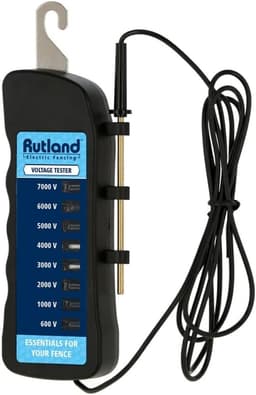
A neon or an LED bar shows a band. The Rutland Essentials tester, Kerbl 428173, is the best value here: eight lights at about £14.72 and 4.5 from 240 ratings, and the listing never states the kilovolt each light means. The M MINGYA eight-lamp neon at about £15.99 prints 600 V to 7 kV. The Honiwu eight-neon at about £11.39 states 600–7,000 V, and the earth method is unstated. Above 7 kV the last lamp is the whole answer, so 8 kV and 12 kV look alike. The Hotline 47KV10 is the top pick in the same step family: 1 kV increments to 10 kV, no earth stake, about £27.99, and 4.5 from 497 ratings. It is still not a digital meter. Sun is the neon's usual failure. Rutland reviews say you shade the lamps. The Mingya 7 kV neon draws the same complaint. Hotline comments split: several reviewers read the LEDs in sun, and some cannot.

What the LCD adds

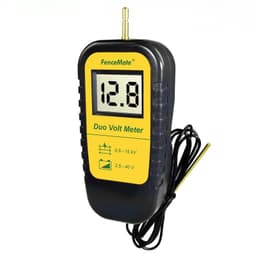
A digital fence voltmeter prints a number you can compare with last week. FenceMate's SX-01, at about £29.99, is listed up to 15,500 V, at 3.8 from 16 ratings. The cell arrived low, and an earth-wire fixing broke within two days. Use 15.5 kV as the listed top. The SX-03-UK, at about £35.99, is the duo: 0.5–15 kV on the fence and 2.5–40 V on a battery, 4.7 from 20 ratings. That second range checks a 12 V leisure battery. One reviewer supplied a ground pin. Agri-Supply's within-100 V line was not measured on either FenceMate in this file.

Earth probe versus no probe

The display and the earth method come bundled, and they are different jobs. A neon with a spike, such as the Rutland, can sit on the wire, on the energiser terminals and on the earth stake. A shaded Rutland can attempt Gallagher's stake check: short the fence about 100 m out until it is under 1.0 kV, then expect the stake under 0.3 kV. You still see lights, not 0.3 kV as a digit. A self-earthing LED cannot replace the spike. The Hotline is faster between posts, and it has no probe for the stake. Do not use it to sign off the earth. The FenceMate duo uses a lead, so it can show the number on that same check. One SX-03 reviewer had to supply the pin.

Which to buy

Buy lamps when a coarse band will change what you do and you can shade the window. The Rutland at about £14.72 is the lamp with a long record and a spike in the box. The Hotline LED is steps to 10 kV with no stake, the largest sample, and still not a number. Skip it for thick tape and for the earth-stake test. Buy digits when you will compare the far end each week. The SX-03-UK is the conditional pick if you accept a 9 V cell, 20 ratings and the chance you supply a pin. The SX-01 at about £29.99 is the fallback when you do not need the battery-voltage range. Leave arrows and beepers off this fork. Price bands are on the fence tester buying guide.

Common questions

Why can't I see the neon in the sun?
Neon flashes faintly in bright daylight. Rutland reviews say you shade the window, and the Mingya 7 kV neon draws the same complaint, including a return. An LED bar or an LCD avoids that flash. Several Hotline reviewers read their LEDs in sun, and some still cannot, so a hand over the display stays useful.
Is an LED bar a digital meter?
The Hotline 47KV10 shows 1 kV steps to 10 kV. That is a band of lights, with a stated step the Rutland listing does not give. A digital meter prints a figure, such as 0.5–15 kV or up to 15,500 V on the FenceMate models. Expecting a digit from the Hotline will disappoint you on the first reading.
Do digital testers need batteries?
Both FenceMate LCDs use a 9 V cell, listed as included. On the SX-01 that cell arrived low and the screen warned of a low battery. The Rutland and Mingya 7 kV neons are the probes that do not ask you to add a battery. The Hotline includes coin cells, and those sometimes arrive flat as well.
Can a neon test the earth system?
A neon with a soil spike can go on the earth stake and on the energiser terminals. The Rutland includes that spike. You see lights, and the kilovolt per light is unstated, so Gallagher's under 0.3 kV is hard to confirm on that window. A self-earthing LED has no spike. A digital with an earth lead can show the number if the lead is in the box.
Is digital always more accurate?
A digit is easier to compare week to week. It is not a calibrated certificate. Agri-Supply's within-100 V line is not evidence for these FenceMate meters. One Hotline user estimates about 1 kV of over-read on an LED bar, which is one person. Use the digit to spot change, and keep any pass mark tied to the page that published it.
Which is better on tape?
A narrow fob is the awkward contact. Hotline reviews say the body is narrow for ribbon or thick tape. A hook or a hanging probe, such as the Rutland or the Mingya neon, grabs tape more easily, then you shade the neon. A FenceMate lead can touch the tape and still show digits, if the earth side is connected. If that LCD stays blank on a fresh 9 V cell, check the same wire with a shaded neon before you replace the energiser.

Related pages

Sources

Public UK sources listed in the research digest. Listing prices, stars and review counts are the amazon.co.uk figures stored with these ASINs, not a live re-check on 19 October 2026.

  1. Forest Research fencing guide (retrieved 19 October 2026)
  2. Professional Electrician — electric fence controllers (retrieved 19 October 2026)
  3. Gallagher — measure voltage (retrieved 19 October 2026)
  4. Gallagher — check your earthing (retrieved 19 October 2026)
  5. Hotline catalogue 2023 (retrieved 19 October 2026)
  6. Electric Fencing Direct — electric fencing tester (retrieved 19 October 2026)
  7. Code of recommendations for the welfare of livestock: sheep (retrieved 19 October 2026)
  8. amazon.co.uk listings for the eleven ASINs in this comparison (retrieved 19 October 2026)