Independent comparisons. We may earn from shop links. More info

How to test an electric fence

Updated: October 2026

You already own a tester, and so far you have only held it beside the energiser. That spot can look healthy while the far end of a horse tape or a sheep net has collapsed. How to test an electric fence is a fixed order: the unit with the fence off, then the lead-out, then the far end. The [fence tester comparison](/hub/fencing-and-wire/fence-tester) is where the tools differ. This page stops when the reading is low. Peter F. noted the sources on 19 October 2026. Each pass mark below keeps the name of the UK page that published it. This is not a lab test. A qualifying amazon.co.uk link can earn a commission at no extra cost to you.

You already own a tester, and so far you have only held it beside the energiser. That spot can look healthy while the far end of a horse tape or a sheep net has collapsed.

Our top picks

On this page

Before you touch the wire

Use a fence tester, not a household multimeter and not a blade of grass. Electric Fencing Direct makes both points: an ordinary voltmeter is the wrong instrument for the pulse, and a tingle through grass only shows that some energy is there. AHDB's cattle and sheep setup page is the safety frame. Fit warning signs at every 50 m or less on a path. Do not electrify barbed wire. Use one energiser. Do not earth the system to a power pole, and do not run the live wire parallel to overhead lines. If the unit is burnt, cracked or lightning-struck, stop. ShockRite says contact the supplier and do not open the case. A 230 V mains install, a fence near overhead lines, or stock caught in the wire needs a competent person. A self-earthing LED such as the Hotline 47KV10 does not sit across two energiser terminals. Which family you bought is on the fence tester buying guide.

Read the energiser with the fence off

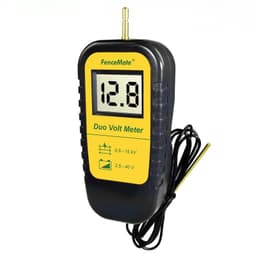
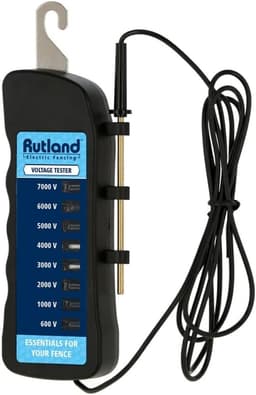
Turn the energiser off. Disconnect the fence lead and the earth lead so nothing is attached. Turn it on. Put the live contact on the fence terminal and the earth probe on the earth terminal. Gallagher's Check page treats higher than 6,000 V on open terminals as healthy. Another Gallagher page treats lower than 6.5 kV as a reason to repair. The ShockRite manual uses under 4,000 V between the terminals as a failed unit. Write down the page you follow. A Hotline bar cannot bridge two terminals the way a probe can. Use a spiked neon, such as the Rutland Essentials tester, or a FenceMate SX-01 or SX-03-UK for this step. If the open-terminal reading already fails your chosen threshold, contact the supplier rather than buying a larger energiser. If the reading is healthy, switch off, reconnect both leads, and only then walk the fence.

Read the lead-out and the far end

With the fence connected, read at the energiser end of the lead-out, then on the first live wire, then at the far end. The open-terminal figure is your reference. A sharp drop in the first few metres usually means the lead-out or the joint onto the fence. Electric Fence Online treats a far end more than 1.5 kV below the energiser as a prompt to check the earth. That 1.5 kV drop is their rule, not Gallagher's animal minimum. On the fence, keep the animal figures separate. Gallagher's UK page says at least 3.5 kV to keep animals in and 4.5 kV against wild animals. Switch the power off before you retie or lift a wire. If the number is low, go to fence tester fault finding rather than turning the energiser up.

How often, and what a beeper is for

Gallagher's UK maintenance advice, as used here, is a check about once a week, and again after a storm, after you move a strip fence, or when stock nose the tape. The FenceMate SX-03-UK prints a digit you can store, from 0.5 kV to 15 kV. The M MINGYA beepers list no kilovolt scale. Hotline's catalogue treats a beep as presence. Do not leave a deliberate short on the fence.

Common questions

Where do I put the probe?
For a fence reading, the live contact goes on the conductor and the earth probe goes into moist soil, or onto the earth terminal when you are testing the unit alone. A self-earthing fob only needs the live contact, and it cannot do the terminal test. Dry, stony ground makes a soil reading worse, which Forest Research and Gallagher's dry-weather notes both describe.
Should the fence be connected when I test the energiser?
Disconnect both leads, then switch on. Electric Fence Online, Gallagher's Check page and ShockRite all read the unit with the fence off. A reading with a weedy fence still attached mixes the unit, the earth and the line. Reconnect both leads before you walk to the far end.
What reading means the energiser is alive?
Name the page. Gallagher's Check page says higher than 6 kV on open terminals. Another Gallagher page flags lower than 6.5 kV. ShockRite's troubleshooting looks for well over 5,000 V, and the ShockRite manual treats under 4,000 V between terminals as a failed unit. Pick one source. Do not average them.
Why test the far end?
The energiser can be healthy while the last bay is not. Joints, grass and a poor earth show up as a drop you miss beside the unit. Electric Fence Online uses a fall of more than 1.5 kV from the energiser to the far end as the prompt to check the earth. Separating earth from a short is the next job, once this reading is low.
How often should I test?
Use a weekly habit from Gallagher's UK maintenance advice, plus a check after storms, after you move the fence, and when animals test the wire. Write the far-end figure down if the meter shows digits. Shaded lights are enough for a coarse glance if you shade them the same way each time.
Can I use a multimeter?
A household multimeter is the wrong instrument for an energiser pulse. Electric Fencing Direct says the same of an ordinary voltmeter. HSE GS38 is for electrical installations, not paddock pulses. Use a fence tester whose scale covers the kilovolts your energiser produces.
When do I stop and call someone?
Stop if the energiser is burnt, cracked or lightning-damaged, and do not open the case. ShockRite says contact the supplier. Also stop for a 230 V mains install, a fence near overhead lines, or animals caught in the wire. A beeper cannot make any of those decisions, because it has no kilovolt scale.

Related pages

Sources

Public UK sources listed in the research digest. Listing prices, stars and review counts are the amazon.co.uk figures stored with these ASINs, not a live re-check on 19 October 2026.

  1. Forest Research fencing guide (retrieved 19 October 2026)
  2. Professional Electrician — electric fence controllers (retrieved 19 October 2026)
  3. Gallagher — measure voltage (retrieved 19 October 2026)
  4. Gallagher — check your earthing (retrieved 19 October 2026)
  5. Hotline catalogue 2023 (retrieved 19 October 2026)
  6. Electric Fencing Direct — electric fencing tester (retrieved 19 October 2026)
  7. Code of recommendations for the welfare of livestock: sheep (retrieved 19 October 2026)
  8. amazon.co.uk listings for the eleven ASINs in this comparison (retrieved 19 October 2026)