Independent comparisons. We may earn from shop links. More info

Electric fence fault finder

Updated: October 2026

The fence is on, you can feel a pulse at the energiser, and the horses or the sheep are walking through it. An electric fence fault finder job starts from that low reading. You separate the energiser, the earth and the line before you buy a bigger unit. The [fence tester comparison](/hub/fencing-and-wire/fence-tester) shows which listings have an arrow. Peter F. noted the sources on 19 October 2026. Every limit below names its publisher. ShockRite's line that up to 80% of faults are about the earth is their wording, not a UK statistic. This is not a lab test. A qualifying amazon.co.uk purchase can earn a commission at no extra cost to you.

The fence is on, you can feel a pulse at the energiser, and the horses or the sheep are walking through it. An electric fence fault finder job starts from that low reading.

Our top picks

On this page

Confirm it is not the energiser

Repeat the disconnected-terminal test before you walk the tape. The first readings are on the how to test an electric fence page. Switch off, remove both leads, switch on, and read between the fence terminal and the earth terminal with a probe meter. Rappa wants over 5,000 V on a disconnected unit. Gallagher's Check page wants higher than 6 kV. The ShockRite manual treats under 4,000 V between terminals as the unit. If you fail the page you chose, stop and contact the supplier. Do not hang a second energiser on the same fence. The Hotline 47KV10 has no earth lead. Use a spiked neon or a FenceMate SX-01 or SX-03-UK. Which to buy is on the best fence tester page.

Test the earth

Gallagher's UK earthing page is the check most often quoted. About 100 m out, short the live fence until a tester on the fence reads under 1.0 kV. Then read the earth stake. Gallagher expects under 0.3 kV. Rappa shorts at least 20 m out and treats more than 500 V on the last stake as a reason to add stakes. The ShockRite manual aims for 200 V or below on the earth. Quote one method. Do not blend 0.3 kV, 500 V and 200 V into one pass mark. A self-earthing fob cannot sit on the stake. Remove the short when you finish. If the stake passes the limit you chose, the leak is on the line.

Walk the line with volts

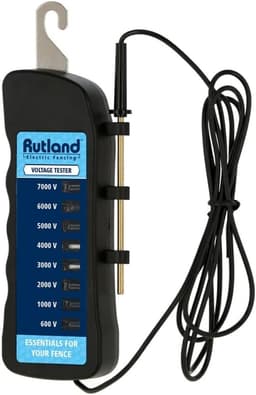
Most testers in this set have no arrow. Start at the energiser end and read at gates, joins and anywhere the voltage falls. A sudden drop between two posts usually means that bay: vegetation, a broken insulator, a tail of polywire, or a gate left unhooked. Farmers Weekly says look about every 100 m and at junctions, and switch off before a repair. The Rutland neon shows a short as fewer lamps, and you shade it in sun. The Hotline LED shows 1 kV steps without a stake. With the power off, lift grass off the lower wire, then read again. If the voltage returns, you have found it.

Walk with current and an arrow

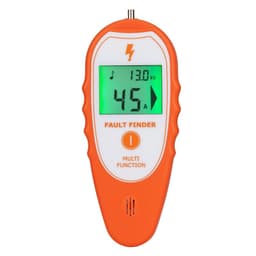
Farmers Weekly says follow amps once you are hunting a leak, with a rule of thumb of about 2.5 A per kilometre, and they say normal varies. Treat 2.5 A/km as their rule of thumb, not a British Standard. In this set, only the M MINGYA backlit unit at about £69.99 claims voltage, current and direction. It has five ratings. Fieldmate's FMFF-01 at about £34.99 claims directional LEDs. It does not state current, so it is not an amp meter. The bullets say 0–10 kV and the spec line says 10 volts. Switch off before you cut vegetation. When an arrow is worth paying for is on the fence tester buying guide.

Common questions

Why is the fence on but the animals ignore it?
The energiser can click while the far end is under the voltage the stock respect. Gallagher uses at least 3.5 kV to keep animals in and 4.5 kV against wild animals. AHDB's training bands for cattle and sheep are separate and often higher. Weeds, a poor earth and a joint all produce an on-but-ignored fence. Confirm the unit on open terminals before you buy a larger one.
How do I test the earth stake?
Use a soil-referenced tester. On Gallagher's page, short the fence about 100 m out until the fence reads under 1.0 kV, then look for under 0.3 kV on the stake. Rappa shorts at least 20 m out and looks at 500 V on the last stake. Take the short off afterwards. A self-earthing pocket LED cannot do this.
What voltage on the earth stake is too high?
Gallagher says under 0.3 kV after the fence is under 1.0 kV. Rappa treats more than 500 V on the last stake as too high. The ShockRite manual aims for 200 V or below. Pick one published method. Do not average the three figures.
How does an arrow find a short?
On a meter that shows current direction, you walk the live wire and the arrow points toward the leak. Rappa says the current falls once you have passed the fault. Farmers Weekly prefers amps for that walk and offers about 2.5 A per kilometre as a rule of thumb that varies. An LED bar with no arrow cannot do this. You walk volts instead.
Can I find a fault with only a voltmeter?
Yes, on a line you can walk. Read at the start, at gates and joints, and where the number falls. A drop inside one bay is the usual short. Both FenceMate LCDs are voltmeters without an arrow, and they still show a fall that eight lamps only suggest. You re-earth a probe meter as you move.
What if there is no arrow on my tester?
Walk the volts. The Rutland neon, the Hotline LED and both FenceMate meters claim no direction. Find the bay where the lights or the digits fall, switch off, and clear that bay. Arrows earn their keep on a long or weedy line, and the two arrow listings here have five reviews each.
When is it the energiser, not the weeds?
It is the energiser when the open-terminal test fails the page you are using: under Rappa's 5,000 V, under Gallagher's 6 kV, or under the ShockRite manual's 4,000 V. It is weeds or earth when that test passes and the fence sags after you reconnect. Test every live wire, not only the top tape, because a lower wire in grass can leak while the top still reads. Burnt or lightning-hit units go to a repairer even if a number is still on the screen.

Related pages

Sources

Public UK sources listed in the research digest. Listing prices, stars and review counts are the amazon.co.uk figures stored with these ASINs, not a live re-check on 19 October 2026.

  1. Forest Research fencing guide (retrieved 19 October 2026)
  2. Professional Electrician — electric fence controllers (retrieved 19 October 2026)
  3. Gallagher — measure voltage (retrieved 19 October 2026)
  4. Gallagher — check your earthing (retrieved 19 October 2026)
  5. Hotline catalogue 2023 (retrieved 19 October 2026)
  6. Electric Fencing Direct — electric fencing tester (retrieved 19 October 2026)
  7. Code of recommendations for the welfare of livestock: sheep (retrieved 19 October 2026)
  8. amazon.co.uk listings for the eleven ASINs in this comparison (retrieved 19 October 2026)