Independent comparisons. We may earn from shop links. More info

Electric fence tester buying guide

Updated: October 2026

You are buying a first tester for horse tape or a sheep net, or you are dropping a grass-stem check that only says the wire is live. An electric fence tester buying guide matches the tool to the reading you will act on: a beep, a band of lights, a number, or a number with a direction. The [fence tester comparison](/hub/fencing-and-wire/fence-tester) holds the eleven amazon.co.uk listings, their shelf prices and their star lines. Prices are the stored figures noted by Peter F. on 19 October 2026. A qualifying amazon.co.uk purchase can earn a commission at no extra cost to you. This is not a lab test.

You are buying a first tester for horse tape or a sheep net, or you are dropping a grass-stem check that only says the wire is live.

Our top picks

On this page

What you are measuring

A fence tester reads the short pulse on the live conductor. Electric Fencing Direct treats an ordinary voltmeter as the wrong tool, and a household multimeter is the same mistake. Professional Electrician summarises BS EN 60335-2-76 as the energiser limit: about one pulse a second, about 10 ms wide, and 5.0 J in a 500 ohm load. That standard describes the controller. It does not certify any tester here. A CE or IEC 61010-1 line on a listing stays a seller claim.

Five tester families

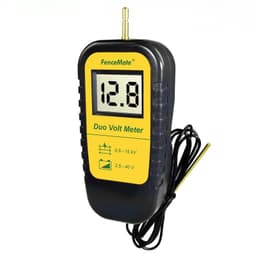
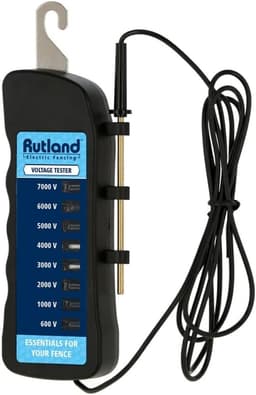
A proximity beeper, the two M MINGYA units at about £9.99 and about £10.99, lists no kilovolt scale. The switched one has a single review that found a battery the bullets say is not required. A neon uses lamps and a spike. The Rutland Essentials unit, Kerbl 428173, is the best value at about £14.72, with eight lights, a ground spike. The kilovolt per light is not stated. The M MINGYA eight-lamp neon is about £15.99 and states 600 V to 7 kV. An LED bar steps in coarse kilovolts. The top pick, the Hotline 47KV10, is about £27.99, with 1 kV steps to 10 kV, no earth stake, and 4.5 from 497 ratings. A self-earthing fob cannot run Gallagher's earth-stake test. A digital prints a number. The SX-03-UK is about £35.99, 0.5–15 kV on the fence and 2.5–40 V on a battery, at 4.7 from 20 ratings. The SX-01 is listed to 15,500 V. A fault finder adds an arrow, and sometimes current. Fieldmate's FMFF-01 at about £34.99 and the M MINGYA unit at about £69.99 both sit on five ratings, and Fieldmate's file says both 0–10 kV and 10 volts. Named skips are on the best fence tester page.

Which voltage number to use

There is no single UK pass mark. AHDB, Gallagher, Electric Fencing Direct and Forest Research do not publish the same stock voltage. Open-terminal checks disagree too. Gallagher's Check page wants higher than 6 kV. Another Gallagher page treats lower than 6.5 kV as a repair. ShockRite's troubleshooting page looks for well over 5,000 V with the fence off, and the ShockRite manual uses under 4,000 V between terminals as a failed unit. Write down which page you followed.

Earth, daylight and the top of the scale

A soil probe or an earth lead can sit on the live wire, on disconnected energiser terminals and on the earth stake. Gallagher's UK earthing page shorts the fence about 100 m out until it reads under 1.0 kV, then expects the stake under 0.3 kV. The Hotline 47KV10 cannot do that stake test. Rappa shorts at least 20 m out and treats more than 500 V on the last stake as a reason to add stakes. Name the source when you quote a threshold. Probe placement is on the how to test an electric fence page. The Hotline stops at 10 kV. The FenceMate digitals are listed to 15 kV or 15.5 kV.

What this set costs

Entry rows run about £9.99 to about £15.99. Only the Rutland has hundreds of ratings. Mid rows run about £27.99 to about £35.99. The Mingya digital at about £69.99 is the top of this set, on five ratings. Pasturetec's Gallagher finder at about £119 including VAT sits outside these ASINs. Pay the extra when you will log a drop, check a 12 V battery or walk toward a short. Batteries and daylight are on the neon versus digital fence tester page.

Common questions

Do I need a tester if I can feel the fence?
A shock shows that a pulse reached your hand at that spot. It leaves the far-end kilovolts unknown, and it mixes a weak earth with grass on the wire. Electric Fencing Direct treats a grass test as the wrong check. Read the fence with a tester before you decide the energiser is too small.
What voltage should cattle or sheep see in the UK?
Name the page you use. AHDB gives untrained cattle or calves about 4,500–5,500 V, trained cattle about 3,500–4,500 V, and sheep about 5,000 V in training then about 3,000–4,000 V. Gallagher says at least 3.5 kV to keep animals in and 4.5 kV against wild animals. Those bands are not one legal minimum.
Is a beeper enough?
A beeper answers presence. Hotline's catalogue does not treat it as a fault finder, and neither M MINGYA beeper lists a kilovolt scale. It is enough when you only need to know a garden wire is live. It is the wrong buy when sheep are pushing a net and you need to see a drop.
When do I need a soil probe?
You need a soil probe or an earth lead to test energiser terminals or the earth stake. Gallagher's check, under 0.3 kV on the stake after the fence is under 1.0 kV, needs a soil reference. A self-earthing fob is faster on the live wire and cannot finish that test.
Will a 7 kV neon read a 10 kV energiser?
It shows that the pulse is above the top lamp. The Mingya and Honiwu neons are listed to 7 kV, so 8 kV and 12 kV look the same. A Hotline bar to 10 kV, or a FenceMate LCD listed to 15 kV or 15.5 kV, still has marks above 7 kV.
Does a tester have to meet the energiser standard?
BS EN 60335-2-76, in the Professional Electrician summary, limits the energiser: about one pulse a second, about 10 ms, and 5.0 J at 500 ohms. These testers are not claimed here against that standard. CE, waterproof or IEC 61010-1 on a listing is seller text unless you hold the certificate. The sheep code expects momentary discomfort only, and electric mesh is unsuitable for horned sheep. A tester does not change that welfare rule.

Related pages

Sources

Public UK sources listed in the research digest. Listing prices, stars and review counts are the amazon.co.uk figures stored with these ASINs, not a live re-check on 19 October 2026.

  1. Forest Research fencing guide (retrieved 19 October 2026)
  2. Professional Electrician — electric fence controllers (retrieved 19 October 2026)
  3. Gallagher — measure voltage (retrieved 19 October 2026)
  4. Gallagher — check your earthing (retrieved 19 October 2026)
  5. Hotline catalogue 2023 (retrieved 19 October 2026)
  6. Electric Fencing Direct — electric fencing tester (retrieved 19 October 2026)
  7. Code of recommendations for the welfare of livestock: sheep (retrieved 19 October 2026)
  8. amazon.co.uk listings for the eleven ASINs in this comparison (retrieved 19 October 2026)