


One indoor room
You want a screen and phone alerts for a nursery, a bedroom, or one damp room, and you do not want another box on the router. You will still check a baby yourself. A sensor can show about 16°C to 20°C. It is not a safer-sleep device.
The best Wi-Fi thermometers, compared.
Top pick: Govee H5179 – One indoor LCD sensor at about £23.99, 4.4 from 1,130 reviews, and a stated ±0.3°C and ±3% RH, with no hub. Best value: QXMH TH02 Pro – About £15.99 with a stated ±1°C and ±5% RH and 4.1 from 504 reviews, ahead of the cheaper listing that states no tolerance. Updated October 2026.


A Wi-Fi thermometer on amazon.co.uk is usually a thermo-hygrometer that sends temperature and humidity to a phone app, for a nursery, a damp room, a greenhouse, a shed, or several rooms while you are out. A sensor can join 2.4 GHz on its own, sit behind a base station, or add. Where a listing states a band, it is 2.4 GHz only. The accuracy line is a manufacturer claim, not a certificate. It does not keep a baby safe, and a humidity percentage does not diagnose damp. If you also need wind and rain, that is a [Wi-Fi weather station](/hub/climate-measuring/wifi-weather-station), not a room sensor. Three other files were set aside because they were not this product: a probe, an infrared gun, and a sensor. Direct Wi-Fi is one router client per sensor and no extra box.
A Wi-Fi thermometer on amazon.co.uk is usually a thermo-hygrometer that sends temperature and humidity to a phone app, for a nursery, a damp room, a greenhouse, a shed, or several rooms while you are out.
Swipe for more
1-2 of 9


Personal buying guide
Question 1 of 2
How many rooms do you need on Wi-Fi?
The Govee H5179 is one indoor LCD sensor on 2.4 GHz Wi-Fi and Bluetooth at about £23.99, and the listing claims ±0.3°C and ±3% RH. It is the largest United Kingdom sample in this set, at 4.4 from 1,130 reviews, and the first 50 in the file are marked United Kingdom. Owners use it for rooms, a shed, a nursery, and a fridge, with 20 days visible online, an export claimed for up to two years in Govee Home, and three AA cells in the box. Full settings can disappear unless the phone is in Bluetooth range, two units in one airtight box disagreed, and one buyer reported five of eight units failing to send data. A battery change fixed one unit after eight weeks, dead cells arrived in a new pack, and the attribute upper limit is 100°F while the bullet says −20°C to 60°C. It can show a nursery figure, and it is not a safer-sleep device. In this comparison it is the top pick for one indoor room with a screen and phone alerts, not a lab winner.
Pros
Cons
Best for: One indoor room with a screen, phone alerts, and no extra hub to plug in.
Less suitable: A stated greenhouse rating, four rooms on one Wi-Fi client, or a buyer who will not use Govee Home.
Specifications
Common questions
Does the Govee H5179 need a hub?
No. It is one sensor on 2.4 GHz Wi-Fi and Bluetooth. The listing says 5 GHz is not the supported band.
What is on the screen?
The attribute table lists an LCD. The listing also states a refresh every 2 seconds and a resolution of 0.1 degree.
Are batteries included?
Yes. The listing says 3 AA alkaline batteries are required and included, plus a lanyard and a user manual.
The Govee H5179 2-pack is two of the same LCD gauges at about £42.99, with six AA cells and two lanyards and no hub, and each gauge is its own 2.4 GHz and Bluetooth client. The listing claims ±0.3°C and ±3% RH and says 5 GHz is not supported. The star line is 4.4 from 1,130, and the 50 review titles in this file match the single-unit file in the same order, so this is not a second sample of 1,130 reviews. This listing also says the alert function only supports Bluetooth settings. You pay a bit under twice the single price of about £23.99, which suits two indoor rooms on two screens, and you do not get a shared Wi-Fi client. The copied review themes still apply: units that stop updating, dead cells in a new pack, and humidity that differs between two units in one box.
Pros
Cons
Best for: Two indoor rooms when you want two screens and you already accept the single H5179's limits.
Less suitable: A buyer counting 1,130 as proof of the pack itself, or a house that needs one Wi-Fi client for several sensors.
Specifications
Common questions
How many sensors are in the Govee H5179 2-pack?
Two gauges, two lanyards, one manual, and 6 AA batteries. There is no hub in the box.
Does this listing support 5 GHz Wi-Fi?
No. The bullet says 5G Wi-Fi is not supported. A range in metres is not stated on this listing.
Where are the alert settings made?
The bullet says the alert function only supports Bluetooth settings. The app is Govee Home.
The GoveeLife H5151 is three sensors plus a Wi-Fi and Bluetooth gateway at about £37.98, and the gateway is the client that joins the router. The listing states ±0.3°C and 0% to 99% RH without a ± humidity figure, and a bullet says the gateway can pair up to 10 sensors. Among 115 reviews at 4.4 stars, the first 50 in the file are marked United Kingdom, and owners like the small sensors for a ceiling void after a leak and for garden checks. A UK review says the extra sensors for that up-to-10 line were not on sale in the UK at that time. Gateways that will not join, or that stop joining after about two years, block the remote view, and sensors can vanish overnight. CSV export goes out by Govee email, reviews say there is no public API for Home Assistant, and the battery attribute says no batteries are required without saying which part.
Pros
Cons
Best for: Three rooms from one Wi-Fi client, if you are content to stay inside Govee Home.
Less suitable: One room with a screen on the sensor, or a plan to add sensors later without buying another kit.
Specifications
Common questions
Does a GoveeLife H5151 sensor join the router on its own?
No. The listing describes three sensors plus a Wi-Fi and Bluetooth gateway. The gateway is the Wi-Fi client.
How many extra sensors does the listing allow?
The bullet says the gateway can pair up to 10 sensors. A UK review says extra sensors were not on sale in the UK at that time.
Is a humidity accuracy figure stated?
No. The listing states 0% to 99% RH and does not state a ± humidity accuracy. Temperature accuracy is listed as ±0.3°C.
The AEGISLINK ATHZ31 sends readings through a base station at about £42.49, and the bullet says it cannot be used alone. All 28 reviews in the file are marked United Kingdom, at 4.4 stars, and those reviews describe three remote sensors plus a base while the attribute table's item count is 1. The app shows temperature, humidity, dew point, and VPD, with history up to a year and email export at no charge, and no accuracy figure is stated. Owners use the kit for a loft, a garage, a nursery, and a patio, and one says an Alexa voice query worked, though finding that link is not obvious. The base plug is criticised as too wide or as blocking the socket, one unit would not switch on, and Smart Life did not connect for one owner. A Home Assistant firmware update failed in the same review set.
Pros
Cons
Best for: Several rooms, if the opened box matches the three-sensor reviews and the plug fits your socket.
Less suitable: A sensor you hoped to use on its own, or a buyer who needs a printed ± accuracy line.
Specifications
Common questions
Can the AEGISLINK ATHZ31 be used without the base?
No. The bullet says it cannot be used alone. Wi-Fi is through the base station.
What readings does the app show?
The listing names temperature, humidity, dew point, and VPD. No temperature or humidity accuracy figure is stated.
How many sensors does the attribute table count?
Number of items and unit count are 1. Reviews of the opened box describe three remote sensors plus a base station.
The UbiBot GS1-AETH is a logger that joins 2.4 GHz Wi-Fi or Ethernet on its own at about £165.99, with a built-in sensor stated as −20°C to 60°C and 10% to 90% RH. The attribute field shows 0.5 with no ± sign and no unit, so it is not a ±0.5°C claim, and 5 GHz is not supported. The listing offers alerts by email, app, SMS, call, HTTP API, or IFTTT, plus PDF or CSV from a free cloud described as 200 MB or up to about two years. Of 75 reviews at 4.3 stars, none of the 23 in the file is marked United Kingdom, though owners who stayed with it mention greenhouse and lab use and no monthly fee. The same file is full of first-day trouble: a Wi-Fi scan that misses the SSID, Ethernet setup called unfriendly, registration that fails, and an internal battery that lasted under a week. An external probe is a different ASIN, B083JXBD7S, and it is not in this box. The 4.3 line is the amazon.co.uk listing, not a United Kingdom-only score.
Pros
Cons
Best for: A room that already has an Ethernet socket, where a web console and file export matter more than a UK review sample.
Less suitable: A first Wi-Fi sensor for one room, or anyone who expected a probe in this box.
Specifications
Common questions
Does the UbiBot GS1-AETH need a hub?
No. It joins 2.4 GHz Wi-Fi or an Ethernet cable on its own. 5 GHz Wi-Fi is not supported.
Is an external probe in the box?
No. The external probe is a separate ASIN, B083JXBD7S. This box lists a battery, not a probe.
Does it measure humidity?
Yes. The listing states 10% to 90% RH, with no condensation, on the built-in sensor.
The GoveeLife H5103 is one room sensor on 2.4 GHz Wi-Fi and Bluetooth, with an e-ink screen, at about £34.99, and the listing claims ±0.3°C and ±3% RH. Among 136 reviews at 4.2 stars, the 46 in the file are marked United Kingdom, and owners often praise a crisp screen you can read across the room without opening the phone. Graphs cover 13 days, with an export claimed for more than two years, while battery life in those reviews runs from about a week to many months against a bullet that says up to half a year. One unit died after an update at just under a year, and some owners found humidity 5–6 points low against a salt check, outside the stated ±3% RH. Settings and alerts can need Bluetooth nearby, and the sensor does not act as a Govee gateway. One review says Home Assistant is not a straightforward fit.
Pros
Cons
Best for: One room where you want a sun-readable screen and no extra box on the router.
Less suitable: Several rooms from one Wi-Fi client, or a Home Assistant install that expects a public API.
Specifications
Common questions
Does the GoveeLife H5103 need a hub?
No. It is one room sensor on 2.4 GHz Wi-Fi and Bluetooth. No hub is in the box.
What kind of screen does it have?
The listing describes a low-power ink screen, also called e-ink, and says it is readable in sunlight.
Does the listing claim humidity accuracy?
Yes. The listing states ±3% RH and ±0.3°C (±0.54°F).
The X-Sense STH55 puts four sensors behind one base station at about £46.95, and the amazon.co.uk listing states ±0.2°C within −20°C to 60°C and ±2% RH from 0% to 100% RH. Across 34 reviews at 4.2 stars, the 15 reviews in the file are marked United Kingdom, and several owners describe pairing in a few minutes for a cellar, bathroom, attic, holiday flat, or garage. The sensors do not join the router on their own, so an unplugged base stops the remote view, and one owner says the app will not show every sensor temperature side by side. Alexa is in the title, and the bullets do not describe a voice command. One UK review describes a USB supply that failed and tripped the house: that is a single report, not a rate, and a hot or failed adapter is a reason to stop. A spare battery pack arrived dead for one buyer, and another called the range poor against the open-air figure of about 500 m.
Pros
Cons
Best for: Several rooms from one Wi-Fi client, where the stated ±0.2°C line matters more than a local screen.
Less suitable: A single room with no spare socket, or a sensor you need to keep working if the base is unplugged.
Specifications
Common questions
Does the X-Sense STH55 need a base station?
Yes. Wi-Fi goes through the base station in the box. A sensor is not described as a standalone Wi-Fi client.
Does it measure humidity?
Yes. The listing states ±2% RH within 0% to 100% RH, and ±0.2°C within −20°C to 60°C.
Is Alexa described beyond the title?
Alexa is in the title. The bullets do not describe a voice command.
The QXMH TH02 Pro is one 2.4 GHz sensor for Smart Life at about £15.99, with a listing claim of ±1°C and ±5% RH from 1°C to 50°C, and no hub is named. Of 504 reviews at 4.1 stars, 20 of the first 50 in the file are marked United Kingdom, and those owners describe an easy Tuya or Smart Life setup, including one Home Assistant link that is a review rather than a listing promise. One UK buyer could not export the data, another returned a unit that read 1.5°C high with no calibration, and two identical units disagreed with each other. One review describes heat and a dead screen after a battery change, so stop using a unit that is too hot to hold. Voice can ask for a reading, and the bullet says the temperature is not shown in the Alexa app. The attribute says no batteries are required. In this comparison it is the best value: a stated accuracy line and 504 reviews at about £15.99. The ZenithCove is cheaper at about £10.99 and does not take that place, with 15 reviews and no stated accuracy line.
Pros
Cons
Best for: One indoor room on Smart Life, when about £15.99 matters more than a ±0.3°C claim.
Less suitable: A nursery figure you will treat as exact, or a greenhouse the listing does not name.
Specifications
Common questions
Does the QXMH TH02 Pro need a hub?
No hub is named. The listing says 2.4 GHz Wi-Fi, and the sensor is sold as one pack.
What does the listing say about Alexa?
Voice can ask for temperature and humidity. The bullet says the temperature is not displayed in the Alexa app.
What accuracy does the listing claim?
±1 degree Celsius and ±5% RH. The stated temperature range is 1°C to 50°C.
The ZenithCove WF001 is a small indoor sensor on 2.4 GHz Wi-Fi for Tuya Smart, Smart Life, Alexa, and Google Home, at about £10.99. The listing says it measures humidity and does not state a ± figure, the upper temperature on the attribute table is 50°C, and a lower limit is not stated. Fifteen reviews sit at 4.0 stars, seven of the 11 in the file are marked United Kingdom, and one owner found the temperature close to a room thermostat while tracing a damp bathroom. Another saw 65–70% RH when a side-by-side check read 50–52%. The app interval is described as 30 minutes and it reports only if the change is about 1°C or more, so the graph stays sparse and the history length is not stated. Alexa reports temperature and not humidity.
Pros
Cons
Best for: A low-cost Smart Life sensor for a rough indoor trend, if you already use that app.
Less suitable: Anyone who needs a stated ± line, a fine graph, or a humidity figure to compare with another meter.
Specifications
Common questions
Which apps does the ZenithCove WF001 name?
The listing names Tuya Smart, Smart Life, Amazon Alexa, and Google Home. No hub is named.
Is a humidity accuracy figure stated?
No. The listing says it measures humidity, and it does not give a ± RH figure.
What is the upper temperature on the listing?
The attribute table says 50 degrees Celsius. A lower limit is not stated.
We compared nine Wi-Fi thermometers on amazon.co.uk and used the published scores for this set. Prices, stars, and review counts are the UK listing lines. There was no lab test. A large United Kingdom review sample, a stated tolerance, a local screen, and a lower shelf price raised a score. A small review count, no accuracy figure, a sensor that stops updating, or a review file with no United Kingdom reviews lowered it. The five weights below sum to 100. They describe what moved the scores. They are not a point split reconstructed after the fact.
Architecture
25%Direct 2.4 GHz, a base station, a gateway, or Ethernet decides whether a sensor works on its own. A base-station sensor does not work if that box is unplugged.
Stated accuracy
20%A ± line is a manufacturer claim, not a certificate. A missing figure, or a 0.5 field with no unit, is not treated as a tested tolerance.
UK review evidence
20%Stars and counts are the amazon.co.uk lines. Only reviews marked United Kingdom count as UK opinion. The H5179 2-pack does not get a second copy of the 1,130-review file.
Screen, history, and alerts
20%A local screen still shows a reading when the app is down. Graph length, export, and the alert path are listing claims, checked against the review notes in the file.
Price and box contents
15%Shelf price, how many sensors are in the box, whether cells are included, and whether a mains plug seats in a UK socket. The cheapest row is not the best value when the review file is short and no accuracy line is stated.
Choose the architecture before the brand. A direct 2.4 GHz sensor, a base station, and an Ethernet logger answer different jobs, and a 5 GHz network will not finish setup. When each sensor should join the router, and when several sensors should sit behind one client, is the point of [direct Wi-Fi or a base station](/hub/climate-measuring/wifi-thermometer/sub/wifi-thermometer-direct-vs-base-station).
A Wi-Fi thermometer here is a thermo-hygrometer. It sends air temperature and relative humidity to a phone app, for a nursery, a damp room, a greenhouse, a shed, or several rooms while you are out. Three other files were set aside because they were not this product: a Zigbee probe, an infrared gun, and a Bluetooth-only sensor. Bluetooth-only is a different category. Direct Wi-Fi is one router client per sensor and no extra box.

Where these listings state a band, it is 2.4 GHz only. The H5179 2-pack says 5 GHz is not supported, and Govee UK says the same of its Wi-Fi thermo-hygrometer. A phone that stays online on 5 GHz can still leave the sensor unable to finish setup.
The AEGISLINK bullet says the sensor cannot be used alone. X-Sense sensors need the base station. If that box is unplugged, the remote view stops. A direct 2.4 GHz sensor is the one that joins the router by itself.
The H5179 2-pack shows 4.4 from 1,130, and the review titles in the file match the single-unit file in the same order. That is one sample, not proof of 1,130 reviews of the pair. The open-air 500 m line on the X-Sense will also shrink through walls and a steel shed.
Architecture is the first split. Direct 2.4 GHz means one router client per sensor and no hub: the Govee H5179, the GoveeLife H5103, the ZenithCove WF001, and the QXMH TH02 Pro. A base or gateway is one Wi-Fi client and several battery sensors. The X-Sense STH55 includes four sensors, a base, and an adapter. The AEGISLINK ATHZ31 bullet says the sensor cannot be used alone. The GoveeLife H5151 is three sensors plus a gateway the bullet says can take up to 10.
The accuracy line is a manufacturer claim, not a certificate. In these listings the X-Sense STH55 states ±0.2°C and ±2% RH. The H5179 and the H5103 state ±0.3°C and ±3% RH. The QXMH TH02 Pro states ±1°C and ±5% RH from 1°C to 50°C. The ZenithCove WF001 and the AEGISLINK ATHZ31 give no numeric accuracy in the bullets. The UbiBot attribute shows 0.5 with no ± sign and no unit, so it is not a ±0.5°C claim.
Three typical situations, each with a recommendation from this comparison.
You want a screen and phone alerts for a nursery, a bedroom, or one damp room, and you do not want another box on the router. You will still check a baby yourself. A sensor can show about 16°C to 20°C. It is not a safer-sleep device.
You want three rooms on one gateway and you are content to stay in Govee Home. The listing states ±0.3°C and does not state a humidity tolerance. If the ±0.2°C line matters more than the review count, the X-Sense STH55 is the four-sensor kit in this set.
You already use Smart Life and you want one indoor sensor with a stated tolerance. About £15.99 matters more here than a ±0.3°C claim. The wider line is ±1°C and ±5% RH. A greenhouse is not named on this listing.
Across these nine amazon.co.uk listings, the top pick for one indoor room with a screen and phone alerts is the Govee H5179: about £23.99, 4.4 from 1,130 reviews, an LCD, three AA cells, and a stated ±0.3°C and ±3% RH. UK reviews still include units that stop updating, and full settings can need Bluetooth. The best value is the QXMH TH02 Pro at about £15.99, with a stated ±1°C and ±5% RH and 4.1 from 504 reviews. The ZenithCove is cheaper at about £10.99 and does not take that place: 15 reviews and no stated accuracy line. A base-station kit such as the X-Sense STH55 is the route when four sensors should share one Wi-Fi client and the ±0.2°C line matters.
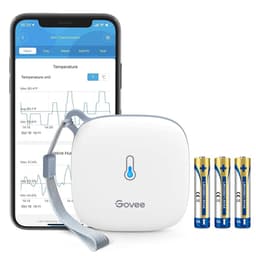
Govee H5179
One indoor LCD sensor at about £23.99, 4.4 from 1,130 reviews, and a stated ±0.3°C and ±3% RH, with no hub.
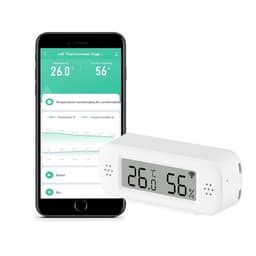
QXMH TH02 Pro
About £15.99 with a stated ±1°C and ±5% RH and 4.1 from 504 reviews, ahead of the cheaper listing that states no tolerance.
Editorial

Peter F. is the editor for DIY & tools at productscompared.co.uk. Comparisons in this category are checked against amazon.co.uk listings, review evidence and public UK sources.
Guides on what to look for, how to use a product, and common mistakes.
Public UK sources used for this comparison. Listing prices are the figures in this category's files on 15 October 2026.
Expert source (DIY & tools): Charlie White (Charlie DIYte) (external profile) – public expert commentary used as a research source, not as a contributor to our pages.
This page contains affiliate links to amazon.co.uk. If you buy through them, we may earn a commission at no extra cost to you. Prices, stars, and review counts are the UK listing lines. We did not run a lab test.