Weather station battery life: when to change cells
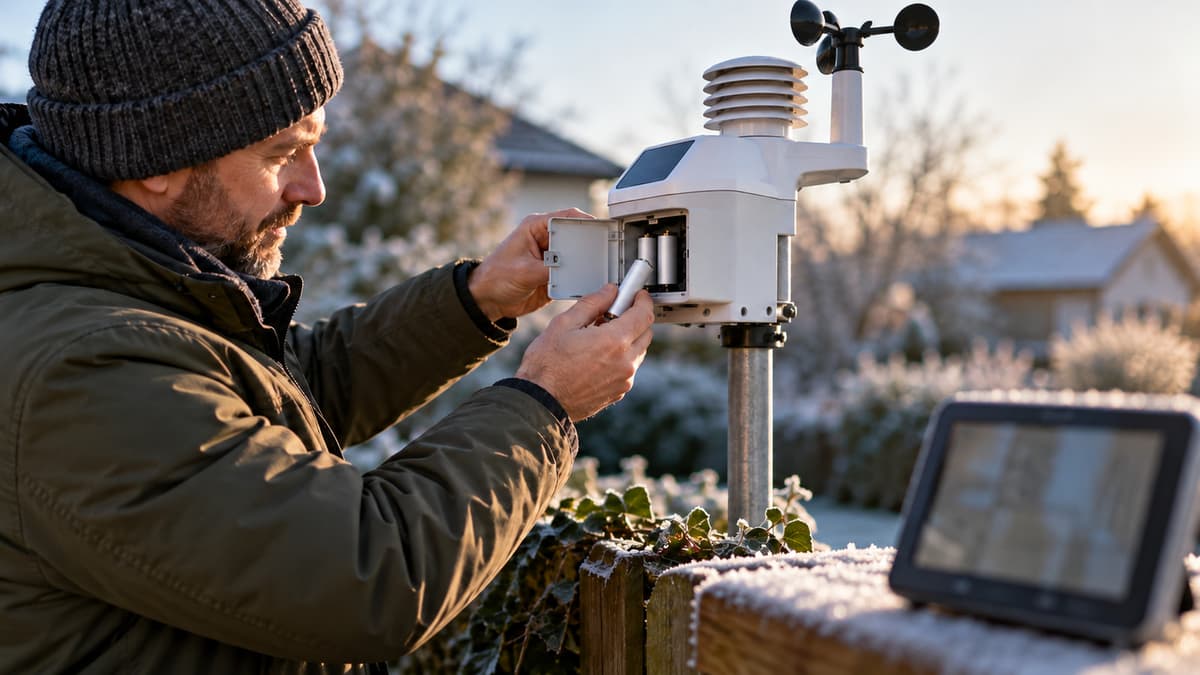
Weather station battery life is not one number. See when to change outdoor cells, why lithium suits frost, and why solar sensors still need backup power.
On this page

The outdoor temperature disappears on the first frosty morning, yet the console and Wi-Fi still work. That familiar failure makes weather station battery life look like a simple calendar problem, but it rarely is. Cell chemistry, the sensor's voltage requirement, winter temperatures and even the meaning of its solar panel determine whether a battery change fixes the reading.
A qualifying purchase can earn us a commission at no extra cost to you. The Ecowitt WS2910 is about £134.99, with 4.5 from 844 amazon.co.uk reviews on 15 October 2026. The style name is WS69. We did not laboratory-test battery life.
In short
Do not use one replacement interval for every weather station. Check the exact sensor manual, use the specified 1.5 V chemistry, replace a set together and consider lithium where the maker permits it for sustained cold. A solar panel may reduce battery use, but it commonly leaves the cells responsible for dark and overcast periods.
There is no single replacement interval
A battery can last months in one outdoor transmitter and roughly two years in another, so an annual change is a habit rather than a technical rule. Ecowitt's WS69 manual gives about two years as the expected battery life for that particular array. It does not establish a two-year promise for every compact thermometer, rain gauge or multi-sensor station.
Transmission every 16 seconds, a small display or a long radio path uses more than a sheltered probe that reports less often. One accessory family can take one AA, two AA or another arrangement, and a battery icon cannot show which. A low-battery warning, widening gaps, or a module that recovers only after warming are the useful signals.
Sound cells can stay in place when winter is only approaching. Compare stations on our Wi-Fi weather station guide if battery status, app alerts and history matter. A connected model still cannot fix the wrong cell voltage.
Check whether batteries are in the box
Battery powered does not mean batteries supplied. Ecowitt's WS69 documentation specifies two AA cells and says they are not included, and the WS2910 listing says the same. Netatmo's UK weather station page says batteries for its outdoor module are included. Those statements concern different products.
A package may power the console from a mains adaptor, include cells for one remote and omit the wind or rain module. The same maker can use AA in one accessory and AAA in another. Note size, number, chemistry, whether cells are included and which part uses them. Check the markings in a clean, dry compartment, and do not copy polarity from old cells that may already sit the wrong way.
For several remote points rather than a full array, our weather station with three outdoor sensors comparison shows how power arrangements vary. Some packages include the initial AAA cells and still need mains power for the indoor unit. Included cells say nothing about age or a future frost.
Choose alkaline or lithium for the weather
Fresh alkaline cells are the ordinary choice when a manual permits them. In a prolonged freeze, alkaline voltage can sag and the transmitter may stop, then look healthy after the cells warm. That recovery leaves a gap exactly when you wanted the cold reading.
Below a sustained 0°C, Greenfrog Scientific's setup guidance and the Ecowitt WS69 manual point towards lithium, which generally holds up better in the cold. Lithium is still not permission for every battery type or charging circuit. Replace the compartment as one matched set. Ecowitt warns against mixing old and new cells, because the weaker cell limits the pair.
Stop if you find swelling, leakage or corrosion. Lithium will not fix water in the cover or a radio path through foil-backed insulation and masonry. If the fault appears at only one mount, test the sensor closer to the console before blaming the cells.
Why rechargeable cells may not work
A rechargeable AA that fits is not always an electrical substitute. Common nickel-metal hydride cells are 1.2 V, while many outdoor modules expect 1.5 V alkaline or lithium. A pair starts about 0.6 V lower, close to the low-voltage threshold even when freshly charged.
Greenfrog Scientific warns of this mismatch. The Ecowitt WS69 instructions say not to use rechargeable batteries, and Netatmo does not support them for the relevant modules. Freshly charged is not the same as compatible. Failed transmissions and repeated pairing can erase any saving you hoped for.
Specialist 1.5 V rechargeables add their own regulation and charging questions. Unless the maker approves them, use the listed disposable chemistry, recycle spent cells at a collection point, and never charge disposable alkaline or lithium cells.
Solar still needs batteries
On the Ecowitt WS69, solar is the primary supply and two AA cells take over when recent light is inadequate. That backup matters in a British winter, when short days and cloud coincide with the weather you most want to record. A panel on the housing does not make the compartment optional.
Other designs only trickle-charge, or they support an internal pack the manufacturer specifies. You cannot tell which by looking at the panel. Fit the specified cells even if the array starts in bright sun without them, or it may vanish after dull days and look like a radio fault. Solar can extend life. It cannot revive a spent cell, and leakage can still damage the contacts.
What to do when a reading disappears
Check whether only the outdoor value has vanished, whether the sensor screen is visible, and whether the failure followed frost, heavy rain, a move or a battery warning. If indoor readings and the app are normal, the fault is in the remote module or its radio path.
- Read the module instructions for size, voltage and chemistry. Do not borrow another brand's reset.
- Bring the sensor within the recommended setup distance and inspect the cover, seal, contacts and polarity.
- Fit one matched set of approved fresh cells. Do not mix brands, ages or chemistries.
- Close the cover and wait for the documented reconnection period. Netatmo says a module can take about ten minutes to return.
- If pairing is required, follow that order. Some stations want the outdoor sensor powered before the console.
Leave the settings in place until you know whether power was the cause, and leave the new cells fitted for the full wait. Greenfrog Scientific notes that an outdoor LCD may fade at around −18°C and return when it warms. If the console still receives data, a pale local screen is not proof of flat cells. A bright local display does not guarantee voltage for radio bursts.
Make a practical before-winter check
On a dry autumn day, check that the mount is firm, the drainage path is clear and the cover closes evenly. Note the fitting date and compare the outdoor reading with a nearby reference after both have settled.
Keep one sealed matched spare indoors. If the manual allows lithium and the sensor sees sub-zero nights, buy that set before a forecast freeze, and keep loose cells away from metal. Change the set when you have a low-power alert, repeated dropouts, leakage or an age near the stated life. If the station is stable, record the date and watch it.
After a change, wait for the reconnection period and confirm that fresh outdoor values advance. If they do not, look at pairing, range, moisture or hardware before fitting another set.
Common questions
How can I tell whether cold or an empty battery caused the failure?
A dropout in a freeze that returns after warming points to alkaline voltage sag. Shorter runs and a low-battery warning point to depletion. Test with the approved chemistry near the receiver. If fresh cells still fail in mild weather, check pairing, contacts and moisture.
Is the most expensive battery automatically the best choice?
Size, voltage and permitted chemistry matter more than price. Lithium suits prolonged cold; alkaline can suit a sheltered sensor in ordinary UK weather. A premium cell will not fix water ingress, a poor radio path or corroded contacts.
Can I leave batteries out of a solar sensor in summer?
Only if the manual says the sensor can run that way. On the WS69 the AA cells are the backup when light is poor, so leaving them out removes that resilience. Fit the specified cells and inspect them.
Common questions
How long do outdoor weather station batteries last?
Why did my outdoor reading vanish during a cold snap?
Are weather station batteries included in the box?
Can I use rechargeable batteries in an outdoor weather sensor?
Does a solar weather station still need batteries?
Should I change outdoor sensor batteries before winter?
Does a faint outdoor LCD mean the batteries are dead?
How long should I wait after changing the batteries?

Peter F. is the editor for DIY & tools at productscompared.co.uk. Comparisons in this category are checked against amazon.co.uk listings, review evidence and public UK sources.
Related articles

What a home weather station costs in the UK
See what different levels of home weather monitoring cost and which features account for the price.

Where to put an outdoor thermometer
Choose a sheltered, representative position and avoid the common causes of distorted outdoor readings.

MSF or DCF77 on a weather station clock
Find out which radio time signal suits a UK weather station and what can interrupt reception.