


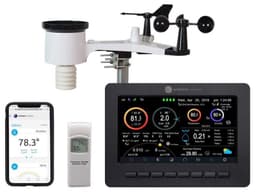


Garden rain and wind
You want rain and wind, you can mount a pole, and you want a colour screen on 868 MHz with WOW named. The WS2910 style name is WS69, while one attribute also says ultrasonic.
The best Wi-Fi weather stations, compared.
Top pick: Ecowitt GW3002 Best value: Ambient Weather WS-1965 – About £119.99 with rain, wind, a colour screen, and 537 reviews, if you accept the printed 915 MHz band. Updated October 2026.


A Wi-Fi weather station measures conditions at your home and can send them over your Wi-Fi. A forecast icon is not a rain gauge. Solar on the array still needs cells, and a mains adapter must suit 230 V and a BS 1363 plug. If you do not need an internet upload, compare a [weather station](/hub/climate-measuring/weather-station) as well. The garden radio is separate from that Wi-Fi link. Ecowitt says suffix A is 868 MHz, suffix B is 915 MHz, and suffix C is 433. Buy the band that matches the sensors you already own. A 915 MHz listing does not pair with 868 MHz UK add-ons.
A Wi-Fi weather station measures conditions at your home and can send them over your Wi-Fi. A forecast icon is not a rain gauge.
32 products checked · 61 hrs invested · +22,800 readers
Swipe for more
1-2 of 9


Personal buying guide
Question 1 of 2
What do you want it to measure?
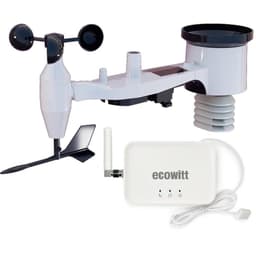
The Ecowitt GW3002 pairs a WS69 outdoor array with a GW3000 gateway for temperature, humidity, rain, wind, light and UV readings. Its gateway offers both Wi-Fi and Ethernet, and the listing gives a 16-second reporting interval. Reviewers also report Home Assistant use, making this a capable option when app or smart-home access matters more than a bedside-style console. The outdoor array uses solar power with two AA cells as backup, although those batteries are not included. There is no local display, so you must use the Ecowitt app, web page or another connected interface to read the data. The listing also undermines clarity by showing 0.06 Hz in its table beside an 868 MHz title. The shelf price is about £109.99. The bullets do not name WOW.
Pros
Cons
Best for: App-led or Home Assistant weather monitoring where Ethernet is useful
Less suitable: Anyone who wants an included local screen for at-a-glance readings
Specifications
Common questions
Is there a screen in the box?
No. The listing display type is no display. You read the gateway in the Ecowitt app, a web page, or, as reviewers report, Home Assistant.
What radio band is stated?
The product title says 868 MHz. The specification table also prints 0.06 Hz, which is not a radio band.
Are batteries included?
No. The bullets say the WS69 uses two AA batteries, not included, or the solar panel.
The Ecowitt WS2910 combines a colour LCD with a 7-in-1 outdoor array for rain, wind, temperature, humidity, light and UV. Its listing specifies 868 MHz and names Ecowitt, Weather Underground, WeatherCloud, WOW and a custom server for uploads. That mix gives you both immediate local readings and several routes for storing or sharing weather data. The 4.5-star rating from 844 reviews provides the strongest blend of rating and review depth among the 868 MHz options here. Its solar-assisted outdoor sensor still requires two AA cells, and batteries for both the sensor and optional console backup are not included. The listing also creates uncertainty by naming the WS69 style while a separate attribute describes the wind sensor as ultrasonic. In this comparison it is the top pick for a garden array with a screen on 868 MHz, not a laboratory winner. The shelf price is about £134.99.
Pros
Cons
Best for: UK garden weather monitoring with a local screen, 868 MHz radio and broad upload support
Less suitable: Buyers who require an unambiguous ultrasonic wind-sensor specification
Specifications
Common questions
Does the box include a rain gauge?
Yes. The bullets include a rain gauge with wind speed, wind direction, temperature, humidity, light, and UV.
Which frequency does the listing state?
868 MHz, alongside Wi-Fi. The style name is WS69. A separate attribute line says ultrasonic, which the bullets do not repeat.
Are batteries included?
No. The table says two AA batteries are required. The bullets also mention three AAA cells or DC power for the console.
The Ecowitt WS3901 uses ultrasonic wind measurement and a haptic rain sensor in its WS90 outdoor array. A 7.5-inch colour LCD gives you local readings, while Ecowitt, Weather Underground, WeatherCloud, WOW and a custom server cover online access. The array also measures temperature, humidity, light and UV, with indoor pressure added by the console. Its compact sensor approach avoids conventional wind cups and a tipping bucket, but rain measurement has a stated qualification. Ecowitt says some rainfall periods can deviate and suggests a separate WH40 when rain accuracy is critical. The heater only serves the ultrasonic surface and will not melt snow built up on the unit. At about £219.00 it is one of the costlier choices here.
Pros
Cons
Best for: Enthusiasts wanting ultrasonic wind sensing, a large screen and flexible data uploads
Less suitable: Users for whom tipping-bucket rainfall measurement or snow clearance is essential
Specifications
Common questions
How does this station measure rain?
The bullets describe a haptic rainfall sensor, not a tipping bucket. Ecowitt says the long-run daily total is close but some periods can deviate, and suggests a separate WH40 if rain accuracy is critical.
Does the heater clear snow?
The listing says the heater suits the ultrasonic surface only and will not melt snow built up on top of the unit.
Where can it upload?
The bullets name the Ecowitt cloud, Weather Underground, WeatherCloud, WOW, and a custom server.
The Ambient Weather WS-2000 covers wind, temperature, humidity, rainfall, UV and solar radiation, with readings shown on a TFT colour console. Its 4.4-star rating from 2,806 reviews gives it the deepest overall review history in this comparison. A 5 V adapter is included for the console, and the metal-listed construction distinguishes it from the mostly plastic alternatives. The listing specifies 915 MHz, and one UK reviewer says optional 868 MHz sensors would not pair with the unit. More seriously for a UK purchase, another reviewer received an American two-pin plug and was told to buy a 110 V to 240 V conversion. At about £239.99, those compatibility concerns are difficult to overlook despite the broad sensor suite.
Pros
Cons
Best for: Buyers wanting a broad sensor suite and large international review history who can verify UK power compatibility
Less suitable: Users needing assured UK plug provision or 868 MHz accessory compatibility
Specifications
Common questions
What frequency is printed on the listing?
915 MHz. A UK review says 868 MHz optional sensors did not pair with this unit.
What plug did a UK buyer report?
An American two-pin plug. The reviewer says the seller told them to buy a 110 V to 240 V conversion.
Are the sensor batteries included?
No. The bullets say the array needs three AAA batteries, which are not included. A 5 V adapter for the console is included.
The Ambient Weather WS-1965 measures temperature, humidity, pressure, wind and rain through an all-in-one outdoor sensor and colour LCD. It connects to the Ambient Weather network and names Alexa support, so you can combine local viewing with online access. Its 4.2-star rating from 537 reviews is a substantially broader user signal than most products in this comparison. At about £119.99, it also costs less than several similarly broad stations with a screen. The important UK caveat is the listing's 915 MHz radio, which may restrict compatibility with 868 MHz accessories. A reviewer also notes that the outdoor unit has no solar panel, and the required batteries are not included. In this comparison it is the best value only if you accept that printed 915 MHz band.
Pros
Cons
Best for: Buyers seeking a competitively priced full station with a colour screen and established review base
Less suitable: Users who need compatibility with 868 MHz sensors or a solar-assisted outdoor array
Specifications
Common questions
Does it measure rainfall?
Yes. The bullets list rain with temperature, humidity, pressure, wind speed, and wind direction.
What radio frequency is on the listing?
915 MHz. The listing does not say 868 MHz.
Are batteries included?
No. The listing says batteries are not included.
The ACCUR8 A8-DWS7100 offers rain, wind, temperature, humidity, UV and pressure readings with an LCD console. It can send data to Weather Underground and WeatherCloud, covering two widely used online services. The listing calls the outdoor unit solar powered, which sounds useful for a mounted garden sensor. However, a UK review says the outdoor unit still needed batteries and the display had to remain plugged in. Another review reports that the UV sensor later stopped working. Its 4.2-star rating comes from only eight reviews, so there is too little user evidence to treat the headline rating with the same confidence as better-established options. The shelf price is about £149.99. WOW is not named, and the outdoor radio band is not stated.
Pros
Cons
Best for: Buyers who want broad sensor coverage and can accept a small review sample
Less suitable: Anyone prioritising proven reliability or genuinely cable-free solar operation
Specifications
Common questions
Which online services does the listing name?
Weather Underground and WeatherCloud. WOW is not named in the bullets.
Is it solar only?
The attribute says solar powered, and batteries are not included. A UK review says the outdoor unit still needed batteries and the display had to be plugged in.
How many reviews are on the listing?
4.2 out of 5 from 8 reviews. One of those reviews says the UV sensor later stopped working.
The Raddy MN6 combines temperature, humidity, pressure, wind, rain, UV and sunlight readings with an LCD console. Weather Underground and WeatherCloud support make it useful if you want to view or share readings online. A UK reviewer also reported that the console continued to show outdoor readings on batteries without Wi-Fi, so basic local use is not wholly cloud-dependent. At about £94.99, it is the least expensive listing here that claims both wind and rain measurement. However, one Storm Éowyn review recorded an 18 mph maximum gust while the cups were spinning and rainfall at about half a separate gauge. That report is not a lab test, but it is a meaningful limitation if wind and rain accuracy are your priority. The outdoor radio band is not stated, and batteries are not included.
Pros
Cons
Best for: Budget-conscious buyers wanting a broad sensor suite and online weather uploads
Less suitable: Users who need strongly evidenced wind and rainfall accuracy
Specifications
Common questions
Does the screen work without Wi-Fi?
A UK review says the console shows outdoor readings on batteries without Wi-Fi. Wi-Fi is for Weather Underground, WeatherCloud, and the phone.
Are batteries in the box?
No. The listing says batteries are not included. The bullets give a choice of an adapter or AA cells.
What did UK reviews say about wind and rain?
One review from Storm Éowyn said the cups spun while the console showed a low speed, with an 18 mph maximum gust, and rain about half of a separate gauge. That is one report, not a lab test.
The Chatthen CSYX028 tracks temperature and humidity through its indoor screen and three supplied outdoor sensors. Its 433 MHz sensor link and 2.4 GHz Wi-Fi connection separate local readings from Smart Life or Tuya app access. You can expand the system to as many as nine sensors, which suits monitoring several rooms or sheltered outdoor spots. Six AAA batteries are included for the supplied sensors, although the indoor unit still needs mains power. The main limitation is scope: the listing includes neither wind nor rainfall measurement, so this is not a complete garden weather station. Its 3.6-star rating from 43 reviews also gives it a weaker user signal than the leading products here. The shelf price is about £49.99. WOW is not named.
Pros
Cons
Best for: Monitoring temperature and humidity across several rooms, greenhouses or sheltered outdoor locations
Less suitable: Garden weather tracking that needs wind, rainfall, UV or barometric pressure
Specifications
Common questions
Does this measure wind or rainfall?
The listing measures temperature and humidity. Wind, rain, and barometric pressure are not in the bullets.
How do the outdoor sensors connect?
The bullets say RF 433 MHz between the indoor unit and the outdoor sensors, and Wi-Fi for the app. A review notes that setup uses 2.4 GHz.
Are batteries included?
Yes. The listing says six AAA batteries are required and included. The indoor unit still needs a mains connection.
The ACCUR8 A8-DWS5100 covers rain, wind, outdoor temperature and humidity, while its console adds indoor pressure. It includes mounting hardware and can upload readings to Weather Underground and WeatherCloud. The listing quotes 0.5 °C temperature accuracy, giving you a concrete specification for comparing temperature performance. Setup is less reassuring: one UK review says the station would not join a 5 GHz network and had to use 2.4 GHz. Another review says the solar cell did not keep the three required AA batteries charged, while the console timed out when used on battery power. With 3.4 stars from 19 reviews, the user evidence is both limited and comparatively weak. The shelf price is about £109.99. The outdoor radio band is not stated.
Pros
Cons
Best for: Buyers wanting an entry-level 5-in-1 station with a screen and common weather-service uploads
Less suitable: Homes that cannot provide 2.4 GHz Wi-Fi or users wanting dependable battery-only operation
Specifications
Common questions
Does it include a rain gauge and wind sensor?
Yes. The bullets describe a rain gauge, a wind meter, and temperature and humidity on the outdoor suite, with pressure on the console.
Will it join 5 GHz Wi-Fi?
A UK review says it would not connect to a 5 GHz network and that the instructions say to use 2.4 GHz.
Are the batteries included?
No. The listing says three AA batteries are required and that batteries are not included.
We compared nine Wi-Fi weather stations on amazon.co.uk and scored them from the listing facts in this set. Prices, stars, and review counts are the UK lines dated 15 October 2026. There was no lab test, and the score does not name a most accurate station in the UK. The four weights below sum to 100.
Amazon stars, damped by review count
40%Star points are the amazon.co.uk rating over 5, times 40, then multiplied by a sample factor: 0.4 under 10 ratings, 0.7 from 10 to 49, 0.9 from 50 to 199, and 1.0 from 200 upwards.
Listing clarity
25%Sensor suite, radio band, uploads, and screen should agree across the title, the bullets, and the attribute table. A forecast icon is not treated as a rain gauge. A missing megahertz figure loses points.
Price for a rain-and-wind suite
20%Points favour a lower shelf price when rain and wind are in the listing. A temperature-only listing does not receive full price credit for being cheap.
Job fit, minus review faults
15%A named 868 MHz radio, a local screen or an honest no-display line, and uploads the bullets actually name add points. A 5 GHz join failure, a 915 MHz set against 868 MHz add-ons, and a two-pin plug report take points off.
A Wi-Fi weather station only earns its place if the sensor suite, the outdoor radio, the screen, and the plug match the garden in front of you. Suite, band, screen, and power are set out in the [Wi-Fi weather station buying guide](/hub/climate-measuring/wifi-weather-station/sub/wifi-weather-station-buying-guide).
A Wi-Fi weather station measures conditions at your home and can send them over your Wi-Fi. The garden radio is separate from that Wi-Fi link. UK Ecowitt stock is 868 MHz. The Ambient listings in this set print 915 MHz. A cheap thermo-hygrometer may use 433 MHz. Ecowitt says suffix A is 868 MHz, suffix B is 915 MHz, and suffix C is 433 MHz. Buy the band that matches the sensors you already own. A 915 MHz Ambient listing does not pair with 868 MHz UK add-ons.

The Chatthen title sits in this set, and the bullets measure temperature and humidity only. Wind, rain, and barometric pressure are not in that listing. A forecast icon on a console is not a rain gauge and not a Met Office forecast.
These consoles join 2.4 GHz. A UK review of the ACCUR8 A8-DWS5100 says it would not connect to 5 GHz. A 915 MHz Ambient listing does not pair with 868 MHz UK add-ons. The GW3002 table's 0.06 Hz line is not a radio band.
Solar on the array still needs cells. ACCUR8 reviewers still report batteries and a plugged-in display. Do not read an hourly rain rate as a daily total, and do not correct a low anemometer up to the 10 metre wind standard yourself.
Start with the sensors the job needs, then the radio those sensors use. Wind, rain, outdoor temperature and humidity, and often UV or light, are the garden suite. A forecast icon is not a rain gauge. The WS2910 bullets include a rain gauge, wind, light, and UV on 868 MHz. The WS3901 uses haptic rain and ultrasonic wind, and Ecowitt says some rainy periods can deviate. The Chatthen listing stops at temperature and humidity on 433 MHz. The outdoor radio is the next line.
Wi-Fi on these consoles is 2.4 GHz, not 5 GHz. Read the uploads the bullets actually name. The WS2910 and WS3901 name Ecowitt, Weather Underground, WeatherCloud, WOW, and a custom server. The Ambient listings name Ambient's network and do not name WOW. Chatthen names Smart Life or Tuya. Only a listing that names WOW, or a compatible custom server, can be said to upload there. WOW asks for a Site ID and a six-digit PIN you choose. The maker does not supply the PIN.
Three typical situations, each with a recommendation from this comparison.
You want rain and wind, you can mount a pole, and you want a colour screen on 868 MHz with WOW named. The WS2910 style name is WS69, while one attribute also says ultrasonic.
You only want temperature and humidity in a few rooms or a greenhouse. The Chatthen listing has three outdoor sensors and no wind or rain in the bullets.
You will read a browser or Home Assistant and you do not need a screen. The GW3002 is a WS69 plus a gateway. The title says 868 MHz. The table also prints 0.06 Hz.
Across these nine amazon.co.uk listings, the top pick for a garden array with a screen on 868 MHz is the Ecowitt WS2910: about £134.99, 4.5 from 844 reviews, and WOW named in the bullets. It is not a lab winner. The style name is WS69, while an attribute also says ultrasonic. The best value is the Ambient Weather WS-1965 at about £119.99, with 4.2 from 537 reviews, a colour screen, and rain and wind in the listing, only if you accept the printed 915 MHz band. The Raddy MN6 is cheaper, at about £94.99, and has 55 reviews, under the line used for that value pick.
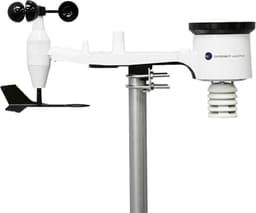
Ambient Weather WS-1965
About £119.99 with rain, wind, a colour screen, and 537 reviews, if you accept the printed 915 MHz band.
Editorial

Peter F. is the editor for DIY & tools at productscompared.co.uk. Comparisons in this category are checked against amazon.co.uk listings, review evidence and public UK sources.
Guides on what to look for, how to use a product, and common mistakes.
Public UK sources used for this comparison. Listing prices, stars, and review counts are from amazon.co.uk on 15 October 2026.
Expert source (DIY & tools): Charlie White (Charlie DIYte) (external profile) – public expert commentary used as a research source, not as a contributor to our pages.
This page contains affiliate links to amazon.co.uk. If you buy through them, we may earn a commission at no extra cost to you. Prices, stars, and review counts are the UK listing lines. We did not run a lab test.