Ecowitt vs Ambient weather station: the radio, not the logo
You already have both names open on amazon.co.uk, and the next sensor is already in your head. An Ecowitt vs Ambient weather station choice here is a radio choice. The Ecowitt WS2910 prints 868 MHz. The Ambient Weather WS-1965 and WS-2000 print 915 MHz. Those bands do not pair. A UK review of the WS-2000 says 868 MHz sensors never appeared. The Products Compared editorial team set those lines side by side on 15 October 2026, with no laboratory test. A qualifying purchase through our links can earn a commission at no extra cost to you. Shelf prices sit on the [Wi-Fi weather station comparison](/hub/climate-measuring/wifi-weather-station).
You already have both names open on amazon.co.uk, and the next sensor is already in your head. An Ecowitt vs Ambient weather station choice here is a radio choice. The Ecowitt WS2910 prints 868 MHz.
You already have both names open on amazon.co.uk, and the next sensor is already in your head. An Ecowitt vs Ambient weather station choice here is a radio choice. The Ecowitt WS2910 prints 868 MHz. The Ambient Weather WS-1965 and WS-2000 print 915 MHz. Those bands do not pair. A UK review of the WS-2000 says 868 MHz sensors never appeared. The Products Compared editorial team set those lines side by side on 15 October 2026, with no laboratory test. A qualifying purchase through our links can earn a commission at no extra cost to you. Shelf prices sit on the Wi-Fi weather station comparison.
Our top picks
| Badge | Product | Outdoor radio | Uploads named | UK plug note | Note | Price | Offer |
|---|---|---|---|---|---|---|---|
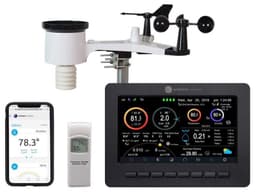
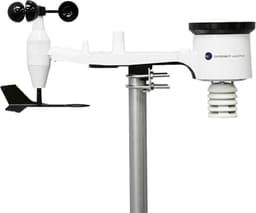
| Best overall |  Ecowitt Ecowitt WS2910 | 868 MHz | Ecowitt, WU, Cloud, WOW | Check the brick for 230 V | 8.6 | about £134.99 | View offer |
| Alternative |  Ambient Weather Ambient Weather WS-2000 | 915 MHz | Ambient network | UK review: American two-pin | 7.4 | about £239.99 | View offer |
| Best value |  Ambient Weather Ambient Weather WS-1965 | 915 MHz | Ambient network | Check the brick for 230 V | 8.2 | about £119.99 | View offer |

On this page
The band on the listing
What you can add later
Screen, uploads, and the plug
When to choose which
Common questions
Can I add an Ecowitt 868 MHz sensor to the Ambient WS-2000?
What does the A in WS3901AE mean?
Cups and a bucket, or haptic rain and ultrasonic wind?
Which listing here names WOW?
Why did a UK Ambient buyer get a two-pin plug?
Related pages
Sources
Public UK sources used for this comparison. Listing prices, stars, and review counts are from amazon.co.uk on 15 October 2026.
- amazon.co.uk listings for the nine kept ASINs (retrieved 15 October 2026)
- Weather Spares — Ecowitt WS2910 Wi-Fi weather station (retrieved 15 October 2026)
- Ecowitt — how to choose the radio frequency (retrieved 15 October 2026)
- Royal Meteorological Society — automatic weather station guide (retrieved 15 October 2026)
- Met Office WOW — manage a site (retrieved 15 October 2026)
- Ofcom — short-range devices (retrieved 15 October 2026)
- Wireless Telegraphy (Exemption) Regulations 2021, regulation 4 (retrieved 15 October 2026)
- Electrical Equipment (Safety) Regulations 2016, regulation 35 (retrieved 15 October 2026)