





Wood burner or smoky kitchen
You want a glanceable laser PM2.5 reading when a stove door opens or a pan smokes, plus a separate carbon monoxide alarm. The Temtop S1 has the deepest particle-review file in this set and does not measure CO2.
The best air quality monitors, compared.
Top pick: DisRun 10-in-1 Best value: Temtop S1 – Laser PM2.5 at about £31.99, with 4.4 from 748 reviews, and no CO2 on the listing. Updated October 2026.


An air quality monitor on amazon.co.uk is a small meter, carbon dioxide, a or formaldehyde claim, and usually temperature and relative humidity. You might use one to see cooking and stove particles, to judge whether a shut room needs fresh air, or to log humidity where damp is a worry. If moisture is the only question, a [hygrometer](/hub/climate-measuring/hygrometer) is the simpler comparison. Quality is the match between the sensor and the job, not the number of functions in the title. Prefer a stated or infrared sensor for ventilation, and a laser reading for smoke, frying or dust. A carbon monoxide alarm, a radon measurement and a mould repair are different products. A meter that lacks the sensor cannot answer the question.
An air quality monitor on amazon.co.uk is a small meter, carbon dioxide, a or formaldehyde claim, and usually temperature and relative humidity.

38 products checked · 62 hrs invested · +24,600 readers
Swipe for more
1-2 of 11




Personal buying guide
Question 1 of 2
What do you need the meter to show?
The DisRun 10-in-1, model MT, is a white portable meter at about £39.99 and about 200 g that claims CO2, HCHO, TVOC, benzene, PM2.5 and PM10, with electrochemical sensors stated for HCHO and TVOC. The CO2 line says a dedicated method and does not use the word NDIR, and the title’s PM0.3–1 sits beside bullets that name PM2.5 and PM10. amazon.co.uk shows 5.0 from seven reviews. A 2000 mAh lithium battery is stated at up to 20 hours, with a USB cable, while the product page asks about carbon monoxide and the bullets do not say yes. One UK review says an app connected quickly, although the bullets do not name an app. The attribute size of 20 x 10 x 20 mm is difficult to reconcile with a 200 g meter, and the listing claims an error margin under ±5 percent without saying which sensor that applies to.
Pros
Cons
Best for: A portable multi-reading glance, if you treat the unstated CO2 method and the seven-review file as the limit
Less suitable: Anyone who needs a named NDIR sensor, a confirmed carbon monoxide alarm, or dimensions that match the weight
Specifications
Common questions
Does the listing say it detects carbon monoxide?
The product page asks that question. The bullets list CO2, HCHO, TVOC, benzene, PM2.5 and PM10. They do not say it detects carbon monoxide.
What battery life is stated?
A 2000 mAh rechargeable lithium battery and up to 20 hours of continuous detection on one charge. A USB cable is named in the same bullet.
Which particle sizes are named?
The bullets name PM2.5 and PM10. The title also says PM0.3–1. The listing claims an error margin of less than ±5 percent, without saying for which sensor.
The Nobito 13-in-1, model 2co8, is a black meter at about £39.09, about 150 g and 3.5 x 7 x 8.9 cm, that claims CO2, HCHO, TVOC, PM1.0, PM2.5, PM10, temperature and humidity. Five of the thirteen functions are a clock, a date, a dual alarm, a timer and a stopwatch, so the title is not thirteen pollutants. The CO2 sensor type is not stated, which is a different claim from the NDIR line on the BREATHE listing. amazon.co.uk shows 5.0 from two reviews, too small a sample to set beside 4.4 from 748. The listing says 6–7 hours from the included lithium-ion battery and USB for continuous use, and one UK review also puts battery life at about 6 hours. Tuya Smart is named for remote readings and for daily, monthly and annual history. Carbon monoxide is not listed. The screen auto-rotates between landscape air readings, a vertical clock and a stopwatch.
Pros
Cons
Best for: A Tuya history screen at about £39, if you can live with an unstated CO2 type and a two-review file
Less suitable: A decision that needs NDIR named on the page, or a carbon monoxide alarm
Specifications
Common questions
What does 13-in-1 include?
The listing counts eight air readings (CO2, HCHO, TVOC, PM2.5, PM1.0, PM10, temperature and humidity) and five clock functions (time, date, dual alarm clock, timer and stopwatch).
Which app does the listing name?
Tuya Smart. The listing says remote readings, daily, monthly and annual history, and that time and date sync from the phone once connected.
How long does the listing say it runs off the charger?
6–7 hours when fully charged. The listing says to use USB for long-term continuous work. A UK review also puts battery life at about 6 hours.
The GoHelmate MT29 is a 15-in-1 Wi-Fi meter at about £69.99, about 200 g and 5 x 10 x 14 cm, with 5.0 from a single amazon.co.uk review. The bullets name PM2.5, CO2, VOCs, humidity, temperature and air pressure, and the title also names PM10, HCHO and TVOC. The CO2 sensor type is not stated, and carbon monoxide is not named. A later bullet says the device requires an internet connection and stores data in the cloud, so a glance that depends on the app stops if the network is down. Power is listed as battery and corded electric, with a charging cable in the box and no hour figure. A separate unit-count field reads 28.3495 gram, which does not match the 200 g weight. Custom thresholds, an audible alert and a colour change are claimed. One review is not a base you can set beside 457 or 748 reviews.
Pros
Cons
Best for: A cloud-logged multi-reading screen, if you already have reliable Wi-Fi and you can accept a one-review file
Less suitable: Offline use beside a stove, a stated NDIR requirement, or a carbon monoxide alarm
Specifications
Common questions
Does the listing say it works without Wi-Fi?
The page asks that question. A later bullet says the device requires an internet connection and stores data in the cloud for the app. Power is listed as battery and mains, which is separate from the data connection.
What does it claim to measure?
The bullets name PM2.5, CO2, VOCs, humidity, temperature and air pressure, and the title also names PM10, HCHO and TVOC. Carbon monoxide is not named.
How long is the battery life on the listing?
No hour figure is stated. Power is battery and corded electric, and a charging cable is in the box.
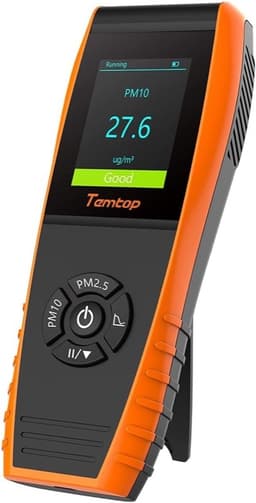
The Temtop S1, manufacturer part S1plus, is the particle meter with the deepest review file in this set: 4.4 from 748 amazon.co.uk reviews, at about £31.99 and about 159 g. The bullets describe a laser sensor for PM2.5, plus temperature and humidity, and they do not list CO2, VOC or formaldehyde. A single press of the setting button switches ECO and A mode, stated at 60 days and 20 days, and the listing advises leaving the meter plugged in so real-time monitoring stays on. UK reviewers say that ECO interval misses short spikes, which is the minute a stove door opens or a pan smokes. A two-second press switches Celsius and Fahrenheit. The box line is the meter and a manual, with no app and no history period stated. It costs about £6.50 more than the S1-up, and that difference buys the larger review count rather than an extra sensor, which is why it is the best-value particle meter in this set.
Pros
Cons
Best for: Smoke, frying or dust, when you want laser PM2.5 and the largest review count among the particle meters here
Less suitable: A shut room that needs a CO2 reading, or a carbon monoxide alarm
Specifications
Common questions
Does the S1 measure CO2 or only particles?
The bullets describe a laser particle sensor for PM2.5, plus temperature and humidity. CO2, VOC and formaldehyde are not listed.
What battery life does the listing state?
ECO mode is stated as 60 days and A mode as 20 days. The listing advises leaving it plugged in so real-time monitoring stays on.
Can the temperature unit be changed?
The listing says a 2-second press of the setting button switches between Fahrenheit and Celsius. A single press switches ECO and A mode.
The Temtop P600, model P600-JP, is a particle-only meter at about £69.99 and about 450 g, with 4.4 from 153 amazon.co.uk reviews. The bullets limit it to PM2.5, PM10 and a histogram of PM2.5 for the last 12 hours, and they claim a laser life of up to 20,000 hours with a stated reach down to 0.3 µm. A separate attribute says Sensor Type: Electrochemical, which conflicts with that laser bullet, so the particle claim sits in the bullets and the clash is unresolved. UK reviews mention a charging cable and say units arrived charged, but battery capacity is not on the listing. Customer reviews on the UK page describe buying it because of a wood burner and a rise when the door is first opened, and one of those reviews mentions a kitchen figure over 200. Those are reviewer comments, not a measurement by Products Compared, and there is no CO2 on the listing.
Pros
Cons
Best for: A stove room or a smoky kitchen, if you want PM10 and a 12-hour particle histogram and you do not need CO2
Less suitable: A ventilation check, or a buyer who wants the sensor-type line and the bullets to agree
Specifications
Common questions
Does the P600 measure CO2?
The bullets say this detector is for particles only: PM2.5, PM10 and a histogram. CO2 is not listed.
What history does the screen keep?
A histogram of PM2.5 for the last 12 hours. Three front buttons open PM2.5, PM10 or the histogram.
Which sensor type is on the listing?
The bullets describe a laser particle sensor with a stated life of up to 20,000 hours. A separate attribute says Sensor Type: Electrochemical. Both lines are in the saved listing.
The Temtop S1-up, model JP-S1-UP, is a 160 g laser PM2.5 meter at about £25.49 that also shows temperature, humidity and an AQI figure on a colour LCD. amazon.co.uk lists 4.2 from 133 reviews. The listing states ECO mode at up to 60 days with less frequent sampling and A mode at up to 20 days, and it tells you to plug the included USB cable in for uninterrupted real-time tracking. UK reviewers of this Temtop pair say that long ECO interval misses a short spike unless the meter is in real-time mode, so the minute a stove door opens can fall between samples. There is no CO2, VOC or carbon monoxide line, and no sound alarm is described. The alert is a colour bar marked Good, Fair and Poor, which is the maker’s scale, not the Defra Daily Air Quality Index. A bracket is in the box, and the size is not stated.
Pros
Cons
Best for: A low-cost particle glance for frying, dust or a stove door, if you leave ECO mode when the spike is short
Less suitable: A ventilation check, a carbon monoxide alarm, or anyone who needs an app history
Specifications
Common questions
Does the S1-up measure CO2?
The listing measures PM2.5, AQI, temperature and humidity. CO2 is not among the stated readings.
How long does the listing say the battery lasts?
ECO mode is stated as up to 60 days with less frequent sampling. A mode is stated as up to 20 days with more frequent sampling. The listing says to plug it in for uninterrupted real-time tracking.
Does the listing include an alarm?
The page asks whether it has an alarm, and the bullets do not describe a sound alarm. They do describe a colour bar from green to red for Good, Fair and Poor.
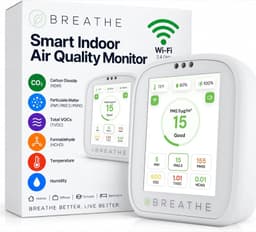
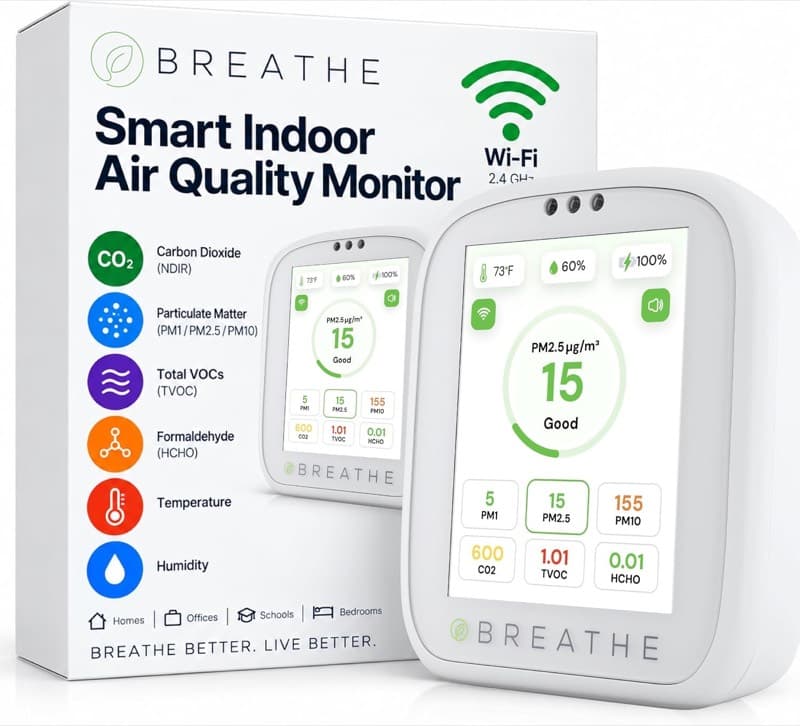
The BREATHE Airmonitor Plus Gen 2, model BTL40001, is the only listing in this set that states both an NDIR CO2 sensor and a laser particle sensor for PM1, PM2.5 and PM10. It is about £99.99, about 113 g and 3.6 x 7.1 x 8.4 cm, with 4.0 from 457 amazon.co.uk reviews. TVOC and HCHO are claimed as dedicated detection, temperature and humidity sit on the colour display, and the Breathe Tech app on 2.4 GHz Wi-Fi is described as keeping up to 90 days of history with CSV export and alerts for CO2 and PM2.5. Portable use is stated at up to 6 hours, then USB-C, and the attribute line also says corded electric, so an all-day reading away from a socket is not what the listing offers. HSE describes NDIR as the appropriate type for portable workplace CO2 checks, which supports wanting the word NDIR for a shut room and does not turn this consumer unit into a workplace instrument. Carbon monoxide is not listed, and a 4.0 average across 457 reviews means a large minority of buyers did not give full marks.
Pros
Cons
Best for: A shut bedroom or home office where you want stated NDIR carbon dioxide as well as particles, and you can leave it on USB-C
Less suitable: A budget under about £40, all-day use with no cable, or a landlord carbon monoxide alarm
Specifications
Common questions
Is the CO2 sensor described as NDIR?
Yes. The item highlight says a professional NDIR sensor, and a bullet says NDIR CO2 measurement together with a laser particle sensor.
How long does the listing say the battery lasts?
Up to 6 hours of portable use. The same bullets say it can stay on USB-C power for continuous use. The attribute line also says corded electric and a 6-hour average battery life.
What history does the app keep?
Up to 90 days, with export. Alerts are described for CO2 and PM2.5. The app is Breathe Tech, on 2.4 GHz Wi-Fi.
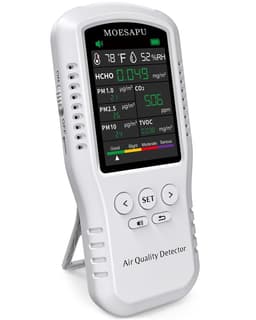
The MOESAPU meter at about £79.99 is one of two listings here that name a CO2 method rather than a bare claim: a built-in infrared sensor, stated at 0–9999 ppm, plus an electrochemical VOC sensor, HCHO, TVOC, PM1.0, PM2.5, PM10, temperature, humidity and a 3.2 inch colour LCD with curves for up to 10 hours. amazon.co.uk shows 4.0 from one review, so that infrared claim has almost no UK review file behind it. A 1500 mAh battery is stated at over 10 hours on USB-C, or you can leave it plugged in, and the listing says you can manually correct the main readings. The model strings disagree: a bullet says T-Z01-Pro, the item model is T-Z01-Ultra-6in1-BUK, and the part number ends in BDE, while the attributes say batteries included: no, and batteries required: yes. Infrared is not the same wording as the NDIR line on the BREATHE listing. No app is named, carbon monoxide is not listed, and the unit weighs about 240 g.
Pros
Cons
Best for: A desk meter with a named infrared CO2 range and on-device 10-hour curves, if one review is enough
Less suitable: A purchase that needs hundreds of reviews, the word NDIR on the listing, or an app export
Specifications
Common questions
What kind of CO2 sensor does the listing name?
A built-in infrared CO2 sensor, with a stated range of 0–9999 ppm. It also names an electrochemical VOC sensor.
Can the sensors be calibrated from the menu?
The listing says the user can manually correct CO2, HCHO, TVOC, PM (1.0, 2.5 and 10), temperature and humidity.
How much history is stored?
Up to 10 hours, shown as a gas curve for CO2, HCHO and TVOC and a particulate curve for PM1.0, PM2.5 and PM10.
The Temtop M100 2nd, part EU-M100 2nd, is the dearest unit in the set at about £159.99 and about 1.09 kg, with a 7-inch touchscreen and 3.8 from 10 amazon.co.uk reviews. The bullets name PM2.5, PM10, CO2, TVOC, temperature, humidity and AQI, and they do not name the CO2 sensor type, formaldehyde or carbon monoxide. Daily and monthly trend charts are on the device, with manual calibration claimed for PM2.5, CO2, temperature and humidity, plus alarm thresholds and a do-not-disturb mode, and a UK review mentions phone notification alerts. LoRa sub-units for other rooms are a separate purchase. The host claims up to 1000 metres with those sub-devices, and the box is one monitor, while power is not stated. A 7-day weather forecast is also claimed, which is a different job from the air sensors, and ten reviews at 3.8 do not support treating the highest price as the strongest meter in the set.
Pros
Cons
Best for: A single-room host with a large touchscreen, if you will judge the unstated CO2 type for yourself
Less suitable: A buyer who wants NDIR named on the page, extra rooms without a further purchase, or the strongest review file in the set
Specifications
Common questions
What does the M100 host measure?
The bullets name PM2.5, PM10, CO2, TVOC, temperature, humidity and AQI. They do not name the CO2 sensor type, formaldehyde or carbon monoxide.
Are the extra room sensors included?
No. The listing says LoRa sub-units must be purchased separately. It claims coverage up to 1000 metres with those sub-devices.
Can it be calibrated?
The listing says manual calibration for PM2.5, CO2, temperature and humidity, plus alarm thresholds, brightness, a screensaver and a do-not-disturb mode.
The Bekasa 5-in-1, model Culp-DS-ZXD0246-B, is a 170 g battery meter at about £16.99 whose attribute line names an electrochemical CO2 sensor, with temperature, humidity and a visual alarm in the bullets. Across 199 amazon.co.uk reviews the average is 3.1, the weakest star line in this set that actually has a count. The item highlight also names TVOC and HCHO, while the bullets describe carbon dioxide, temperature and humidity and do not name carbon monoxide. Particles are not listed, so a stove door or a smoking pan will not appear as PM2.5. The listing says the meter does not need calibration and does not state a battery capacity. A colour LCD is not an NDIR reading, and the non-domestic CO2 monitors in Approved Document F Volume 2 are specified as NDIR and mains powered, which this unit is not.
Pros
Cons
Best for: A low-cost glance at a CO2 claim plus temperature and humidity, if you accept an electrochemical sensor and a 3.1 average
Less suitable: A shut room where you want stated NDIR, or a stove where you need a PM2.5 reading
Specifications
Common questions
Which CO2 sensor does the listing name?
The attribute line says Sensor Type: Electrochemical. The bullets also say the meter shows CO2, temperature and humidity and does not need calibration.
Does the listing say it detects carbon monoxide?
The bullets describe carbon dioxide, temperature and humidity. Carbon monoxide is not named there. The item highlight names TVOC and HCHO as well as CO2.
How is it powered?
The listing says battery powered, with a visual alarm. It does not state a battery capacity.
The Amazon Smart Air Quality Monitor at about £69.99 lists five factors: PM2.5, volatile organic compounds, carbon monoxide, humidity and temperature. Carbon dioxide is not one of them, so a routine that starts a purifier does not tell you whether a shut bedroom needs a window. The listing ties the unit to the Alexa app, a colour LED, phone notifications, Echo announcements, and routines for air purifiers, dehumidifiers and heaters. The saved listing has no customer-review line, so there is no star average and no review count to quote. UK reviews describe a mains plug, a body smaller than a Rubik’s cube, and coarse history in the Alexa app. Power, weight and size are not stated on the listing itself. Formaldehyde is not named separately from VOC. The carbon monoxide factor is a sensor line on a consumer meter, not a landlord carbon monoxide alarm.
Pros
Cons
Best for: An Alexa household that wants PM2.5, VOC and a carbon monoxide factor to drive a routine, and does not need CO2
Less suitable: A shut room, a buyer who wants a star count before paying, or a legal carbon monoxide alarm
Specifications
Common questions
Does it measure CO2?
The listing’s five factors are particulate matter (PM2.5), volatile organic compounds, carbon monoxide, humidity and temperature. CO2 is not one of them.
Does it work with Alexa?
The listing says it works with Alexa, shows a score in the Alexa app, can notify a phone or an Echo, and can run routines for air purifiers, dehumidifiers and heaters.
What is the amazon.co.uk star rating in the saved listing?
The saved listing has no customer-review line with a star average or a review count. The rating is n/a
We compared 11 air quality monitors on amazon.co.uk and scored them from the listing facts in this set. Prices, stars and review counts are the UK lines. There was no lab test, and a score is not a Defra or WHO mark. The four weights below sum to 100.
Review evidence
40%Stars and review counts are the amazon.co.uk lines. A 5.0 from one or two reviews cannot outrank a 4.4 from hundreds of reviews. Where the saved listing has no customer-review line, that block stays low and the rating is not invented.
Sensor clarity
35%Points for a sensor the listing actually names, matched to a job. Stated NDIR plus a laser particle sensor scores highest. A named infrared CO2 sensor is not worded as NDIR. Electrochemical CO2 is not treated as NDIR.
Value
15%Useful stated capability per pound inside this set, not the cheapest title. A deep particle-review file at about £32 scores higher here than an electrochemical meter at about £17 or a host at about £160 whose CO2 type is unstated.
Listing clarity
10%Full marks when the bullets, the sensor line and the power line agree. Deductions where a highlight disagrees with the bullets, two sensor types conflict, or the star line is missing.
Name the job before the price. Particles, fresh air, humidity or a smart routine each need a different sensor. Sensor type, power and the limits of a consumer meter are set out in the [air quality monitor buying guide](/hub/climate-measuring/air-quality-monitor/sub/air-quality-monitor-buying-guide).
An air quality monitor is a small indoor meter for one or more signals: PM2.5, sometimes PM1 and PM10, carbon dioxide, a VOC or formaldehyde claim, and usually temperature and relative humidity. Name the job first. Particles, fresh air, humidity, or a smart routine. A meter that lacks the sensor cannot answer the question. UK shoppers in this set use one to see cooking and stove particles, to judge whether a shut room needs fresh air, or to log humidity where damp is a worry.
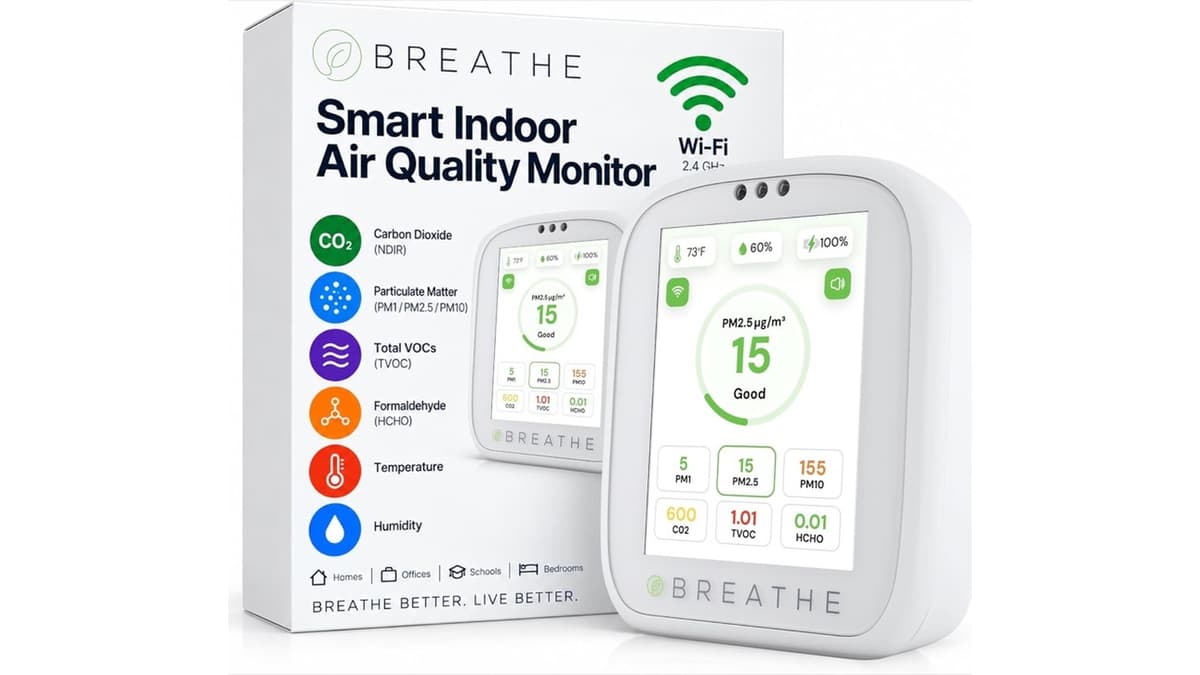
A laser PM2.5 meter does not tell you whether a shut room needs a window. CO2 does that job, and a CO2 meter does not show stove particles. Buy the sensor that matches the question.
Nobito’s 13-in-1 line includes a clock, a date, a dual alarm, a timer and a stopwatch. Five of the thirteen functions are not air readings. Read the sensor list, not the number in the title.
A one-minute cooking peak is not a 24-hour mean. Defra’s PM2.5 index and the WHO annual guideline are not the green light on the meter. ECO mode on the Temtop S1 can miss that short spike.
Start with the question, then the sensor the listing actually names. Smoke, frying and a wood burner need laser PM2.5. A shut bedroom or office needs CO2. Humidity where damp is a worry is a third job, and it does not repair the moisture. BREATHE is the only listing here that states both NDIR CO2 and a laser particle sensor. MOESAPU names infrared CO2 at 0–9999 ppm, which is not the word NDIR. Bekasa names electrochemical CO2 and does not list particles.
A bright screen that claims about 6 to 10 hours still wants USB for a full day. The Temtop S1’s 60-day figure is ECO sampling, and UK reviewers say a short spike falls between samples unless you use real-time mode and mains. Weigh the review file next. Temtop S1 is 4.4 from 748. BREATHE is 4.0 from 457. A 5.0 from one or two reviews is a thin base. The Amazon saved listing has no star line, so none is quoted. Then draw the line the meter cannot cross.
Three typical situations, each with a recommendation from this comparison.
You want a glanceable laser PM2.5 reading when a stove door opens or a pan smokes, plus a separate carbon monoxide alarm. The Temtop S1 has the deepest particle-review file in this set and does not measure CO2.
You want carbon dioxide, preferably with NDIR stated on the listing, to judge whether a closed room needs fresh air. The BREATHE unit states NDIR and a laser particle sensor, and it expects USB-C for all-day use.
You want PM2.5, VOC and a carbon monoxide factor to drive an Alexa routine for a purifier, dehumidifier or heater. Skip this meter when CO2 is the point. The saved listing has no star line.
Across these eleven amazon.co.uk listings, the top pick for a shut room is the BREATHE Airmonitor Plus Gen 2: about £99.99, stated NDIR CO2 and a laser particle sensor, 4.0 from 457 reviews, and up to 6 hours away from USB-C. The best value for smoke, frying or dust is the Temtop S1 at about £31.99, with 4.4 from 748 reviews and laser PM2.5, temperature and humidity. It does not measure CO2. A carbon monoxide alarm and a radon test remain separate products.
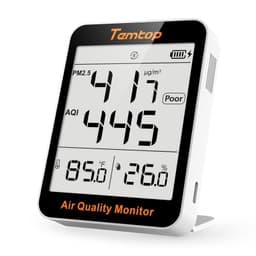
Temtop S1
Laser PM2.5 at about £31.99, with 4.4 from 748 reviews, and no CO2 on the listing.
Editorial

Peter F. is the editor for DIY & tools at productscompared.co.uk. Comparisons in this category are checked against amazon.co.uk listings, review evidence and public UK sources.
Guides on what to look for, how to use a product, and common mistakes.
Public UK and international sources used for this comparison. Listing prices are from amazon.co.uk on 15 October 2026.
Expert source (DIY & tools): Charlie White (Charlie DIYte) (external profile) – public expert commentary used as a research source, not as a contributor to our pages.
This page contains affiliate links to amazon.co.uk. If you buy through them, we may earn a commission at no extra cost to you. Prices, stars and review counts are the UK listing lines. We did not run a lab test.