Independent comparisons. We may earn from shop links. More info

PM2.5 or CO2: which monitor you need

Updated: October 2026

A shut bedroom and a smoky kitchen are not the same measurement. Carbon dioxide climbs because people are in a closed room, and the fix is fresh air. PM2.5 climbs because something is burning, frying or shedding dust, and the fix is to stop the smoke or capture it. One screen shows both only when the listing contains both sensors. An air purifier will not paper over the wrong choice. This page is that fork for the listings in our [air quality monitor comparison](/hub/climate-measuring/air-quality-monitor). Products Compared did not lab-test these meters.

A shut bedroom and a smoky kitchen are not the same measurement. Carbon dioxide climbs because people are in a closed room, and the fix is fresh air.

Our top picks

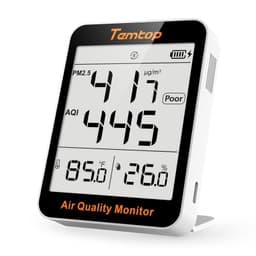
Temtop Temtop S1

Best overall

Temtop Temtop S1
8.7/10about £31.99
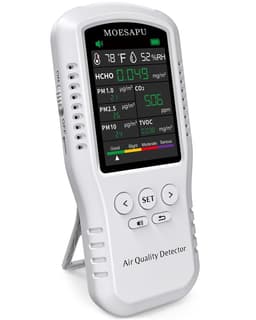
MOESAPU MOESAPU T-Z01

Alternative

MOESAPU MOESAPU T-Z01
4.3/10about £79.99
On this page

CO2 is a fresh-air reading

Carbon dioxide, as HSE and GOV.UK use it, is a ventilation indicator. In a shut bedroom or home office it rises when fresh air does not keep up. It does not mean the air is full of smoke. GOV.UK’s education guidance calls under 800 ppm good ventilation, 800 to 1,500 adequate, and over 1,500 poor, for those settings. HSE says a CO2 monitor is a poor proxy beside an air cleaner, which does not remove CO2, or where a process such as a gas hob produces it. Those bands are not a statute for your flat, and they only help if the meter measures CO2. The Temtop S1, the S1-up and the P600 do not list it. Bekasa lists CO2 as electrochemical, which is not NDIR. HSE points to NDIR for portable workplace checks. Where to stand the meter is on how to use an air quality monitor.

PM2.5 is a particle reading

PM2.5 is fine particles from frying, a candle, a stove door, smoke and dust. You can have a high particle reading in a well ventilated room, and a low one in a stuffy room. WHO’s 2021 guideline is 5 µg/m³ annual and 15 µg/m³ over 24 hours. Defra’s outdoor index puts PM2.5 band 1 at 0–11 µg/m³ as a 24-hour mean, and very high at 71 or more. Approved Document F Volume 1 uses 25 µg/m³ outdoor PM2.5 as a one-year threshold. That 25 is not the WHO 5. The P600 adds PM10 and a 12-hour histogram and still has no CO2. A wood stove is this particle case, on the air quality monitor for a wood burner page.
Temtop Temtop S1

Testsieger

Temtop Temtop S1
8.7/10about £31.99

The fixes are not the same

If CO2 is high, open a window or a door where you can. A HEPA purifier does not lower carbon dioxide. GOV.UK says air cleaning units can reduce some airborne contaminants and do not replace ventilation. If PM2.5 is high because of the pan, stop the smoke or send it outside with a hood that vents outdoors. A purifier can catch some of what is already in the room. It is not that hood. Opening a window can clear CO2 and can also let outdoor particles in. On a filthy day the CO2 may fall while PM2.5 rises. HSE warns that a CO2 monitor is the wrong ventilation check in a room whose only fresh-air device is an air cleaner.

Which meter in this set matches the fork

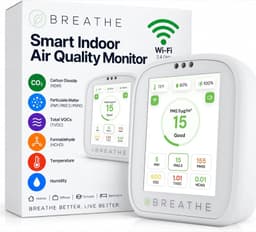
For particles only, the Temtop S1 at about £31.99 states laser PM2.5 and has 4.4 from 748 reviews. The P600 at about £69.99 adds PM10 and a 12-hour histogram, still with no CO2. Neither can tell you the bedroom needs a window. For stated NDIR and laser particles together, the BREATHE Airmonitor Plus Gen 2 at about £99.99 uses both words, with 4.0 from 457 reviews. MOESAPU at about £79.99 states infrared CO2, not the word NDIR, and has 4.0 from one review. The Amazon monitor at about £69.99 measures PM2.5 and does not measure CO2, and its saved listing has no star line. Nobito, DisRun, GoHelmate and the Temtop M100 2nd claim CO2 without stating the type. A qualifying amazon.co.uk purchase can earn us a commission at no extra cost to you. Listings were read on 15 October 2026.

Common questions

Should you buy a PM2.5 monitor or a CO2 monitor?
Buy PM2.5 if the problem is smoke, frying, a stove or dust. Buy CO2, preferably with NDIR stated on the listing, if a shut room feels stuffy with the window closed. Buy both only when one listing actually states both. A single air quality title does not guarantee either sensor. Match the word on the bullet to the room you complain about.
Can one meter do both?
Yes, if the listing says so in sensor language you can check. In this set the BREATHE Airmonitor Plus Gen 2 states NDIR CO2 and a laser particle sensor. MOESAPU states infrared CO2 plus particles, with one review behind it. Several other rows claim CO2 without naming the type, or measure particles and skip CO2. Both is a pair of lines on the page, not a 10-in-1 title.
Does a high CO2 reading mean the air is full of smoke?
No. CO2 in this context is a fresh-air indicator from occupancy, as HSE and GOV.UK use it. Smoke, frying and stove particles show up as PM2.5. A stuffy bedroom can be high in CO2 and low in particles. A smoky kitchen can be the other way round. Using one number as a proxy for the other is how people buy the wrong meter and then distrust it.
Does a high PM2.5 reading mean you should open the window for fresh air?
Not automatically. A high particle reading means something is producing or bringing in particles. Opening a window can dilute them, and it can also let outdoor PM2.5 in on a polluted day. The first response to a frying spike is the hood that vents outside, or stopping the smoke. Open the window when the problem is CO2 from a shut, occupied room. The two fixes are different.
Is a green PM2.5 light the same as the UK daily index?
No. A green lamp is the manufacturer’s band. Defra’s index 1 for PM2.5 is a 24-hour mean of 0–11 µg/m³, and very high is 71 µg/m³ or more. WHO’s 15 µg/m³ figure is a 24-hour guideline, and the 5 µg/m³ figure is annual. A one-minute green or red at the hob is not those means. Read the number and how long it lasted.

Related pages

Sources

Public UK and international sources used for this comparison. Listing prices are from amazon.co.uk on 15 October 2026.

  1. GOV.UK — ventilation and air quality in education and childcare settings (retrieved 15 October 2026)
  2. Approved Document F Volume 1 (2026) — ventilation (retrieved 15 October 2026)
  3. Approved Document F Volume 2 — buildings other than dwellings (retrieved 15 October 2026)
  4. WHO global air quality guidelines 2021 (retrieved 15 October 2026)
  5. WHO indoor formaldehyde guideline, 0.1 mg/m³ over 30 minutes (retrieved 15 October 2026)
  6. The Smoke and Carbon Monoxide Alarm (Amendment) Regulations 2022 (retrieved 15 October 2026)
  7. GOV.UK — radon (retrieved 15 October 2026)
  8. Defra Daily Air Quality Index — PM2.5 (retrieved 15 October 2026)