Independent comparisons. We may earn from shop links. More info

How to use an air quality monitor

Updated: October 2026

The first number on a new air quality monitor often looks like an emergency. You set it on the kitchen table while the pans are hot, and the colour flips before you have decided what the device is measuring. That reading is usually your breath, the extractor, or a one-minute spike, not a verdict on the house. Use it for the room you occupy: seated head height, at least half a metre from you, away from the window. A green light is the maker’s scale, not the Defra daily index. Which sensor you should have bought is on the [air quality monitor comparison](/hub/climate-measuring/air-quality-monitor).

The first number on a new air quality monitor often looks like an emergency. You set it on the kitchen table while the pans are hot, and the colour flips before you have decided what the device is measuring.

Our top picks

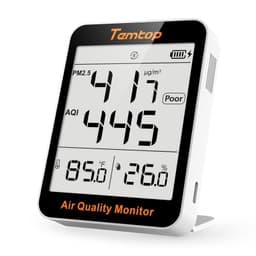
Temtop Temtop S1

Best overall

Temtop Temtop S1
8.7/10about £31.99
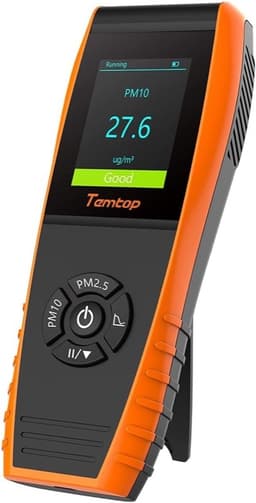
Temtop Temtop P600

Alternative

Temtop Temtop P600
6.9/10about £69.99
On this page

Put it where the room’s air is, not where you breathe on it

Choose the room you use for an hour or more, not the hallway. Put the meter at about seated head height, at least 0.5 metres from the nearest person, because breath is high in carbon dioxide. Keep it away from windows, doors, vents and direct sun. HSE, GOV.WALES and Approved Document F Volume 2 use that pattern in their own settings. Those pages are not a statute for your flat. A kitchen with a gas cooker is a poor place to treat CO2 as a ventilation score. Do not park the meter in the stove throat, and do not breathe on the inlet. The fork is on PM2.5 or CO2.

Let it settle, and do not trust ECO mode for a short spike

Leave the meter long enough to stop reading the minute you stood over it. Compare a window-open period with a window-shut period, rather than the first second. SAMHE tells schools to leave a plugged-in monitor by an open window for 15 minutes if the morning CO2 reading is not below 500 ppm. That is a school procedure, not a home statute. GOV.WALES says a reading far below 400 ppm or over 1,500 ppm may mean the monitor, not the room. The Temtop S1 and S1-up tie ECO mode to up to 60 days, against an A mode of up to 20 days. UK reviewers say that interval misses a short spike unless the meter is in real-time mode. For the minute a stove door opens, switch to live mode. GoHelmate’s listing says an internet connection is required. Stove limits are on the wood burner page.
Temtop Temtop S1

Testsieger

Temtop Temtop S1
8.7/10about £31.99

A spike is not a daily index

A cooking minute and a 24-hour mean are different objects. Defra’s Daily Air Quality Index for outdoor PM2.5 puts index 1 at 0–11 µg/m³ as a 24-hour mean, and very high at 71 µg/m³ or more. WHO’s 2021 guideline is 5 µg/m³ annual and 15 µg/m³ over 24 hours. Approved Document F Volume 1 uses 25 µg/m³ outdoor PM2.5 as a one-year threshold, which is not the WHO figure of 5. A maker’s traffic light is none of those scales. When the colour flips while you fry and falls after the extractor has run, you have watched a spike. GOV.UK’s education guidance calls under 800 ppm good ventilation, 800–1,500 adequate, and over 1,500 poor, for those settings, not as a home statute. If CO2 is high, open a window where you can. An air cleaner does not lower CO2. If the high number is cooking particles, use a hood that vents outside.

When the meter is the wrong tool

Stop treating the screen as the decision when the hazard is not a ventilation score. If you suspect carbon monoxide, leave and contact a Gas Safe registered engineer. Landlord alarm rules are about fitting an alarm, not about reading PM2.5. A radon question needs a validated measurement against UKHSA’s action level, an annual average of 200 Bq/m³. None of these monitors is that test. Persistent damp needs the moisture fixed. Products Compared did not lab-test these meters. A qualifying amazon.co.uk purchase can earn us a commission at no extra cost to you. This page is from the Products Compared editorial team, as of 15 October 2026.

Common questions

Where should you put an air quality monitor?
Put it in the room you use, at about seated head height, on a flat surface, away from windows, doors, vents and direct sun. Keep it at least half a metre from people so you are not measuring breath. Try a second spot if the first reading never matches how the room feels. Do not site it in a corridor, or in the plume from a stove door.
How long should you wait before you trust the number?
Long enough that the reading is no longer your arrival. Compare a period with the window open and a period with it shut, rather than the first second. SAMHE’s school guide uses 15 minutes by an open window if the morning reading is not under 500 ppm. That is their procedure, not a home law. A CO2 figure far below 400 ppm is a reason to suspect the placement.
Why did the reading jump while you cooked and then fall?
You watched a short particle spike, not a 24-hour average. Defra’s PM2.5 index is a 24-hour mean, and WHO’s 15 µg/m³ figure is also a 24-hour guideline. A pan can push a consumer meter hard for a few minutes and then drop when the hood has run. If the meter was in ECO mode, it may have missed the worst minute. Use live mode next time you fry.
Does a green light mean the air meets the UK daily index?
No. The colour bands on these meters are the maker’s own Good, Fair and Poor scale. Defra’s outdoor Daily Air Quality Index for PM2.5 is a 24-hour mean, with index 1 at 0–11 µg/m³. A green lamp at 7 pm is not that mean, and it is not the WHO annual guideline of 5 µg/m³. Read the number and the time base, not the colour alone.
When do you stop using the meter and call someone?
Contact a Gas Safe registered engineer if you suspect carbon monoxide. Write to the landlord about persistent damp. Use a validated radon detector if the question is UKHSA’s action level of 200 Bq/m³. A high CO2 reading that falls when you open the window is a ventilation habit. A high reading beside a combustion appliance, when you also feel unwell, is a reason to stop the DIY checks.

Related pages

Sources

Public UK and international sources used for this comparison. Listing prices are from amazon.co.uk on 15 October 2026.

  1. GOV.UK — ventilation and air quality in education and childcare settings (retrieved 15 October 2026)
  2. Approved Document F Volume 1 (2026) — ventilation (retrieved 15 October 2026)
  3. Approved Document F Volume 2 — buildings other than dwellings (retrieved 15 October 2026)
  4. WHO global air quality guidelines 2021 (retrieved 15 October 2026)
  5. WHO indoor formaldehyde guideline, 0.1 mg/m³ over 30 minutes (retrieved 15 October 2026)
  6. The Smoke and Carbon Monoxide Alarm (Amendment) Regulations 2022 (retrieved 15 October 2026)
  7. GOV.UK — radon (retrieved 15 October 2026)
  8. Defra Daily Air Quality Index — PM2.5 (retrieved 15 October 2026)