UK radon action level: test your home properly
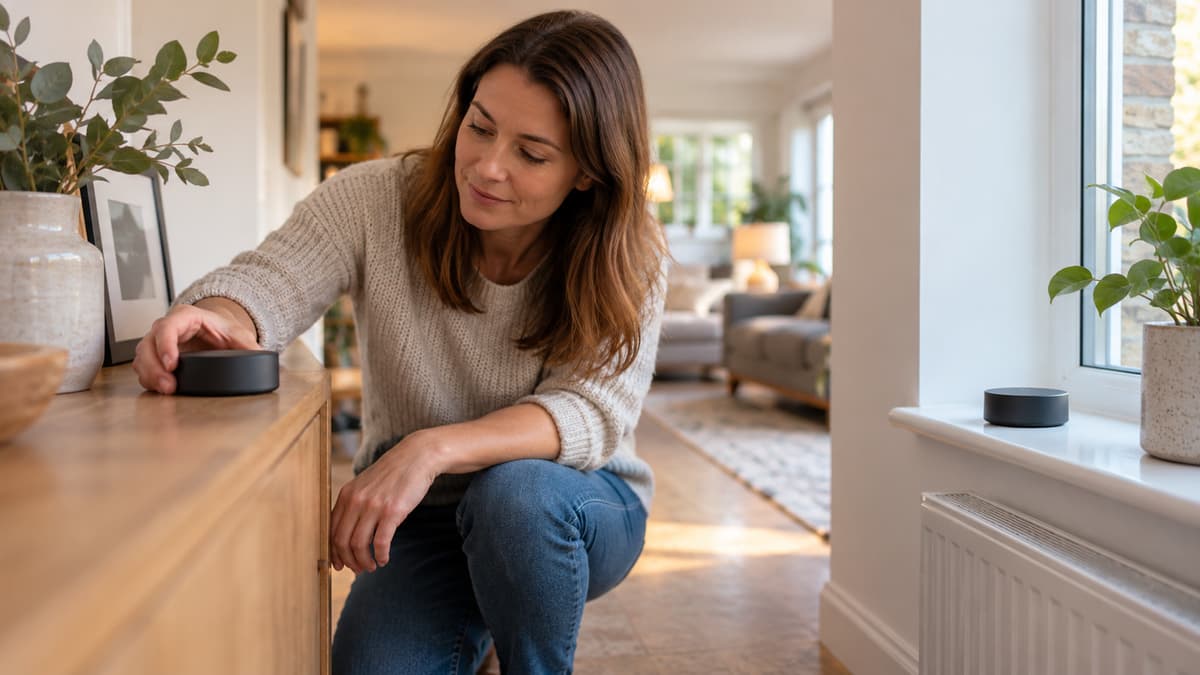
The UK radon action level needs a validated three-month test. See what 100 and 200 Bq/m³ mean, and why a live air-quality monitor cannot replace that test.
On this page

Your new indoor meter may show particles, carbon dioxide and humidity within minutes, yet it has not answered the radon question. The UK radon action level is a home's annual average, from two passive detectors left in place for three months.
Products Compared has not measured radon in a laboratory. The levels, pack price and placement rules below are UKHSA's published advice, set out in October 2026.
In short
The action level is more than 200 Bq/m³ as an annual average. UKHSA's domestic method uses two passive detectors for three months and laboratory analysis. An ordinary air quality monitor does not measure radon unless its listing says so. The 100 Bq/m³ target and the roughly 20 Bq/m³ UK-home average are context, not substitutes for that action level.
The UK radon action level is an annual average
UKHSA recommends reducing radon where the measured home average is more than 200 Bq/m³. Because levels vary, an afternoon screen cannot show whether the property is above the action level.
The target level is 100 Bq/m³, the aim when radon is reduced and for protection in new buildings. Between 100 and 200 Bq/m³, UKHSA says consider action, particularly if a smoker or ex-smoker lives there. The average UK home is around 20 Bq/m³, and individual risk below 100 Bq/m³ is described as relatively low. That is not a result for your address. Keep the laboratory report with its dates.
What a valid home radon test involves
A domestic pack holds two small passive detectors, one for the living area and one for an occupied bedroom. Leave them for three months, return them prepaid, and a validated laboratory analyses them. Seasonal correction turns that exposure into an estimate of the yearly average.
UKHSA's measuring page states £52.80 including VAT for the pack, covering detectors, analysis and prepaid return. That is not an amazon.co.uk price. UKHSA aims to post the result about four weeks after the detectors arrive back.
A shorter test is more uncertain, and passive detectors give no weekly screen, so you cannot stop early because the first weeks look quiet. In the UKHSA validation scheme, validated measurements run for at least three and no more than 12 months.
An address report is a risk estimate, not a measurement
The UKHSA address report costs £3.90 including VAT. It estimates the probability that the address is above the action level. It does not sample your rooms and cannot declare the house safe.
If the address is in an affected area, UKHSA still recommends a measurement. An occupied basement used for more than 50 hours a year should be measured whatever the map says.
Where to put the two detectors
Put one detector in the room you use most as a living area and one in the main occupied bedroom. UKHSA suggests a shelf, furniture or the hanging loop, at about 1–2 metres, not on the floor. Orientation does not matter.
Keep them away from direct sunlight, heat, windows, draughts, children and pets for the full three months. Results can be less reliable if the occupier changes, the home is empty for more than a few weeks, building work is under way, the detectors go out late or the test is cut short. Record the start date and tell the laboratory if one of those applies.
Why an air quality monitor cannot answer the question
Models in our air quality monitor comparison state combinations of PM2.5 or PM10, CO2, volatile organic compounds, formaldehyde, carbon monoxide, temperature and humidity. None states a radon sensor. A qualifying purchase can earn us a commission, at no extra cost to you.
Carbon dioxide is commonly shown in parts per million and particles in micrograms per cubic metre. Radon is becquerels per cubic metre, so a CO2 or carbon monoxide reading is not a radon result. Carbon monoxide alarms follow separate rules in our carbon monoxide alarm rules.
The BREATHE Airmonitor Plus Gen 2 at £99.99 states an NDIR CO2 sensor, a laser particle sensor, TVOC, HCHO, temperature and humidity, and up to 90 days of app history. Radon is not among those readings. The same limit applies to the other monitors in that comparison, including ones described as multi-function. Use a named sensor for particles, CO2 or humidity, and order a radon measurement for radon.
Electronic radon monitors are a third category
An electronic radon monitor claims to measure radon and can show a changing reading. That live display is not a substitute for the validated three-month test used for the UK action level.
UKHSA's 2024 chamber study compared seven consumer electronic radon monitor types with passive detectors. At about 166 Bq/m³, only one electronic type stayed within 10% error. The others were roughly 20–50% away. The passive UKHSA detectors stayed within 10% at both the higher and lower exposure. The study is not a reason to pick a named electronic winner. A trend on a device you already own may prompt the passive test.
What to do with the result
Above 200 Bq/m³, UKHSA recommends reducing radon. Between 100 and 200, consider action, particularly if a smoker or ex-smoker lives there. Below 100, individual risk is described as relatively low. The figure estimates an annual average from the three-month method, the placement and the analysis, so small differences are not a live trace.
If the home was empty, building work was under way or the return was late, ask the laboratory before you treat the number as a normal year. Use the air monitor for the pollutants its listing names, and the passive pack for radon.
Common questions
What is the UK radon action level?
Is 100 or 200 Bq/m³ the important number?
How long does a proper UK home radon test take?
How much does the UKHSA radon detector pack cost?
Does a radon address search test my home?
Does an air quality monitor measure radon?
Where should I place home radon detectors?

Peter F. is the editor for DIY & tools at productscompared.co.uk. Comparisons in this category are checked against amazon.co.uk listings, review evidence and public UK sources.
Related articles

Carbon monoxide alarm rules for UK landlords
See where carbon monoxide alarms are required and why an air monitor is not a substitute.
Ideal indoor humidity UK: the bands that matter
Understand what a humidity reading can tell you about condensation and mould risk.

Regenerate a hygrometer: restore an analogue dial
Restore a mechanical hygrometer before relying on its indoor humidity reading.