Regenerate a hygrometer: restore an analogue dial

Learn how to regenerate an analogue hygrometer with a warm damp cloth, when to adjust the screw, and why that cloth step is different from a salt check.
On this page
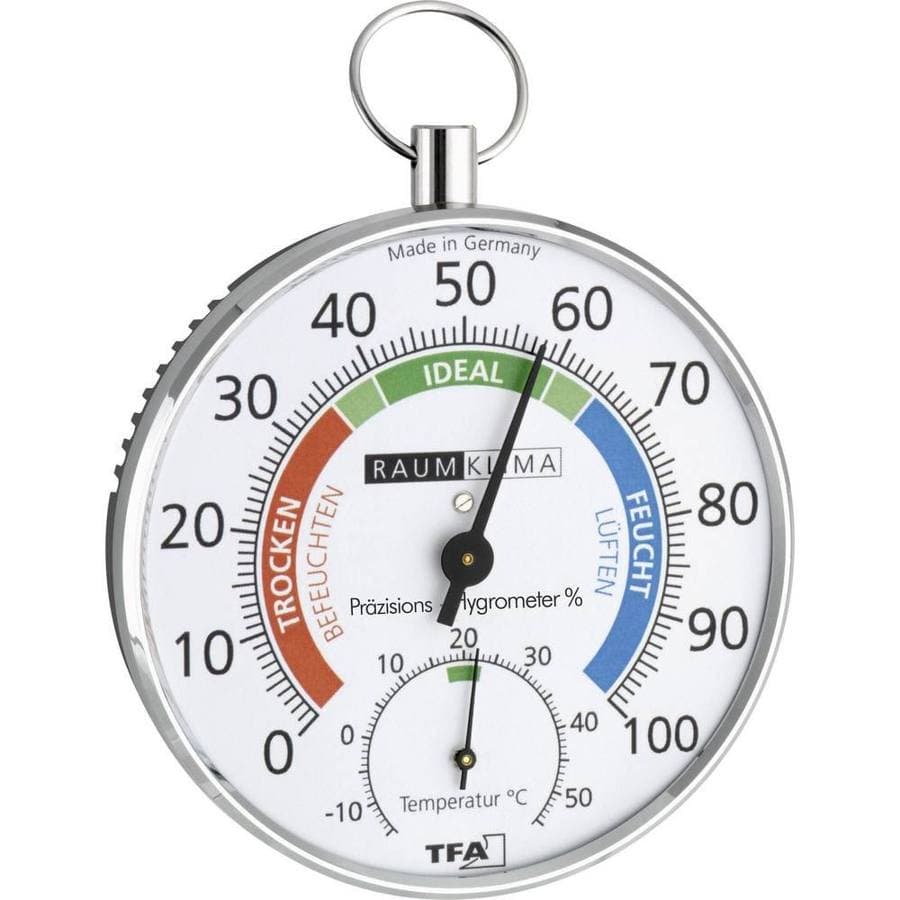
Two humidity dials sit on the same shelf, yet one says 45% and the other 60%. Before you reach for the little screw on the back, regenerate the hygrometer properly. A warm, wrung-out cloth can restore the analogue movement, but the number under that cloth is not your calibration reference.
Products Compared used TFA’s regeneration instructions and the National Physical Laboratory’s typical calibration interval. We did not run a laboratory check. The featured dial is the TFA 45.2027 at about £17.39 on amazon.co.uk. A qualifying purchase can earn us a commission at no extra cost to you.
In short
Wrap the analogue hygrometer in a warm, thoroughly wrung-out tea towel for about 15 to 30 minutes. A move into roughly the 90 to 99% RH region shows that the mechanism has responded. Do not use that broad reading to set the screw. If adjustment is still needed, compare the dial later in normal room air with a trustworthy reference, or carry out a separate salt check.
What regeneration does
An analogue hygrometer uses natural or synthetic hair, or another hygroscopic material, to move a pointer. Dry storage can leave that mechanism slow or stuck. A short spell in high humidity lets the sensing material and linkage travel the upper scale again. A strong movement shows the mechanism can react. It does not prove that 50% on the face matches a traceable reference at every point.
When you are checking a dial from a TFA Dostmann hygrometer comparison, a responsive instrument can still be offset, and a badly stuck dial may not recover.
How to regenerate a hygrometer
Use a clean tea towel, warm water rather than boiling water, and a cloth that is damp without dripping. Do not remove the cover, immerse the dial, or spray water into vents.
- Soak a clean tea towel in warm water and wring it until it no longer drips. Water left on the case means the cloth is too wet.
- Wrap the whole analogue hygrometer so the front, back, and edges sit in one humid pocket, on a stable, water-resistant surface.
- Wait about 15 to 30 minutes, the window in TFA’s instructions. Do not keep opening the cloth, because that releases the moist air.
- Unwrap and check the response. The pointer should normally sit in about the 90 to 99% RH area, and the hand should not be caught on the face or cover.
- Return the dial to normal room air and let it settle. The first number after unwrapping is not a stable room reading.
Do not wrap a digital meter or a remote weather-station sensor unless the maker explicitly says so. Moisture may reach a sensor, contacts, or circuit board.
What the cloth reading means
TFA says a damp cloth cannot provide a clear reference value. About 90 to 99% RH is a broad response, because the cloth, temperature, wrapping, and trapped air all change the result. A stop at 91%, 95%, or 98% does not size the error at 45% in a bedroom. Forcing every dial to one cloth value can shift an aligned instrument away from the range you use.
If the hand barely moves, check that it is not caught and repeat once with a warm, evenly damp cloth around the whole case. A bent pointer, a damaged linkage, or contamination needs replacement or specialist attention.
Adjusting the calibration screw
After regeneration, compare in the room you monitor. Keep the sensing areas close, away from a radiator, sunny window, outside wall, or fan blast, and wait about 30 to 45 minutes. A screw turned after five minutes only chases different response times. Calibration is a comparison with a reference. Traceability connects that reference to recognised standards.
Use the small cross-head screw on the back if the model has one. Make a modest turn, do not press the pointer, and align near the humidity you actually use. One adjustment cannot guarantee the full scale. If the figure affects a collection, a process, or safety, use a calibrated reference or a professional service. For ordinary monitoring, a broader hygrometer comparison can help you keep the dial or replace it.
A salt check is a different test
A home salt check uses damp table salt in a sealed container to create about 75% RH. Leave the instrument inside for several hours, commonly six to twelve, and read it before opening. The salt should be a moist slush, kept off the case, out of sunlight, and away from heating. The cloth is 15 to 30 minutes at very high humidity, only to restore the response.
Purity, leakage, temperature, and a short wait limit a kitchen setup. It is a field check, not a UKAS certificate. Note the original reading and any correction so later drift is visible.
When two hygrometers disagree
Disagreement can come from dry storage, a faster response, a cold wall, or overlapping tolerances. Set both at the same height for 30 to 45 minutes. Regenerate a dry-stored analogue dial first, and do not wrap a digital unit. If the gap remains, use a third reference. Averaging two unknown readings does not show which is closer.
Relative humidity changes with temperature, so cases that have not reached the same room temperature can legitimately disagree. If the concern is condensation or mould rather than the mechanism, read indoor humidity and mould.
How often to regenerate
TFA recommends regeneration at least every six months, after a long dry spell, and when a new dial arrives, because storage and transport are unknown. Record the date, the settled comparison, and any adjustment. The National Physical Laboratory describes six to twelve months as a typical calibration interval, shorter when the instrument is handled harshly or an error matters more.
Check sooner if the pointer stops following the weather, stays pinned, or shows a large gap against a trusted reference. Do not turn the screw for every small difference until position, temperature, and settling time match.
Common questions
How do I regenerate an analogue hygrometer?
Should the needle read exactly 95% under the damp cloth?
When should I turn the calibration screw?
Is a damp-cloth treatment the same as a salt test?
How often should I regenerate an analogue hygrometer?
Why do two hygrometers disagree in the same room?
Can I wrap a digital hygrometer in a wet cloth?

Peter F. is the editor for DIY & tools at productscompared.co.uk. Comparisons in this category are checked against amazon.co.uk listings, review evidence and public UK sources.
Related articles

Indoor humidity, condensation and mould
Understand indoor humidity readings and what they can tell you about condensation and mould risk.
When to change outdoor sensor batteries
Recognise weak-sensor symptoms and choose a sensible battery replacement interval.

An infrared thermometer measures surfaces, not food centres
Learn what an infrared thermometer actually reads and where its limits matter.