Router collet size 6mm or 1/4 inch: match the shank

A 6 mm shank and a quarter-inch collet are different sizes. So are 12 mm and a half inch. Match the sleeve on your UK router before you tighten the nut.
On this page

The bit in your hand is stamped 6. The collet in the palm router is stamped 1/4. Router collet size 6mm or 1/4 inch is the fit that decides whether that cutter stays put. A quarter inch measures 6.35 mm. A shank stamped 6 mm belongs in a 6 mm sleeve. The difference is 0.35 mm.
A half inch measures 12.7 mm, and a shank stamped 12 mm is 0.7 mm smaller. A shop title that writes 1/2 inch / 12 mm as a single size has joined two sleeves. The smaller shank is the one that enters and then lets go. In the ten rows of our DeWalt router comparison, the TOPWAY at £49.99 claims three sizes and the DCW620B at £324.98 leaves the collet off the amazon.co.uk file. You match the stamp on the sleeve to the stamp on the shank. A qualifying purchase can earn a commission at no extra cost to you. We read the listings and DeWalt's UK collet lines. We did not measure the sleeves.
In short
A quarter inch is 6.35 mm and a half inch is 12.7 mm. A 6 mm shank and a 12 mm shank need their own sleeves, and a shop line that pairs them with the inch names has mixed two sizes. DeWalt's UK DCW620 kit page lists 6.35 mm and 12.7 mm. The amazon file for the bare DCW620B does not, so you read the collet that arrived before a bit from a mixed set goes in.
The shank has to match the sleeve
A router collet is a split sleeve. The nut draws it into a taper and the steel closes on one diameter, the router bit shank size on that sleeve. A drill chuck can close from 8 mm to 6 mm. This sleeve cannot. It only collapses through the range it was ground for.
A smaller shank lets the steel close past its seat, or miss the bit. The cutter can look home and the nut can feel tight. Tug along the spindle with the battery off or the plug out. UK reviews here include a slipped cutter on the TOPWAY and bits that ride down the shaft on the RAYLEEY at £61.99. A harder feed leaves a loose sleeve loose.
A larger shank stays out. Leave it unfiled. A 12.7 mm shank stays out of a 12 mm sleeve, and a 6.35 mm shank stays out of a 6 mm sleeve. The smaller bit is the one that goes in on the wrong diameter. Seat the sleeve on the plain shank, clear of the flutes. The how to use a router page puts the battery back only after the nut is tight, you have tugged the bit, and the depth is set. Take the pack off before a spanner touches the nut. A palm tool near 1.7 kg still spins if the switch is bumped.
The sizes UK buyers actually meet
Work in millimetres first, then add the inch name. The inch name is the label. The millimetre figure is the fit.
- 6.00 mm is sold as 6 mm. The other sleeve is 6.35 mm, a quarter inch.
- 6.35 mm is a quarter inch. The other sleeves are 6 mm and 8 mm.
- 8.00 mm is sold as 8 mm. The other sleeve is 6.35 mm, a quarter inch.
- 12.00 mm is sold as 12 mm. The other sleeve is 12.7 mm, a half inch.
- 12.70 mm is a half inch. The other sleeve is 12 mm.
An 8 mm router collet is a European size. From 6.35 mm to 8 mm is 1.65 mm. From 6 mm to 6.35 mm is 0.35 mm. A 1/2 inch router collet is 12.7 mm, so a 12 mm router bit in a half inch collet enters a sleeve ground for the larger shank.
Four palm listings claim quarter-inch bits only: the RAYLEEY at £61.99, the L1NXIXI at £54.99, the YWNYT at £72.99, and the Chengsuwei at £47.49. The JOJOCY at £58.99 lists two collets and states no sizes. The TOPWAY at £49.99, ASIN B0F49CQ4BJ, claims a quarter inch, 6 mm, and 8 mm. That claim is a listing we have not measured. It is our top pick for light edges if you already own a DeWalt pack: a fixed base, 1.74 kg, 4.3 from 47 reviews. UK reviews mention poor spanners and one slipped cutter. Match the sleeve to the shank, then tug the cutter with the battery off.
What DeWalt prints
DeWalt's UK page for the DCW620 kit lists 6.35 mm and 12.7 mm collets. The DeWalt router collet on that page is that pair, a quarter inch and a half inch, so a 6 mm bit and a 12 mm bit sit outside it. The same page lists a 70 mm plunge and a 63 mm maximum cutter. Those figures are travel and cutter diameter. The shank is still 6.35 mm or 12.7 mm.
The amazon.co.uk file for the bare DCW620B, ASIN B0D484Q8QN, at £324.98, leaves the collet blank. The box is one router and batteries are required. Item weight there is 5.1 kg. DeWalt UK's 3.6 kg gross belongs to the kit page. The only UK review on the amazon file says the tool failed after eight months. Read the sleeve that arrived, and keep a title that says 1/2 inch / 12 mm away from that reading.
The DCW604 class is the 8 mm compact, with both bases and a cutter around 30 mm. DeWalt's GB wording also puts a quarter-inch label on that line. The stamp on the sleeve wins, because 8 mm and 6.35 mm differ. The DCW604 is absent from these ten listings, so this article gives it no amazon.co.uk price. A palm tool that claims a DeWalt pack does not inherit either collet. The buying guide sets the base beside that. In this set the plunge body is the DCW620B, after you have read its sleeve.
What a mixed bit set does
A mixed pouch puts a 6 mm straight bit, an 8 mm round-over, and a quarter-inch chamfer in one bag, sometimes with a 12 mm cutter loose at the bottom. The stamp is on the shank, or only on a packet already in the bin. Sort them before the router comes down. A bit with no stamp stays on the bench. Trying it is how a 6 mm shank spends the afternoon in a quarter-inch collet.
Faithfull's FAI KWJ Mark 3 instructions call for a half-inch shank, a cutter of 12.7 mm diameter, and a 30 mm guide bush. The 12.7 mm on the cutter is the width of the slot. The half-inch figure is the shank for a 12.7 mm collet. A palm listing that only accepts quarter-inch bits cannot hold that cutter. A 12 mm shank is the wrong steel in a 12.7 mm sleeve. The jig is a plunge-router job. A sink or hob opening goes to a joiner if you have not run a template. The Chengsuwei at £47.49 lists five quarter-inch bits. They belong in a quarter-inch sleeve.
If the nut will not tighten
Leave the motor off when the nut will not draw the sleeve in.
- Take the pack off, or unplug, and keep your hand clear of the switch.
- Read the sleeve and the shank against the millimetre sizes above.
- When the stamps differ, change the sleeve or the bit. Leave tape, solder, and paper out of the gap.
- Seat the plain shank clear of the flutes and tighten with both spanners.
- Tug along the spindle with the power off. If the bit moves, leave the motor off.
Leave the nut loose until a shank is inside. An empty collet can close on air, and the next bit then fails to sit. The only UK review of the Chengsuwei, at £47.49 and 4.2 from 8 reviews, says the collet nut would not tighten and the tool was returned. The review shows a failed grip and does not name the cause.
If the sizes match and the nut still spins, check you are on the collet flats. TOPWAY reviews mention poor spanners, and a soft spanner rounds the nut, so replace it or return the tool. Health and Safety Executive guidance on supplying machinery expects instructions in English. It does not define these diameters. If a matched shank and a tug still fail, stop.
Common questions
Is 6 mm the same as a quarter inch?
Is 12 mm the same as a half inch?
What collet is on a DeWalt compact router?
What collets come with the DCW620?
Can I tighten an empty collet?
Why did a nut not grip?
Which shank does a worktop cutter use?

Peter F. is the editor for DIY & tools at productscompared.co.uk. Comparisons in this category are checked against amazon.co.uk listings, review evidence and public UK sources.
Related articles

How much does a router cost UK: the price the box hides
Palm bodies in this set run from £47.49 to £72.99, tool only. The DeWalt plunge is £324.98, and the battery is still extra.

Corded or cordless router: pick by the cutter
A cordless body moves around a door. A 230 V motor holds speed on a large cutter when a small pack starts to fade.

Router wood dust UK: extract it at the cutter
HSE sheet WD5 expects extraction at the cutter, and usually a mask. A listed hood is not your measured exposure.

Router burning wood: check the feed before the motor
A dark edge shows when the feed is slow, you pause on a corner, or the bit is blunt. Check the cutter first.

Kitchen worktop router jig: the router the sheet asks for
Faithfull's jig asks for a half-inch shank and a 12.7 mm cutter. A quarter-inch palm router does not hold that bit.

Blunt router bit: when the boxed cutter is finished
A blunt bit scorches the edge or snaps in the cut. Tell a dull flute from a loose collet before you replace the set.

Router depth of cut: shallow passes, not the stroke
Depth of cut is one pass, not the full plunge stroke. A 70 mm travel and a printed 3 mm limit are separate figures.
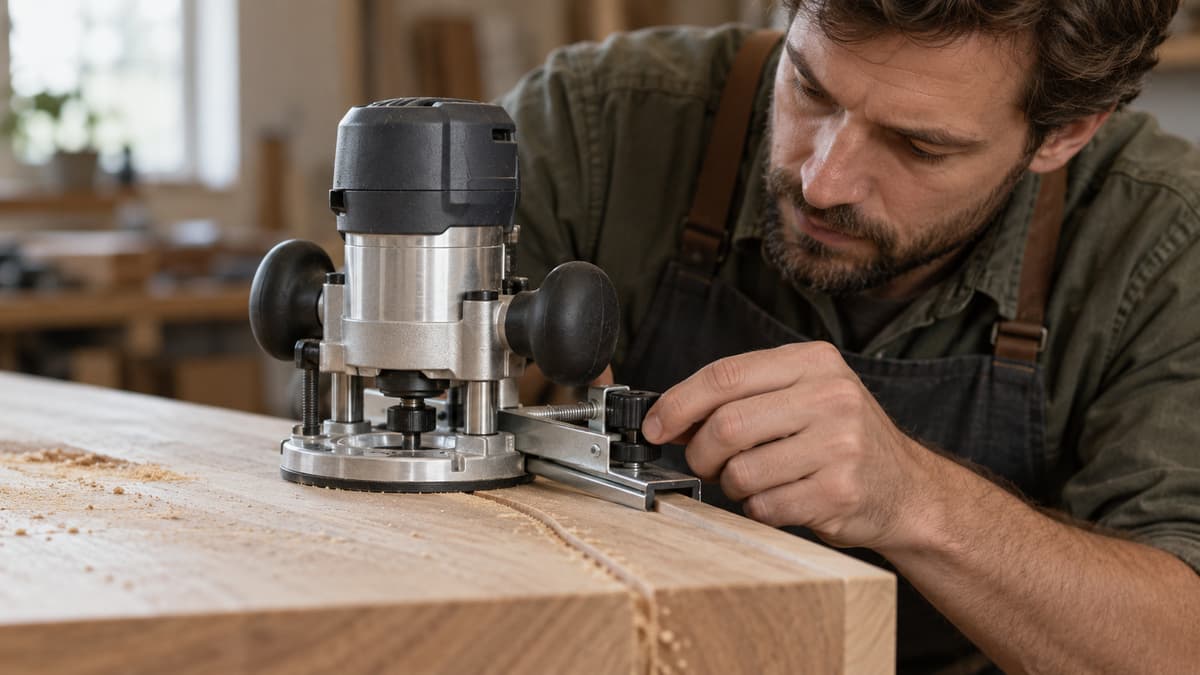
Router edge guide not straight: when the fence will not lock
A wandering groove usually means the fence moved. UK reviews show one wing nut that drops. Clamp a batten, or send it back.

Router noise hearing protection UK: what 95 dB means at the bench
Employer action values sit at 80 and 85 dB. A declared level around 95 dB(A) still calls for defenders on a long cut.