Router edge guide not straight: fence will not lock
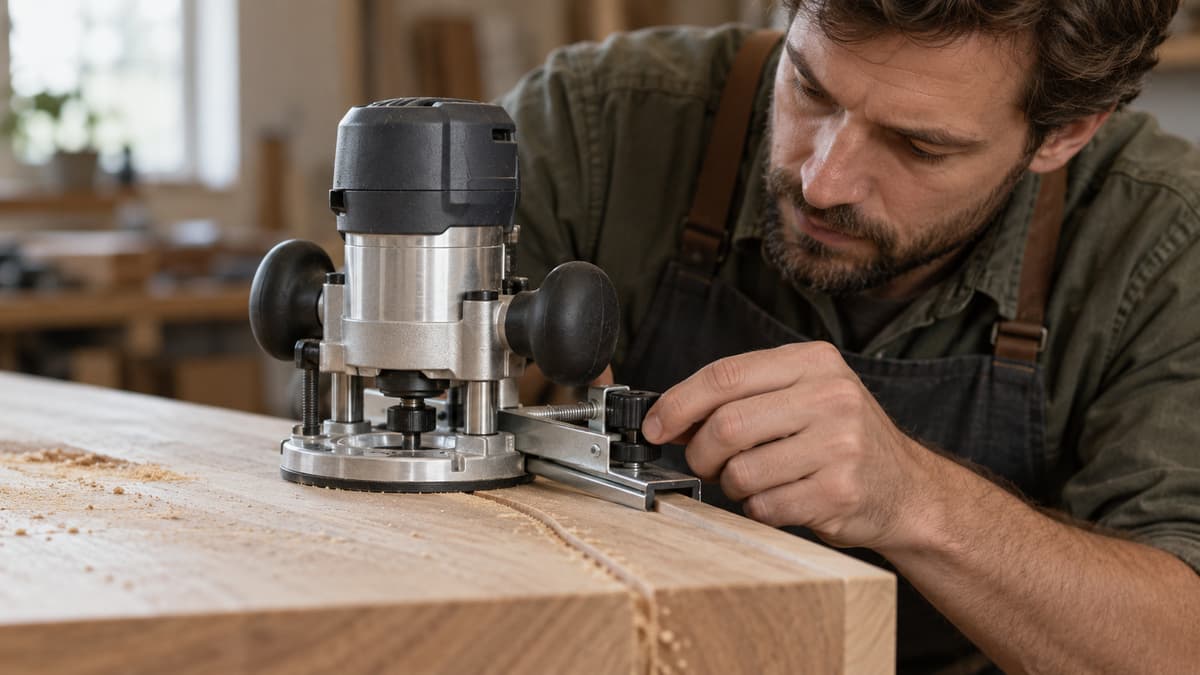
A router edge guide not straight usually means the fence moved. UK palm-router reviews show one wing nut that drops. Clamp a batten, or send the tool back.
On this page

You set the rods, lock the wing nut, and the first few centimetres look true. Then the groove bends. The pencil line was straight, and the board was straight when you checked it. A router edge guide not straight, on a budget palm router, is often a guide that moved once the cutter started to push.
The box calls that rod an edge guide. Buyers often treat one screw as a parallel fence. On several amazon.co.uk palm bodies in the DeWalt router comparison, United Kingdom reviews describe a guide that drops, a side guide that will not lock, or a wing nut that strips. Clamp a batten, or send the tool back. Peter F. read those listings in October 2026. We did not run these fences on a bench, and the prices below are from that file. A qualifying purchase can earn a commission at no extra cost to you. What to check before you buy sits on the buying guide.
In short
A router edge guide not straight usually means the fence shifted, and the groove copied that shift. A United Kingdom review of the JOJOCY at £69.99 describes one wing nut and a wandering groove, and a UK review of the RAYLEEY at £61.99 says the side guide will not lock. If a short scrap cut disagrees at the two ends, clamp a straight batten or return the tool.
A fence has to stay where you set it
A parallel fence holds the same distance from the cutter at the start of the board and at the end. The bit pushes sideways, and that load tries to rotate a round rod in its clamp. One wing nut has a small face, the ears are often plastic, and vibration keeps working on the joint after you let go. A few centimetres of cut is enough for the rod to twist, and then the groove leaves the line.
Set the offset, lock the nut, and try to turn the rod with your fingers before the motor touches the real piece. If your hand can move it, the cutter can move it. Two locking screws, or a clamp on a flat bar, resist that twist better than a single nut. This comparison has the review texts, not a bench measurement. A named edge guide is in the box. That does not show it stays put once the bit is loaded.
Stop once the nut is seated. The L1NXIXI at £54.99 has a United Kingdom review that says the baseplate wing nut stripped after two uses. The review leaves open whether that nut clamped the fence, the sole, or both. A ruined thread is the end of adjustment. For a long groove, treat the rod as unproved until a scrap cut matches at both ends.
What UK reviews say about these guides
The JOJOCY at £69.99 is a fixed-base palm router, 4.1 from 22 reviews, and the listing says it is not a DeWalt. The box includes a dust hood, an edge guide, a trimmer guide, and 15 bits, with no battery. One United Kingdom review says the edge guide is held by one wing nut, drops, and the groove wanders. Another UK review returned it because the base moved.
A second JOJOCY, at £58.99, is 3.5 from two reviews, which is the whole file. Both United Kingdom texts call the bits and the rail guides inadequate, and say the tool locks after each use until a button is pressed. The included list still names an edge guide.
The RAYLEEY at £61.99 is 3.4 from 14 reviews. The title says a palm trimmer and the spec table says plunge, so the base is described twice. It claims a straight guide, a trimming guide, and 15 quarter-inch bits. One UK review says the side guide will not lock. Another says the bits keep riding down the shaft.
The L1NXIXI at £54.99 is 3.8 from 22 reviews. One UK review says a bit broke within about 3 inches. Another says the baseplate wing nut stripped after two uses. Our top pick, the TOPWAY at £49.99, is 4.3 from 47 reviews and 1.74 kg. Guides and wrenches are listed, and bits are absent from the included-components line. UK reviews mention doors, poor spanners, and a slipped cutter, so run the scrap test if a rod is in the box.
Checks before you blame the timber
A bowed batten and a moving fence write a similar curve. Separate them before you scrap the board or the tool. Seat the shank and tighten the collet with both wrenches, then tug the cutter. The RAYLEEY review about bits riding down the shaft is this fault. A loose shank changes the cut while the fence is still where you left it.
Measure the offset at the cutter and again along the rod before you switch on. A difference of a millimetre on a steel rule means the rod is skewed, and the groove will copy it. Lock the nut and try to twist the rod by hand. Movement under your fingers is movement under the cutter.
Switch on only after the fence is secured. Run about 300 mm on scrap you have already sighted along a straightedge, then measure the groove back to the edge at both ends. A router groove not straight over that short length is the guide, the base, or the collet. Press the sole on a flat bench and watch for rock. One JOJOCY review at £69.99 returned the tool because the base moved. The DeWalt DCW620B at £324.98 lists one DCW620B in the box and does not list a guide, so that bare body says nothing about a DeWalt fence. Depth and feed, once a guide is locked, sit on the how to use page.
A batten when the side guide will not lock
When the wing nut router guide will not hold, take it off the line that matters. A straight batten, clamped to the work, gives the base a reference that does not depend on that nut. Sight the batten against a straightedge first. A twisted lath copies its own curve into the groove. Two clamps are a sensible minimum once the piece is longer than about 600 mm, one near each end, so the middle cannot spring. That length is a workshop rule of thumb.
Set the batten so the base runs against it and the cutter sits on your line. Pass an offcut, measure both ends, then move to the workpiece. Keep the base pressed to the batten for the whole pass. A shallow pass keeps the side load down. Some other listings in this set print a 3 mm limit. That figure is their claim, and it was not measured here.
The batten is awkward inside a carcass or on a narrow stile, where the clamps will not sit. It also cannot drop a cutter into the face of a panel. The TOPWAY and both JOJOCY bodies are fixed-base tools, so they start from an edge. A stopped groove needs a plunge router. The DCW620B is the only DeWalt plunge body in the set, and its box line is still the router alone.
When the tool should go back
Seat the nut once and test the rod by hand. If the thread is already stripped, more force scraps the only clamp. The L1NXIXI review of a wing nut stripped after two uses is where setup ends. The Consumer Rights Act 2015 requires goods to be of satisfactory quality and as described. A part sold as an edge guide is there to hold a line. You have a short-term right to reject within 30 days of delivery. After that, the Act gives a repair or a replacement, then a price reduction or a final right to reject. The text is on legislation.gov.uk. A seller’s returns window can differ. The Act still applies, and a star average does not cancel it.
Note the offset at both ends, whether the rod turned in your hand, and photograph a stripped thread. Keep the tool when a second scrap check matches at both ends and the job is a short chamfer. Send it back when the nut will not lock, the rod drops as soon as the bit loads, or the base shifts on the bench. A new cutter leaves a moving rod where it was.
Common questions
Why does my groove curve after a few centimetres?
Is one wing nut enough?
Can I tighten the wing nut harder?
Should I return the router?
Can I use a clamped batten instead?
Do DeWalt fences do this?
Is the base plate the problem, rather than the fence?
Will a better bit fix a moving guide?

Peter F. is the editor for DIY & tools at productscompared.co.uk. Comparisons in this category are checked against amazon.co.uk listings, review evidence and public UK sources.
Related articles

When a router bit is blunt
Scorch and a rough edge often mean a dull cutter. A fresh bit still follows a fence that has already shifted.

How deep to cut with a router
One full-depth pass overloads a small cutter. Take shallow passes, and lock the depth before the motor starts.
Why a router burns the wood
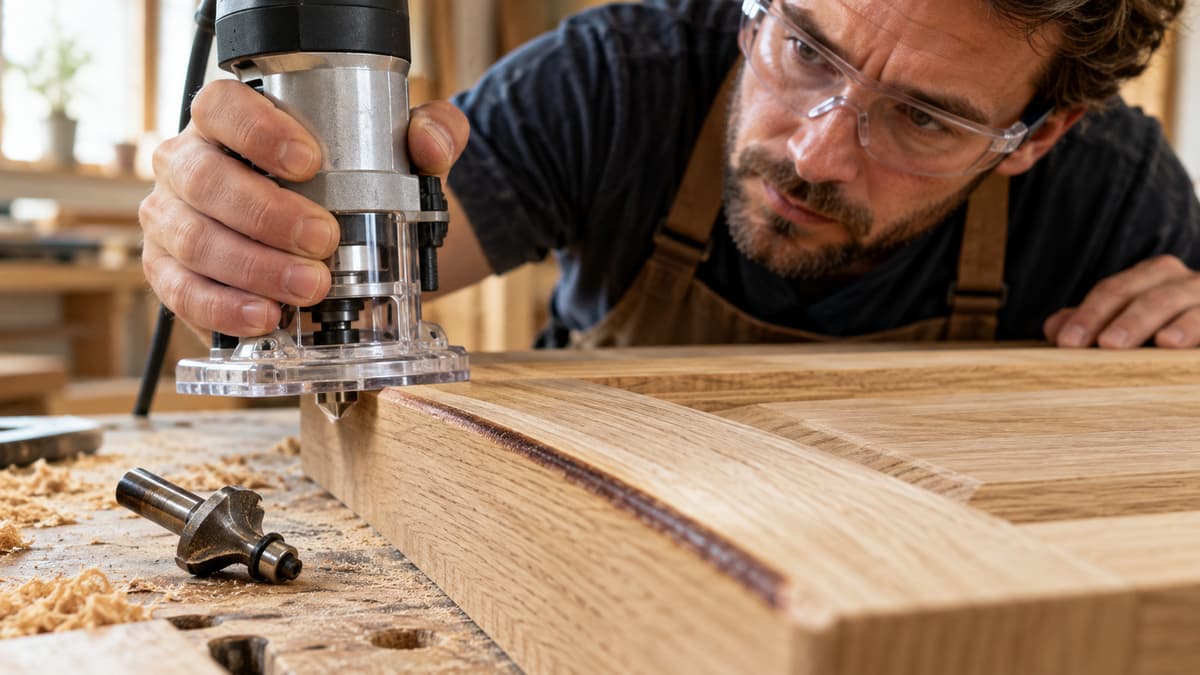
A slow feed or a blunt bit leaves a brown line. Check the cutter, then check whether the fence still holds.