Router burning wood: check the feed before the motor
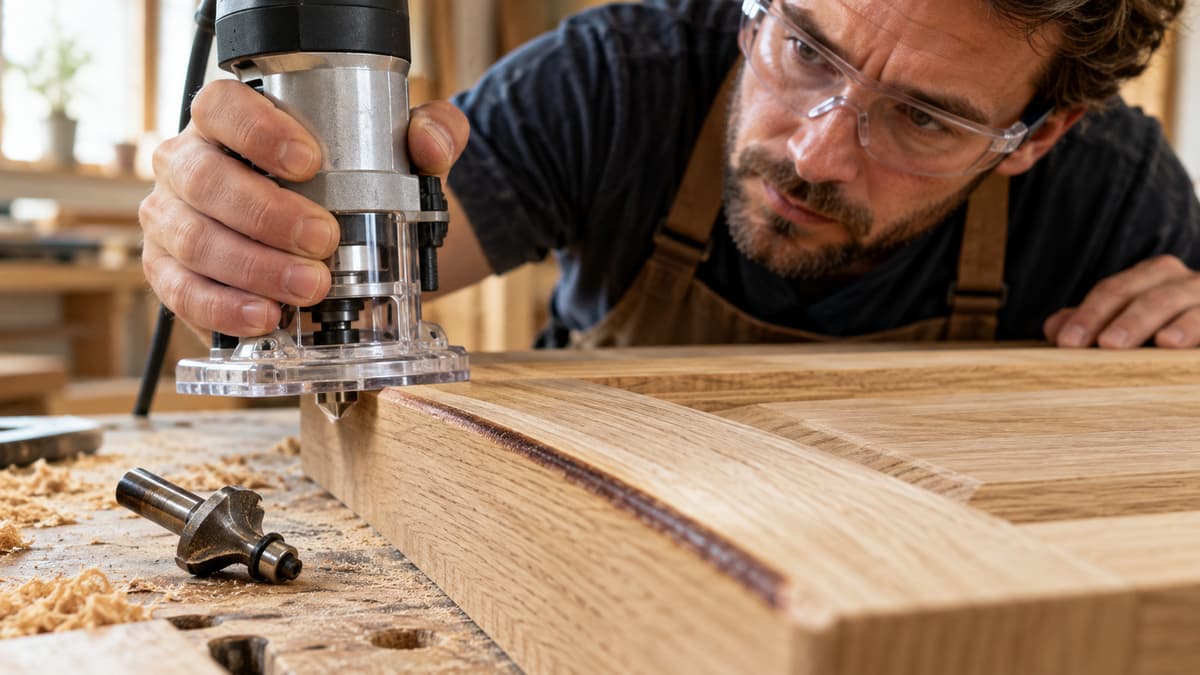
Router burning wood leaves a dark edge when the feed is slow, you pause on a corner, or the bit is blunt. Check the cutter before you blame the motor.
On this page

You finish a round-over on an oak door stile, lift the palm router, and the rounded edge is a dark brown line. The motor still sounds willing. Router burning wood is that line: heat in the fibres where the cutter rubbed instead of cutting a chip. A slow hand, a pause at the corner, or a blunt edge will leave it. Motor size is the wrong first suspect.
Work through a short order. Look at the bit, then how fast you moved, then the speed dial, then the depth of that pass, and only then the species. Router scorch marks on the same board, with the same bit, almost always change when the pace changes. If they stay put, the carbide was already finished.
The prices and review lines below are from the amazon.co.uk listings in this router set, and the feed advice follows Trend's UK note on feeding the timber. We did not scorch a test panel in a lab, and this page does not set a universal rpm. A qualifying purchase can earn a commission at no extra cost to you. Setup sits on how to use a router. The ten bodies are on the DeWalt router comparison.
In short
A dark edge is char from a cutter that stayed in one spot or could not make a chip. Feed with a steady pace, keep moving through the corner, take more than one pass when the motor note drops, and retire a blunt or pitch-coated bit. Oak shows the mark clearly, so change the edge and the feed before you change the machine.
Scorch marks are heat in the fibres
The black or dark brown line is burnt wood. Each tooth should lift a chip. When it skims and rubs, friction heats the carbide and the fibres beside it. A short rub at routing speed leaves a crescent you will see under oil.
Oak, ash, and beech show it quickly. They are dense, and the pale face makes a dark line obvious. Pine scorches too. Resin smears onto the carbide, the next inch runs hotter, and you can get a shiny brown smear.
The shank conducts that heat into the collet, so a bit that has just burnt an edge is too hot to pinch. Let it stop, then let it cool on the bench. A dip under the tap can stress a brazed tip. Pitch baked on in that heat makes the next pass start blunt.
A light tan haze can lift on a sharp clean-up pass. A black crust, crumbly under a fingernail, is char in the fibres. You recut to sound wood, or you hide the edge under paint.
Keep the feed moving, including the corner
Trend's UK guidance is direct. A tentative feed heats the cutter and burns the timber, because the teeth need a chip to carry heat away. On a hand-held router the feed rate is your pace. If the cutter sits in a corner while you plan the next move, the scorch is already there.
On oak, a pause under a second at the end of a stile is enough for a brown hook. Practise the path on an offcut so the corner is a change of direction. Keep pressure into the fence or the bearing so the cutter does not hop out and drop back in.
If the motor note falls, take another pass at less depth and keep the pace up. Trend also points at several passes when speed under load drops. One palm listing in this set prints a 3 mm pass limit. That is the seller's line, not a depth we measured. The turret is on how deep to cut with a router.
A hop or a lifted fence means the pace is too fast for that guide. You want a curl or a granular chip, not dust. Sort a loose guide on a scrap before you slow your hands to fight it.
Diameter, the speed dial, and a motor that bogs
At the same rpm, a bit twice as wide travels about twice as far at the cutting edge each revolution. That rule of thumb is why a wide cutter scorches when the hand is slow. Router speed too fast, on a large cutter, polishes and then burns. A small bit can stay faster if the shank is tight and the feed still makes a chip.
DeWalt fits a variable-speed control to the DCW604 and the DWE625 because one rpm does not suit every diameter. This page did not measure a safe rpm. A CNC chip-load table assumes a rigid machine, and a palm base on a door edge is not that setup.
In this amazon.co.uk set the speeds are claims. The TOPWAY at £49.99, our top pick for light edge work if you already own a pack, lists up to 28,000 rpm. The JOJOCY at £69.99 claims 10,000 to 30,000 rpm. The DCW620B at £324.98 prints no speed, so none is invented here. Drop the dial for a wider cutter and prove it on an offcut.
If a cordless pack sags, rpm falls while the dial stays put. Take a shallower pass or a sharper bit. A corded router that holds speed on a large cutter is a separate choice on the buying guide.
Blunt and dirty bits from the box
A blunt router bit burn looks like a slow-feed burn, which is why the motor gets the blame. You hear a higher squeal, the waste is dust, and pushing harder only heats the bit and the timber. A glazed face, or a rounded land, is finished for a clean edge.
Pine resin cooked onto the flute blocks the chip, so the next oak edge runs hot. Scrape it with a plastic scraper or a resin cleaner made for cutters. A wire wheel rounds the edge. A black crust on the carbide needs a new bit.
The JOJOCY at £58.99 lists six bits, is 3.5 from two reviews, and a UK review calls the bits and the rail guides inadequate. The TOPWAY at £49.99 does not list bits as included. UK reviews mention poor spanners and one slipped cutter. Tighten the nut, then tug the bit. A creeping shank rubs even with a new grind.
When last month's settings now scorch, the bit has changed. Replacing it is on when a router bit is blunt. A 6 mm bit in a quarter-inch collet is loose. The sizes are on router collet size: 6 mm or 1/4 inch.
What to change first
Use an offcut of the same timber, at least 300 mm long. Fit one sharp bit in the matching collet, tug it, and set a light depth. Reach speed before you enter, already moving. A bit spinning in one spot brands a crescent into the edge.
Run this order. Each line is a change you can see on the offcut.
- Make one steady pass that throws chips rather than dust.
- Copy that pace on the job and keep moving through the corner.
- If the motor note drops, take a shallower pass at the same pace.
- After a wider cutter, lower the dial and test on the offcut again.
- Treat the species as the problem only when those four still scorch.
A second light pass cleans a pale haze if the bit is sharp and you do not pause on the old mark. On a painted edge, stop sanding at 180 grit before a round-over goes flat. On a glue face, recut to sound wood, because char blocks the glue.
The TOPWAY, top pick at £49.99, 1.74 kg, and 4.3 from 47 reviews, has a UK review of a slipped cutter and poor spanners. It is a fixed palm base. A stopped groove on that base makes you dwell, and the dwell burns. The two bases are split on the plunge and trim page.
Common questions
Why is the edge black?
Is the router too powerful?
Should I slow the feed or the speed?
Do cheap bits burn more?
Does oak burn more than pine?
Will a second light pass clean it?
When is the bit finished rather than the technique?
Can I sand the scorch out?

Peter F. is the editor for DIY & tools at productscompared.co.uk. Comparisons in this category are checked against amazon.co.uk listings, review evidence and public UK sources.
Related articles

When a router bit is blunt
A bit from the box is often used until the edge burns or the carbide fails. A glazed cutter rubs the timber instead of making a chip.

How deep to cut with a router
One full-depth pass overloads a small cutter and leaves a burn. Several lighter passes keep the motor from bogging down in the cut.

Router collet size: 6 mm or 1/4 inch
A 6 mm shank is a different size from a quarter inch. A loose collet lets the bit slip, rub, and scorch the edge.