Router depth of cut: shallow passes, not the stroke

Router depth of cut is the bite of one pass, not the full plunge stroke. A 70 mm UK DeWalt travel and a printed 3 mm seller limit are separate figures.
On this page
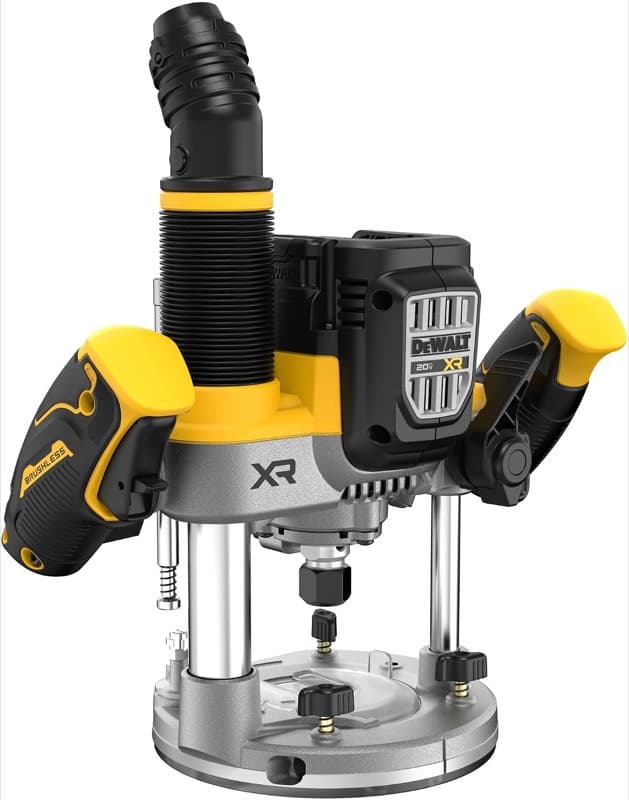
The shelf groove is marked at 20 mm, the bit is in the collet, and the turret still sits on its deepest stop. One pull would put that whole depth on the cutter. Router depth of cut is the timber you remove on this pass. The plunge stroke is only how far the motor can travel, and those two numbers get swapped on the first afternoon with a new router.
In this amazon.co.uk set the only plunge router is the DeWalt DCW620B, ASIN B0D484Q8QN, at £324.98, tool only, 4.7 from 175 reviews. DeWalt's UK kit page lists a 70 mm plunge for that class. That 70 mm is travel. A palm body here does not publish that stroke, and a fixed base has none.
The listings were read on 16 October 2026, with DeWalt's UK figures for the DCW604, DCW620 and DWE625 classes, Trend's getting-started note, Machine Mart's how-to, and a Faithfull jig example in 10 mm steps. We did not run a lab test. A qualifying purchase can earn a commission at no extra cost to you. Setup is on the how to use a router page, and the rows are on the DeWalt router comparison.
In short
Router depth of cut is the bite of this pass. Plunge travel on the DeWalt pages we checked is about 55 mm on the DCW604 class, 70 mm on the DCW620, and 80 mm on the DWE625 class, and you reach each stroke in steps. A 3 mm groove limit appears on two LIROPAU listings only. If the motor note drops, that step was too deep for the bit, the timber and the pack.
Travel is not the same as one bite
How far the carriage can drop is the plunge stroke. How much timber you take before you retract is the router depth of cut.
The DCW604 class is an 8 mm router, plunge about 55 mm, maximum cutter about 30 mm. It is not in these ten listings, so there is no amazon.co.uk price here. The DCW620 class is the plunge router in the set. DeWalt's UK kit page lists 70 mm of plunge, a 63 mm maximum cutter, and collets of 6.35 mm and 12.7 mm. The bare DCW620B file does not print 70 mm. It lists a three-position turret, a 2.25 hp claim and an item weight of 5.1 kg. The kit page's gross is 3.6 kg. The 70 mm is carriage travel. The 63 mm is cutter diameter.
The corded DWE625 class lists an 80 mm plunge, about 2,100 W to 2,300 W, at 230 V, and it is not in this amazon set. How deep can a router cut, as a finished groove, can be the full stroke in steps if the bit is long enough. A 20 mm shelf housing sits inside those strokes and is still more than one bite on a small cutter. Palm router maximum depth here is the seller's claim: 24 mm on the L1NXIXI at £54.99, and 49 mm on the YWNYT at £72.99, which the spec table does not repeat. Neither claim was measured here.
Setting the stop on the turret
The plunge router turret on the DCW620B is a three-position stop. You measure the step you lock on scrap. Trend's order is to preset the stop and the fence, reach full speed, plunge, and retract before you set the tool down. Fit the bit with the pack off, seat the shank and tug it. A quarter inch is 6.35 mm, not 6 mm, and a half inch is 12.7 mm, not 12 mm. Those sizes are on DeWalt's UK kit page, not in the bare file. On scrap of the same timber:
- Lower the cutter until it kisses the surface, and treat that height as zero.
- Raise the motor, lock a small step on the first turret stop, and make a short pass at full speed.
- Retract fully before you lift the base.
- If the note held, index to the next stop. If it fell, raise that stop before you continue.
Router pass depth is that locked step. How many passes for a 20 mm groove is 20 mm divided by the step that held its note, then a lighter pass inside the 20 mm. A measured 5 mm that held is four cutting passes. If the note fell, use a smaller step. That 5 mm is your measurement, not a depth for every bit.
A fixed base has no turret. The plunge and trim page is the split: a groove in the face needs the plunge. The TOPWAY at £49.99 is the comparison's pick for door edges when you already own a pack. It cannot start in the middle of a board.
When a listing prints a pass limit
A printed router depth per pass belongs to that listing. Two LIROPAU files in this set print one. ASIN B0DPFTC896, at £61.99, says each groove pass should not exceed 3 mm, in a sentence that also calls the tool a Wi-Fi router. The title says cordless and the spec line says power source ac. ASIN B0F93KXN6Z, at £59.33, prints a 3 mm pass limit and a base of 88 x 83 mm, without saying whether that base plunges. A 20 mm groove under that ceiling is six passes of 3 mm and a 2 mm last pass. That sum is for those bullets. It does not set the DCW620's pass, and the 70 mm travel does not erase what those sellers wrote.
The L1NXIXI, ASIN B0F5QFJJWV, at £54.99, claims up to 24 mm. It is 3.8 from 22 reviews and 1.71 kg. A UK review says a bit broke within about 3 inches of cut. The 24 mm is a maximum, not one bite. The YWNYT, ASIN B0H5CDVTP5, at £72.99, claims 49 mm and is 5.0 from one UK review. The spec table does not repeat 49 mm. One pass toward that figure on a 2.33 kg body is what a turret is for.
A Faithfull jig example uses 10 mm steps. That 10 mm belongs to the jig sheet. Mark 3 mm and 10 mm as someone else's figure before you lock a stop.
A lighter last pass
Machine Mart splits a deep cut and finishes with a light pass. Leave a little timber, run the heavier passes above it, and skim with the motor already at speed. On a 20 mm housing the skim is part of the 20 mm. Measure the groove with a rule, because the file does not publish the spacing of the three stops.
A wide bit asks more of the motor than a narrow one at the same depth, so the light pass matters more there. A round-over can be one locked height. A housing cannot, once you are past the step that held on scrap. If the note was steady and the floor still scorches, the bit is blunt, and the next deeper pass will scorch sooner. The skim cleans a cut the motor could already make. It does not add depth the stroke does not have.
If the motor bogs down
When the pitch drops hard, the pass is too deep, the feed is too fast, or the bit is blunt. Trend says to split a pass that drops the speed hard. A percentage on their feeding page is not a threshold we verified, so use the drop you can hear. Retract, recover, and raise the stop. Oak and ash drop the note at a step pine may accept. Prove the step on an offcut of the same board.
The DCW620B needs a battery, and none is in the box. DeWalt says a PowerStack or FlexVolt pack gives more power than a standard pack. We have not measured that claim. A sag that recovers after a pause is a reason to take less. The twist shut-off on a DCW620 is not a depth stop. A sink or hob opening is a joiner's job if you have not run a template. Stop too if the board might contain asbestos. The only UK review on this file says the tool failed after eight months, so 4.7 from 175 reviews is not a long British record. Prove the stops on scrap.
Common questions
How deep should one router pass be?
Is the plunge stroke the depth I should cut in one go?
Why does a seller say 3 mm?
How do I use a plunge router turret?
What is a finishing pass on a router?
Can a palm router match a 70 mm plunge?
Does hardwood change the router pass depth?
What should I do if the motor note drops?

Peter F. is the editor for DIY & tools at productscompared.co.uk. Comparisons in this category are checked against amazon.co.uk listings, review evidence and public UK sources.
Related articles

Kitchen worktop router jig
A worktop jig asks for a half-inch plunge router and a guide bush. Depth still comes in steps.
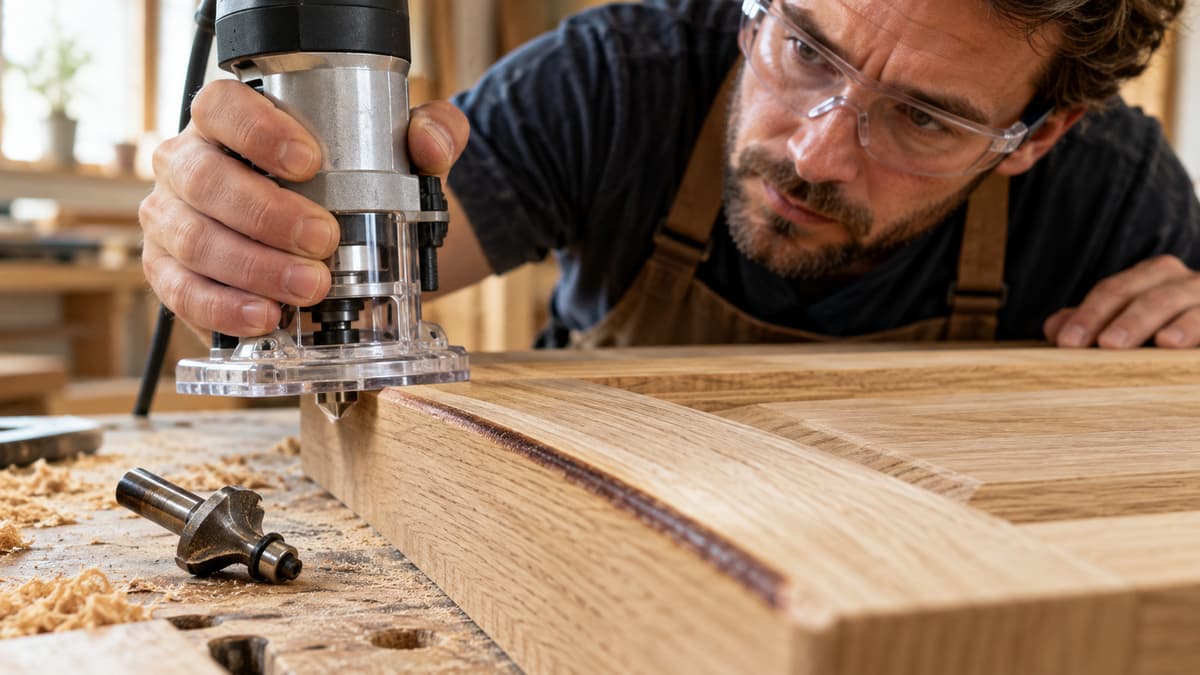
Why a router burns the wood
Scorch along a groove often comes from a slow feed, a blunt bit, or a pass that drops the motor note.

When a router bit is blunt
Included bits get used until they burn or snap. A deep pass on a dull cutter is a common way that starts.