Kitchen worktop router jig: the router the sheet asks for

A kitchen worktop router jig needs a half-inch plunge router, a 30 mm bush and a 12.7 mm cutter. An 800 W fixed palm trimmer misses that printed sheet.
On this page
The two lengths of laminate are on the floor, the jig is still in the box, and the only router to hand is an 800 W palm trimmer. A kitchen worktop router jig will not turn that trimmer into the machine the instruction sheet describes. Faithfull's KWJ Mark 3 sheet asks for a 30 mm guide bush, a cutter 12.7 mm in diameter and 50 mm long, and a half-inch shank. Trend's KWJ700 page asks for a plunge router that accepts a 12.7 mm shank, at least 1,300 W, the same 30 mm bush, and a 12.7 mm by 50 mm cutter.
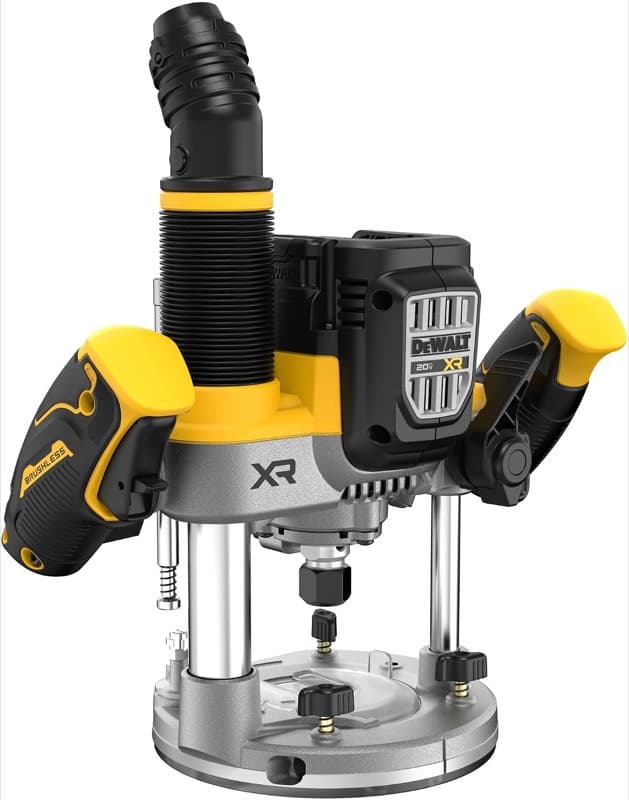
In the DeWalt router comparison, the half-inch plunge body is the DCW620B at £324.98, tool only. The palm rows are fixed bases, and the bits they claim are quarter inch. A sink or hob opening is where a fitter should take the slab. This page follows those sheets and the amazon.co.uk file. It does not replace the manual in the jig box, and we did not run a test cut. A qualifying purchase through our links can earn us a commission at no extra cost to you. The plunge and trim page separates a base that lowers the cutter from a base that cannot.
In short
A kitchen worktop router jig is drawn for a plunge router, a 30 mm guide bush, and a 12.7 mm cutter on a half-inch shank. Faithfull's female-joint example steps down in 10 mm passes, and that depth belongs to that sheet. An 800 W fixed palm trimmer, including the JOJOCY in this comparison at £69.99, misses Trend's 1,300 W line and cannot plunge into the face of the worktop.
The jig is a template, not a skill bypass
A worktop jig is a shaped template. The guide bush runs in the slot and the cutter follows at a fixed offset, which is why the sheet names one bush diameter. A different bush means the male and female profiles no longer meet. The jig does not choose the router, and it does not replace the cut order printed on your own instructions.
You still set the collet, the depth stop, and the feed, and you keep the bush in the slot for the whole pass. If the bush lifts out, the bolt holes miss the recess the sheet drew. Follow the pins and the clamp marks on the jig you bought. This article only checks that the router is the class of tool that sheet assumes.
Post-formed laminate is a heavy job on a kitchen floor. The jig saves a freehand scribed joint. It still needs a half-inch shank and a 50 mm cutter taken in steps. Practise the bush on scrap chipboard before the worktop leaves the wrapping.
The straight joint is what these jigs are sold for. Support both lengths so the template cannot twist while you clamp it. A sink or hob cut-out is a different template, and the buying guide separates a plunge body from a trimmer before you spend.
Router, bush, and cutter the sheets ask for
Faithfull's KWJ Mark 3 instructions specify a 30 mm guide bush, a 12.7 mm cutter, a 50 mm cutting length, and a half-inch shank. The worked example for the female joint uses 10 mm passes. That 10 mm step is for that example. Use it on another jig only when that sheet also prints 10 mm.
Trend's KWJ700 page asks for a plunge router with 12.7 mm shank capacity, at least 1,300 W, a 30 mm bush, and a 12.7 mm by 50 mm cutter. A powerful router with the wrong bush still cuts the wrong offset. A correct bush on a quarter-inch collet cannot hold that cutter. Buy the bush with the jig when the box does not list one.
DeWalt's UK pages put the DCW620 in the half-inch class with a 70 mm plunge, and the DWE625 in the half-inch class with an 80 mm plunge. Plunge travel is not one pass, and it is not Faithfull's 10 mm step. The DWE625 includes list names a 30 mm bush, so confirm a used kit still has it. The amazon.co.uk file for the DCW620B, ASIN B0D484Q8QN, prints neither a collet nor a bush. It lists a three-position turret, 5.1 kg, a 2.25 hp claim, and £324.98 with the battery not included.
The only United Kingdom review says it failed after eight months, so 4.7 from 175 reviews is not a long-service record. Trend's KWJ650 line 1/2 inch / 12 mm mixes two shanks. A half inch is 12.7 mm. Seat the shank you actually have. The how to use page covers closing the nut on that shank.
Why a palm trimmer is the wrong body
In this comparison the JOJOCY at £69.99 claims 800 W, six speeds from 10,000 to 30,000 rpm, a fixed base, and 2.25 kg. It is not a DeWalt. A fixed base holds one height and starts from an edge.
The jig needs the cutter lowered into the face and lifted inside the slot. A palm trimmer stays at one height. A plunge router can be locked later for edge work.
Trend's 1,300 W line sits above the 800 W claim. We did not meter the JOJOCY. The DCW620B prints 2.25 hp, not watts, so that file does not tick the watt line by itself. It does show a plunge title and £324.98 with no battery. The corded DWE625, with an 80 mm plunge and a 30 mm bush on DeWalt's includes list, is not in this amazon set and has no amazon.co.uk price here.
Most kept ASINs are fixed palm tools with quarter-inch bits claimed. A quarter inch is 6.35 mm, so it will not hold a 12.7 mm shank. The DCW620B lists 5.1 kg against the JOJOCY's 2.25 kg. If your only yellow tool is that palm trimmer, leave the worktop wrapped. Check the collet when the DCW620B arrives, because the amazon table leaves it blank.
Passes, clamps, and the post-formed edge
On Faithfull's female-joint example the step is 10 mm. A 50 mm cutter and a 70 mm or 80 mm plunge describe reach, not one drop. A full-depth pass heats the laminate and makes the bush harder to hold in the slot. Lock the steps on the turret. If your sheet prints a different step, use that step.
Clamp the jig so the worktop cannot walk. A clamp knob in the slot forces a stop the laminate will show. Clear the path, retract the cutter, then set the router down.
The post-formed edge is the rounded front of the worktop. The male and female profiles let that curve continue across the joint. A small shift becomes a lip the bolts will not plane away. Dry-fit the lengths in daylight, then stop. The sink or hob opening needs its own support and its own template.
When to hand the slab to a fitter
Hand the slab over when the opening is a sink or a hob and you have not run an internal template. Unsupported waste in the middle breaks the laminate on the way down and takes the edge with it. A fitter already owns that support. A second worktop costs more than the call-out.
Hand the job over as well when the collet is not half inch, the 30 mm bush is missing, or the only router is a fixed palm trimmer. The DCW620B is the plunge router in this set, at £324.98 tool only, 5.1 kg, with one router in the box. Confirm the collet, and read the United Kingdom review that reports a failure at eight months, before you treat 4.7 from 175 reviews as a workshop record.
Wear a mask and run extraction for the whole joint. Chipboard dust does not stop because the cut is short. If you cut at work, follow your employer's controls for a hand-held router. If an old top might contain asbestos, leave it. The jig is the template. The router it assumes is a half-inch plunge tool with a 30 mm bush.
Common questions
What router does a worktop jig need?
What guide bush does a kitchen worktop jig use?
What cutter diameter and shank should I fit?
Can I joint a worktop with an 800 W trimmer?
How deep is each pass on a worktop jig?
Can I joint a worktop that has a sink cut-out myself?
Is 12 mm the same as half an inch on the jig sheet?
Does the DeWalt corded router have a 30 mm bush?

Peter F. is the editor for DIY & tools at productscompared.co.uk. Comparisons in this category are checked against amazon.co.uk listings, review evidence and public UK sources.
Related articles

Router collet size: 6 mm or 1/4 inch
A 6 mm shank is a different size from a quarter inch, and 12 mm is not a half inch. The wrong collet wastes the bit.

How deep to cut with a router
One full-depth pass overloads a small cutter. Lock several shallow steps on the turret before the bit reaches finished depth.
Why a router burns the wood
Scorch marks usually come from a slow feed or a blunt bit. Look at the cutter and the pace before you blame the motor.