Corded or cordless router: pick by the cutter

A corded or cordless router is a cutter decision. A 230 V motor holds speed on a large bit, and an 18 V body is the easier tool to move between rooms on a job.
On this page
You are halfway along a landing, rounding a door edge, and the lead has looped a stair spindle. Later you are at the bench with a wide bit in oak, and the motor note drops as soon as it takes a full bite. Corded or cordless router is the choice of which supply can finish the cut you actually have.
A cordless body suits a small cutter when you already own a pack and the lead is what slows you down. A 230 V motor suits a large cutter that has to hold speed for the whole pass. Peter F. read the amazon.co.uk listings in the DeWalt router comparison, DeWalt's UK pages for the DCW620 and the DWE625, and the power-source notes from Howe Tools and the Axminster DWE625KT page, on 16 October 2026. We did not run a lab test or time a battery. A qualifying purchase can earn a commission at no extra cost to you.
In short
Choose a cordless router for door edges, hinge recesses, and any cut where the lead slows you down. Choose a 230 V router when the cutter is large, the pass is long, or you are jointing a worktop beside a socket. A 110 V site router stays on a 110 V supply. It is the wrong plug for a house.
What each supply is for
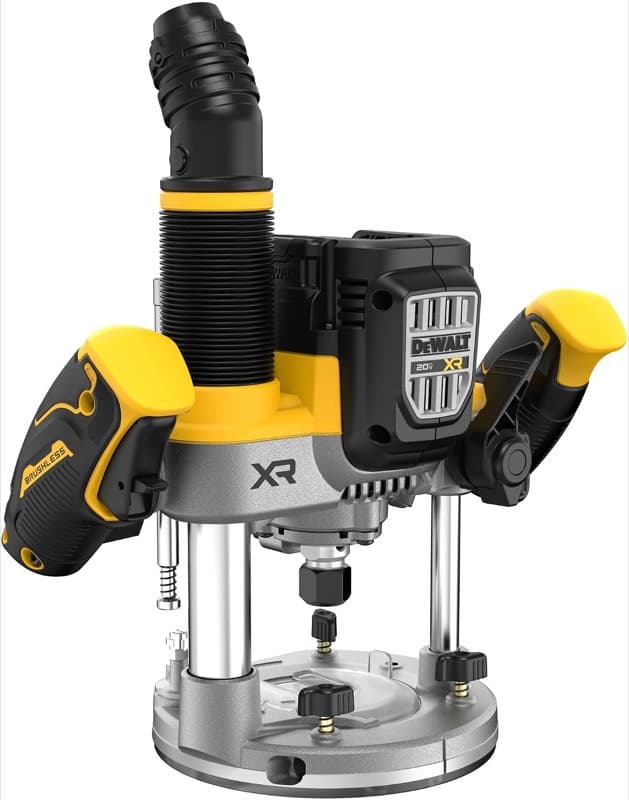
DeWalt's UK page for the cordless DCW620 lists 11,000–23,000 rpm and a 70 mm plunge. The corded DWE625 page lists 9,000–22,000 rpm, an 80 mm plunge, and about 2,100–2,300 W. The speed bands overlap, so the top of the dial will not pick a winner. The corded page states a mains wattage in the two-kilowatt class. That is the figure that matters when a wide cutter loads the motor.
On amazon.co.uk the bare body in our set is the DCW620B at £324.98, listed at 4.7 from 175 reviews. The title says 20 V. The power claim is 2.25 hp, the item weight is 5.1 kg, and the box is the router alone. Horsepower on a battery listing and watts on a mains page are different claims. Do not treat 2.25 hp as proof the pack holds a 2,100 W cut. Collet size is absent from that spec table.
The other nine routers in the set are third-party palms. Several claim about 800 W. The JOJOCY at £69.99 is one of those claims, on a fixed base, and the Chengsuwei is £47.49. Howe's guide notes that cordless routers are more common on quarter-inch work.
When cordless is the better tool
Cordless earns its place when the work moves and the cutter stays small. Hinge recesses, a round-over on a door, and a light chamfer on architrave all put the socket a room away. In this set the TOPWAY at £49.99 weighs 1.74 kg, has a fixed base, and is listed at 4.3 from 47 reviews. Several United Kingdom reviews say it runs on a DeWalt 18 V pack and that people have used it on doors and hinge recesses. The battery is not included, and the same reviews mention poor spanners and one slipped cutter, so tug-test the bit before the real edge.
A fixed base cannot start a cut in the middle of a board. A groove that begins inside the face needs a plunge, which is the DCW620 class. The plunge versus trim page separates those bases before you choose a supply. The amazon DCW620B bullets include a three-position turret and dual LEDs, and the listing weight is 5.1 kg. On a ladder, take the palm and leave that plunge at floor level.
Every cordless row in this set is tool only. The 18V XR page sets out the battery family. The DCW620B title says 20 V, and UK reviews of the TOPWAY say a DeWalt 18 V pack runs that palm. That does not mean every pack fits the plunge. Check the fit before you buy a second charger, because two titles print a different number.
When the cord is the point
The cord is the point when the motor has to stay at speed under a large cutter. A wide moulding or a long pass in oak shows a fading pack as a burn or a stepped edge. We did not measure that sag. The published reason to keep a mains motor is the 2,100–2,300 W class on the DWE625 page, with 80 mm of plunge against 70 mm on the cordless DCW620. In a workshop the socket is already on the wall.
A kitchen worktop usually sits on this side of the line. Jig instructions that join a laminated top expect a plunge router and a guide bush, and a fixed palm does not meet that instruction. Both plunge depths can clear a top in passes. A socket beside the units makes the 230 V motor the simple choice. With no nearby 230 V outlet, a cordless plunge can make the joint in shallow passes with a second pack. This page will not promise that one charge finishes a kitchen.
230 V at home and 110 V on site
UK mains are 230 V, and the domestic plug is BS 1363. Shop to that plate, even where older copy still says 240 V. Howe's buying guide also talks about 110 V for site. A 110 V router stays on a 110 V supply. Do not cut the yellow plug off and fit a 13 A plug, and do not force an adaptor into a house socket. If the van tool is 110 V, a house job usually needs a site transformer. This pass did not price one. For a weekend bench, buy the 230 V version and leave the yellow lead in the van.
Axminster lists the DWE625KT as 230 V with a 3 m cable. Three metres is short when the bench is in the middle of a garage, so use an extension meant for a motor of this class, not a lamp reel. A 230 V plug does not belong on a site that only offers 110 V either. A battery plunge never sees that temporary board. That is a fair reason to own one if your week is other people's houses, and a poor reason to retire a 230 V motor that already fits the workshop.
What a battery listing will not tell you
There is no runtime test in this project, so a minutes-per-charge figure would be a guess. The drain changes with cutter diameter, depth of cut, the timber, and the pack you own. The DCW620B at £324.98 cannot reveal that figure, because the battery is not in the box. DeWalt's UK page for the DCW620H2-GB is a different product, sold with two 5 Ah packs.
The listing is 4.7 from 175 reviews. Review texts that praise dust collection are mostly from outside the United Kingdom. The only United Kingdom review says the tool failed after eight months. That is one review, not a workshop survey, so 4.7 is not a UK record of long service. Axminster's DWE625KT page carries a declared noise figure. This article does not repeat a decibel number. A short cut is still loud.
Which supply to buy
Buy a cordless palm if the work is door edges and hinge recesses and a DeWalt pack is already charged. In this set that is the £49.99 fixed-base body at 1.74 kg, with no plunge and no battery in the box. Buy the DCW620B at £324.98, tool only, if you need a cordless plunge for stopped cuts away from a socket and you have read the UK failure review beside the 4.7 line. It is the only DeWalt body in the amazon set, and it does not replace a mains motor on a wide cutter.
Buy the corded 230 V router if the tool will live in the workshop or you are jointing worktops next to a normal socket. Shop the DWE625 class as 230 V with a BS 1363 plug, and leave any 110 V version with the site kit. If your week is both a landing and a bench, own both supplies. Check the shelf price on the day, because a tool-only figure moves, and a kit with two packs is a different basket.
Common questions
Is a cordless router as powerful as a corded one?
Will a cordless router cut a kitchen worktop?
What voltage do I need for a router at home?
Can I use a 110 V site router in a house?
How long does a router battery last?
Which router is lighter on a ladder?
Do I still want a corded router in the workshop?
Does soft start exist on both corded and cordless routers?

Peter F. is the editor for DIY & tools at productscompared.co.uk. Comparisons in this category are checked against amazon.co.uk listings, review evidence and public UK sources.
Related articles

How much does a router cost UK
Palm bodies in this amazon set are £47.49 to £72.99. The DeWalt plunge is £324.98, and the battery is still extra.

Kitchen worktop router jig
A worktop jig wants a plunge router and a guide bush. A fixed palm trimmer does not meet that instruction.

Router collet size: 6 mm or 1/4 inch
A 6 mm shank is a different size from a quarter inch. The wrong collet will not hold the bit you already own.