




An AC load you can separate
You want a mains AC check and you should not open a consumer unit live. The AstroAI CM2K0R is about £18.99, with 4.5 from 8,794 reviews and CAT III 600 V. The listing says the jaw cannot test DC current.
The best current clamps, compared.
Top pick: BSIDE UP1 scope clamp Best value: AstroAI CM2K0R clamp meter – About £18.99, 4.5 from 8,794 reviews and CAT III 600 V, for mains AC when DC current is not part of the job. Updated October 2026.

A current clamp reads current from the magnetic field around a conductor, so you do not break the circuit. On amazon.co.uk the usual product is a clamp meter: the jaw, a display, and often voltage and continuity on probes. True is for distorted waveforms, not a safety rating. The [AC or DC current clamp](/hub/pliers/current-clamp/sub/current-clamp-ac-or-dc) page is that one decision, before a brand. The first split is what the jaw measures.
A current clamp reads current from the magnetic field around a conductor, so you do not break the circuit.

42 products checked · 62 hrs invested · +22,800 readers
Swipe for more
1-2 of 12


Personal buying guide
Question 1 of 2
What does the jaw need to read?
The BSIDE UP1 is not a handheld multimeter. At £49.99 it is a current-clamp transducer with a BNC output for a digital oscilloscope, stated from 10 mA to 100 A AC/DC and up to 20 kHz. The star line is 5.0 from four reviews, with one of three stored bodies labelled in the United Kingdom, so the US and German texts are not British opinion. The UK reviewer says it does what it says and that accuracy on the 10 A range was still acceptable, and also that it drifts after zeroing on the 100 A range more than they wanted. A BNC-to-4 mm banana adapter is not in the box, which matters if the scope does not take BNC directly. The listing includes the transducer, a manual, a bag and a charging cable, on a rechargeable cell, at 121 g. There is no CAT line, no non-contact voltage and no meter screen. If you do not already own a scope, this listing does not give you a number you can read on its own.
Pros
Cons
Best for: Someone who already has an oscilloscope and wants a current waveform, after zeroing, on the 10 A range the UK review found acceptable.
Less suitable: A householder who wants a number on a clamp-meter screen, or a distribution board.
Specifications
Common questions
Does the jaw measure DC current?
Yes. The listing states 10 mA to 100 A AC/DC into a BNC oscilloscope input, not a multimeter screen.
Will it work as a handheld multimeter?
No. The listing is a current-clamp transducer with a BNC output for a digital oscilloscope.
What is in the box?
The transducer, a manual, a bag and a charging cable. The UK review says a BNC-to-4 mm banana adapter is not included.
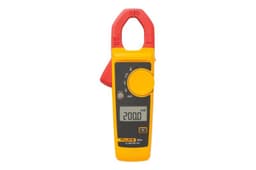
The Fluke 302+, at £123.06, carries the highest star line in the set: 4.7 from 2,549 reviews. Only four of 50 stored review bodies are labelled in the United Kingdom, and those UK texts call it accurate and well made, with simple ranges for current, voltage and continuity. The listing marks CAT IV 300 V and CAT III 600 V, and the jaw is AC only, up to 400 A. It does not measure DC amps in the clamp, which reviewers note, and the bullets do not claim True RMS. The box is the meter and TL75 hard-point test leads, with no carry bag listed, at 426 g, and the country of origin field says Malaysia. One stored review mentions a 30 mm jaw, which is not in the specification block, so 30 mm stays a review remark rather than a Fluke field. You pay for the category line and the long review file, not for solar DC or a milliamp leakage resolution. Most of the stored praise is from other marketplaces, so the 2,549 is not a count of UK-only opinions.
Pros
Cons
Best for: AC work where the CAT IV 300 V / CAT III 600 V line matters more than DC current.
Less suitable: Battery or solar DC, a milliamp leakage check, or a buyer who needs the review file to be mostly British.
Specifications
Common questions
Does the jaw measure DC current?
No. The listing does not give this jaw a DC current range.
What safety marking is on the listing?
CAT IV 300 V and CAT III 600 V.
Are test leads included?
Yes. The included-components line names the TL75 hard-point test leads. A carry bag is not listed.
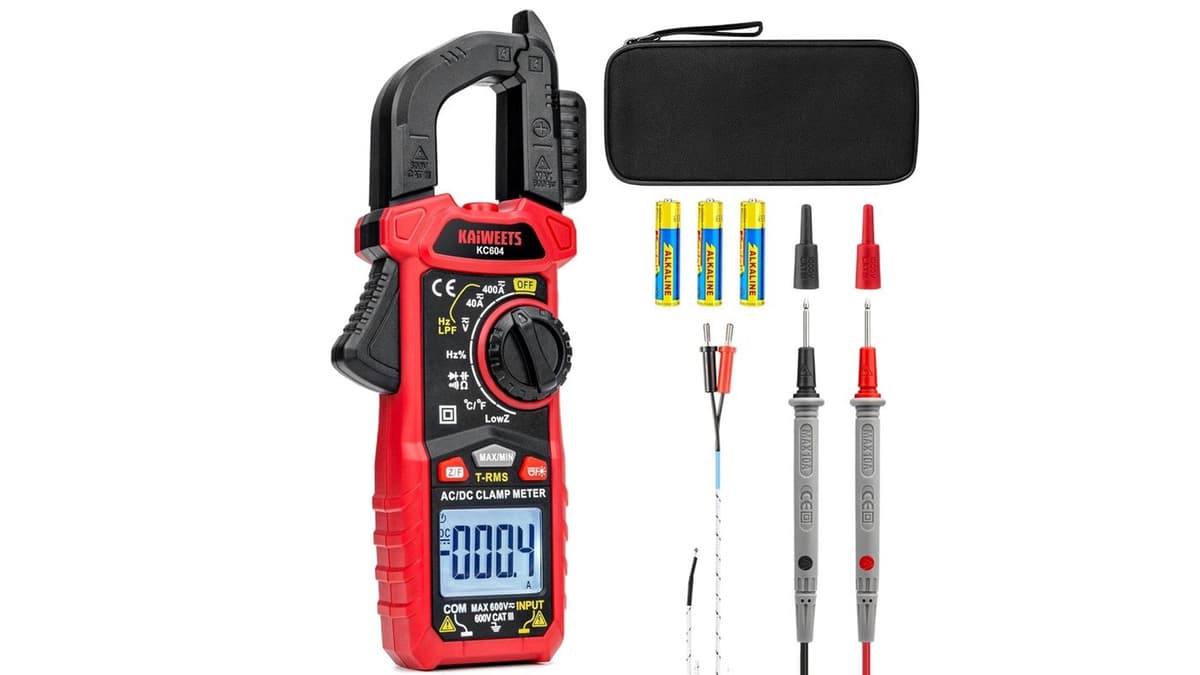
The KAIWEETS KC604 is the top pick in this set for a general AC and DC jaw: £30.39, 4.6 from 1,993 reviews, 400 A AC/DC and CAT III 600 V on the bullets. All 50 stored review bodies are labelled in the United Kingdom. Reviewers bought it because another clamp was AC-only, mention a one-handed mode dial, and one comparison with a calibrated instrument was called reasonably accurate. True RMS, LowZ and LPF are stated, the jaw opening is 2.8 cm, and an orange backlight warns above 80 V or 1 A. It weighs 410 g. The bullets list a carry case, a manual and two sets of leads, while the included-components field says no, and one reviewer says the manual will not fit the case-cover pocket. Counts are not stated, and no stored review in that sample describes a dead jaw. It remains a load meter: a 400 A range has not measured 9 mA of leakage, and it is not a CAT IV meter for the origin of the installation.
Pros
Cons
Best for: Mains AC plus domestic solar or battery DC, when CAT III 600 V is the category you need.
Less suitable: Service-head work that wants CAT IV, or a BS 7671 leakage figure in milliamps.
Specifications
Common questions
Does the jaw measure DC current?
Yes. The listing states AC and DC current in the jaw.
Does the listing include temperature measurement?
Yes. A thermocouple is included on the bullets.
Does it come with a case?
The bullets say it comes with a carry case. The included-components field says no.
The KAIWEETS HT206D title says 600 A AC/DC and 600 V, and the review file is the largest here: 4.5 from 11,767 reviews at £42.49, with all 50 stored bodies labelled in the United Kingdom. Reviewers use it for current on cars and solar without breaking the circuit, like the narrow jaw on automotive wiring, and one electrician says a quick job left them less sceptical. LowZ, LPF, a two-colour backlight, 6,000 counts, a thermocouple, two AAA batteries and a storage bag are listed, and it weighs 218 g. The standards line is IEC 61010-1:2000-1 and does not state a CAT III or CAT IV pair. DC is the recurring limit: an empty jaw still showed about 0.2 A until it was zeroed, and a reviewer says useful DC stops around 60 A, so it is no use on a starter motor. Probe leads are called too short, and a retired Fluke user would not use it as a professional main meter. One reviewer clamped a live conductor and expected volts from the jaw, which stayed at zero because the jaw reads current. True RMS and the jaw opening are not stated.
Pros
Cons
Best for: An AC or modest DC load check where the review volume matters and you zero the jaw before every DC reading.
Less suitable: Starter-motor current, or work that needs a printed CAT III or CAT IV rating.
Specifications
Common questions
Does the jaw measure DC current?
Yes. The listing states AC and DC current in the jaw. Reviewers describe zeroing trouble, and useful DC around 60 A rather than starter current.
Does the listing include resistance?
The auto-ranging description includes resistance among the usual multimeter functions. A dedicated resistance range figure is not stated.
Is the display backlit?
Yes. The listing states a two-colour backlight.
The AstroAI CM2K0R, at £18.99, is the AC clamp buyers in this set have reviewed in the largest numbers: 4.5 from 8,794 amazon.co.uk reviews, with 31 of 50 stored texts labelled in the United Kingdom. Reviewers use it for DIY checks and, in one case, generator loading on a motorhome, and several say a comparison with another meter was close enough for that work. The listing's important tip says the jaw cannot test DC current, and several UK reviewers say the advert had suggested otherwise, so a battery lead or a solar string can read zero while current is flowing. Probes go to 600 V, the safety line is surge category III 600 V, and the display is 2,000 counts with non-contact voltage and a backlight that reviewers mention. The box lists the meter, a pair of test leads, a manual and a storage bag, at 415 g. One reviewer found the leads too loose to use, and another says a unit failed in under a year after a battery change. True RMS and the jaw opening are not stated. It is the best-value row when the job is mains AC, and the wrong saving when the current is DC.
Pros
Cons
Best for: Mains AC load checks, including a flex you can separate, when DC current is not part of the job.
Less suitable: Car batteries, solar DC, or any buyer who read AC/DC on a title and expected current in a DC cable.
Specifications
Common questions
Does the jaw measure DC current?
No. The listing's important tip says this meter cannot test DC current.
What safety line is on the listing?
600 V surge category III.
The Crenova 606C+ lists AC and DC current in the jaw up to 600 A, a 25 mm opening, True RMS and CAT III 600 V, at £29.99 with 4.4 from 414 reviews. Of 50 stored texts, 47 are labelled in the United Kingdom, and reviewers use the jaw on solar panels and car batteries, which is the Hall-effect job an AC-only clamp misses. The bullets name LowZ, V.F.C. and inrush, and the box lists probe leads, alligator clips, a K-type thermocouple and AAA batteries. Reviewers describe a case as part of a complete kit, while the included-components line does not use the word case, and one zip failed on the second use. One reviewer says temperature measurement does not work, even though the same thermocouple worked on another meter. Another calls the non-contact voltage indication too ambiguous to rely on, and the continuity beep needs extra button presses. At 590 g it is one of the heavier meters here. A 600 A range still will not resolve a few milliamps of leakage.
Pros
Cons
Best for: An AC and DC load clamp around £30 when you want a stated 25 mm jaw for solar or car cables.
Less suitable: A leakage figure in milliamps, or a purchase made mainly for the temperature range.
Specifications
Common questions
Does the jaw measure DC current?
Yes. The listing states AC and DC current in the jaw.
Does the listing include temperature measurement?
Yes, with the included K-type probe. One reviewer says temperature measurement did not work.
Does it come with a case?
Reviewers describe a case. The included-components line lists leads, clips, a thermocouple and batteries, not the word case.
The Neoteck CM-3002 bullets and style name say up to 800 A AC/DC and True RMS, with a colour screen, at £42.74 and 4.3 from 402 reviews. Forty-six of 50 stored texts are labelled in the United Kingdom. Reviewers mention the kit of leads, thermocouple and pouch, and one calls voltage, resistance and the thermometer fast or accurate, while capacitance works but takes about 3–4 seconds with no on-screen progress. The standards line is CE only, so there is no CAT pair to quote. One reviewer says DC current is not an option, which conflicts with the 800 A AC/DC title, and another says a whole mains flex reads nothing, which is what a healthy flex does when live and neutral are clamped together. Test leads are called hit and miss, resistance was inconsistent on one unit, and one unit did not work at all. The maximum operating voltage field says 800 volts while the style name is talking about 800 A. Weight is 220 g and counts are 6,000, so confirm the DC function is on the dial before you rely on the bullet.
Pros
Cons
Best for: A colour-screen AC clamp for home checks, after you confirm DC current is actually on the meter you received.
Less suitable: Solar or battery work you cannot return, and any board where you need a CAT rating on the label.
Specifications
Common questions
Does the jaw measure DC current?
The listing states AC and DC current in the jaw. One reviewer says DC current is not an option on the meter they received.
Does the listing include temperature measurement?
Yes. A thermocouple is in the box.
Does it come with a case?
A storage pouch is in the included components.
The Kethvoz KE-7200APP is the Bluetooth clamp in the set, listed from 10 mA to 400 A AC/DC at £42.99, with 4.1 from 56 reviews and 38 stored UK texts. Reviewers use it to log car-battery current without breaking the circuit and call the app handy for that. True RMS, a 26 mm jaw and 6,000 counts are stated, and the safety line is CAT II 600 V and CAT III 300 V, which stops short of the CAT III 600 V meters. The same reviews are why the logging claim needs a limit: the Bluetooth link drops after a few minutes, so a long log fails. One reviewer returned a unit that sat at about 1 A with no current and showed a temperature that was not zero with no thermocouple connected. Another failed after a year of little use, with bad internal connections on the selector switch. The included-components line names only the user manual, while a reviewer lists probes, batteries and a carry case. It weighs 390 g, and a stated 10 mA floor is already coarser than a 9 mA leakage decision you would want to trust on the last digit.
Pros
Cons
Best for: A short Bluetooth log of an AC or DC load that stays inside CAT III 300 V.
Less suitable: A long unattended log, a 600 V distribution board, or a 9 mA leakage figure.
Specifications
Common questions
Does the jaw measure DC current?
Yes. The listing states AC and DC current in the jaw.
Does the listing include temperature measurement?
Temperature is in the measurement list. A reviewer reports a temperature reading that is not zero with no thermocouple connected.
Is a backlight specified?
A dedicated backlight line is not stated.
The BSIDE ACM91 lists AC and DC current with a 1 mA claim, True RMS and LowZ, at £49.99 and 3.9 from 13 reviews. Only three review bodies are stored, all labelled in the United Kingdom, and none of them praises the 1 mA claim. The leads did pass current after the reviewer worked the shrouded plugs into the sockets, and the meter powered on and showed a reading after zeroing. The same texts call it inaccurate and poor value: after zeroing, the reading wandered with nothing in the jaw, and the reading changed when the meter was moved on the cable. The standards line names IEC 61010-1, IEC 61010-2-030, IEC 61010-2-032 and IEC 61010-2-033, without a CAT voltage beside them. It is a 6,000-count meter at 137 g. The bullets mention a case, while the included-components field names the meter, and no jaw opening in millimetres is given. Naming the clamp-meter parts of IEC 61010 is not the same thing as a stable milliamp.
Pros
Cons
Best for: A buyer who will check the leads and the zero on a known current before trusting any milliamp.
Less suitable: A BS 7671 leakage figure, or a jaw you expect to hold its reading when you move the meter.
Specifications
Common questions
Does the jaw measure DC current?
Yes. The listing states AC and DC current in the jaw.
Does the listing claim 1 mA resolution?
Yes. Stored UK reviews instead describe leads that did not seat, a reading that wandered after zeroing, and a reading that changed when the meter was moved.
Is a jaw opening given?
No millimetre figure is in the file.
The BSIDE U0 is an open-jaw fork, not a closing clamp, listed at £35.99 with AC and DC current in the fork. You slide a conductor into the slot instead of squeezing a hinge. The only stored review is labelled in the United Kingdom, against a star line of 3.9 from six reviews, so five ratings are not in the file. That reviewer used it on caravan electrics, liked an audible tone while tracing indicators in a car boot, and praised the light body and a hidden USB-C port on the rechargeable cell. The same review says some functions are fiddly and that the instructions need to stay handy. It weighs 102 g, measures 19.2 × 3.6 × 3 cm, and lists probes to 600 V, with a charging cable, probe pins and test leads in the box. The specification met line is CE only, which is not a CAT rating. True RMS and a jaw opening in millimetres are not stated, and one caravan job is not a record of accuracy on a consumer unit.
Pros
Cons
Best for: A pocket check of an accessible conductor, such as caravan wiring, if you accept a single stored review.
Less suitable: A consumer unit or any job where you need a stated CAT III or CAT IV line.
Specifications
Common questions
Does the jaw measure DC current?
Yes. The listing states AC and DC current in the jaw.
Is the jaw a closing clamp?
No. The listing describes an open fork, so you do not open a hinge.
Is it rechargeable?
Yes. The bullets say a built-in rechargeable battery, and the only stored UK review mentions a hidden USB-C port.
The Elitech CM-210DC bullets claim up to 1,000 A AC/DC, True RMS, CAT III 600 V and CAT II 1000 V, at the stored shelf price of £29.99. The star line is 3.8 from six reviews, and only one of five stored bodies is labelled in the United Kingdom, so a German Vine text in the file is not a UK verdict. That UK review says AC and DC current both worked, unlike cheaper AC-only clamps, and that voltage sat close to other meters the reviewer owns. The same review calls the thumb wheel cheap and says this is not a professional-class tool. A separate UK note calls it really good for checking solar-panel DC cables. The box lists test leads, a K-type probe and three AAA batteries. Jaw opening is described as large, without a millimetre figure, and the specification block does not repeat the CAT line that the bullets claim. Six ratings cannot show whether a dead unit is rare, and the UK reviewer mentions £35.99, which is not the £29.99 captured on the listing.
Pros
Cons
Best for: An occasional DIY look at solar DC cables, if you can return the meter when a known load does not match.
Less suitable: A working electrician who wants a large UK review file behind the 1,000 A and CAT claims.
Specifications
Common questions
Does the jaw measure DC current?
Yes. The listing states AC and DC current in the jaw.
What does the stored UK review say about DIY use?
The UK reviewer calls it reasonable for occasional DIY, and not what they would want as a professional electrician.
Does the listing say it can be used on live circuits?
The listing does not answer that beyond the CAT claim.
The BSIDE UX1 is listed at £49.99 with an AC and DC jaw, a 1 mA claim, True RMS, a colour screen and a built-in rechargeable battery. The star line is 3.2 from five reviews, and four stored bodies are labelled in the United Kingdom. Two of those reviewers call it good or excellent value, one says it works very well for DC and AC, and the case is described as a snug fit. One reviewer says the clamp does not measure 1 mA, so the headline resolution is already disputed inside a file of five. The standards line names UL 61010-1, IEC 61010-2-030 and a CE mark, and it does not give a CAT voltage. The box lists test leads, a thermocouple, a case and a charging cable, and the meter weighs 102 g. Voltage range, counts and jaw opening are not in the file. Five ratings cannot turn a disputed milliamp into a leakage certificate.
Pros
Cons
Best for: A cautious trial of a milliamp claim against a current you already know.
Less suitable: Anyone who would quote 9 mA of protective-conductor current from this meter.
Specifications
Common questions
Does the jaw measure DC current?
Yes. The listing states AC and DC current in the jaw.
Does the listing claim 1 mA resolution?
Yes. One of five stored reviews says the clamp does not measure 1 mA.
Is it rechargeable, and is there a case?
The listing says a built-in rechargeable battery, an EVA case, a thermocouple and test leads.
Twelve current clamps on amazon.co.uk were scored on 16 October 2026 from listing facts, not from a lab test. The 0–100 score starts from the amazon.co.uk star line, is damped when the review file is thin, and weighs listing clarity: a stated CAT line, and whether the jaw is AC only or AC and DC. Price sets the best-value badge and is not part of the score. Each star line stays the amazon.co.uk figure.
Stars
50%The amazon.co.uk star average is the starting point. A 5.0 from four reviews is not treated as a cleaner measurement than 4.6 from 1,993.
Review volume
25%Thin review counts pull the score down. The HT206D file is 11,767 reviews. The BSIDE UX1 file is five.
Listing clarity
25%A stated measurement category, and whether jaw current is AC only or AC and DC. A CE mark is not a CAT rating. AC/DC voltage on a title is not DC current.
Start with what the jaw actually measures, then with the CAT line, then with True RMS and the resolution the job needs. Price comes after those. The notes below follow that order for these twelve amazon.co.uk listings, checked on 16 October 2026. None of the scores is a lab test.
A current clamp measures current from the magnetic field around a conductor, so you do not break the circuit. On amazon.co.uk the usual product is a clamp meter: that jaw plus a display, and often voltage and continuity on probes. This comparison covers twelve listings from about £18.99 to about £123.06. It is not a lab test, and it is not a claim that any meter is the safest. The first split is what the jaw measures.
Live and neutral together read about zero on a healthy circuit. That is also how residual current is measured, so the procedure has to match the question. Separate one insulated conductor for a load reading.
AC/DC voltage on probes is not current in the jaw. The AstroAI listing says it cannot test DC current. The Fluke 302+ has no DC current range. A battery lead can read zero while current is flowing.
Non-contact voltage is not a prove-dead test. A Hall-effect jaw needs a zero with the jaw empty. The HT206D notes describe about 0.2 A on an empty jaw until it was zeroed. A thin-review 1 mA or 1,000 A title is not a proved range.
An AC jaw is a current transformer. An AC and DC jaw is a Hall sensor, and it has to be zeroed empty or the offset sits in the reading. In this set the AstroAI CM2K0R and the Fluke 302+ are AC only. The KC604 states 400 A AC/DC. The Crenova states up to 600 A AC/DC with a 25 mm jaw. The HT206D title says 600 A AC/DC, and reviewers describe useful DC around 60 A rather than starter current. The Elitech bullets claim 1,000 A AC/DC on a file of six reviews.
CAT III 600 V is on the AstroAI, the Crenova and the KC604 bullets. The Fluke prints CAT IV 300 V and CAT III 600 V. The Kethvoz prints CAT II 600 V and CAT III 300 V. The HT206D standards line is IEC 61010-1:2000-1 with no CAT pair. The U0 and the Neoteck are CE only. The UX1 names UL 61010-1 and IEC 61010-2-030 without a CAT voltage. The ACM91 names the clamp parts of IEC 61010, still without a CAT voltage. The UP1 has no CAT line.
Three typical situations, each with a recommendation from this comparison.
You want a mains AC check and you should not open a consumer unit live. The AstroAI CM2K0R is about £18.99, with 4.5 from 8,794 reviews and CAT III 600 V. The listing says the jaw cannot test DC current.
You need a Hall-effect jaw and should skip an AC-only bargain. The KAIWEETS KC604 is about £30.39, with 4.6 from 1,993 reviews, 400 A AC/DC and CAT III 600 V on the bullets. Zero the jaw before you trust a DC reading.
You want CAT III or CAT IV on the listing for AC work. The Fluke 302+ is about £123.06, with 4.7 from 2,549 reviews and CAT IV 300 V / CAT III 600 V. It has no DC current range, and it is not a dedicated leakage clamp.
In this set of twelve amazon.co.uk listings, the top pick is the KAIWEETS KC604. It is about £30.39, with 4.6 from 1,993 reviews, 400 A AC and DC, CAT III 600 V, True RMS, LowZ and LPF on the bullets, and a 2.8 cm jaw. The case line conflicts between the bullets and the included-components field, and a 400 A range has not measured 9 mA of leakage. The best value is the AstroAI CM2K0R at about £18.99, with 4.5 from 8,794 reviews and CAT III 600 V, when the job is mains AC. The listing says that jaw cannot test DC current. The other ten have no award. The Fluke 302+ is the CAT IV row, at about £123.06, and it is AC only. None of these scores is a lab test.
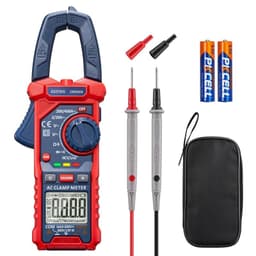
AstroAI CM2K0R clamp meter
About £18.99, 4.5 from 8,794 reviews and CAT III 600 V, for mains AC when DC current is not part of the job.
Editorial

Products Compared publishes British-English buying guides based on amazon.co.uk listings and public UK sources. We do not run a lab and we do not invent test scores.
Guides on what to look for, how to use a product, and common mistakes.
Public UK sources from the research digest, last checked on 16 October 2026. Shelf prices and star lines are the amazon.co.uk figures in the display file.
This page contains affiliate links to amazon.co.uk. If you buy through them, we may earn a commission at no extra cost to you. Prices, stars and review counts are from the UK listings checked on 16 October 2026. We did not lab-test these current clamps.