Independent comparisons. We may earn from shop links. More info

How to use a clamp meter

Updated: October 2026

You have a clamp on a flex, the appliance is running, and the display says zero. That reading is often the cable, not a broken meter. This is how to use a clamp meter for load current: one insulated conductor, centred, and a DC jaw zeroed while empty. The [current clamp comparison](/hub/pliers/current-clamp) lists the twelve models, from an £18.99 AC clamp to the Fluke 302+. The Products Compared editorial team used those listings, Fluke’s UK how-to, HSE GS38 and the Electricity at Work Regulations 1989. There was no laboratory test. Updated 16 October 2026. A qualifying purchase can earn a commission at no extra cost to you. Leakage uses a different jaw position and is only signposted here.

You have a clamp on a flex, the appliance is running, and the display says zero. That reading is often the cable, not a broken meter.

Our top picks

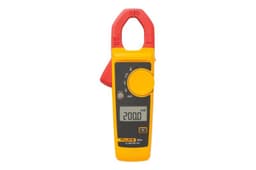
Fluke Fluke 302+ clamp meter

Best overall

Fluke Fluke 302+ clamp meter
8.4/10about £123.06
On this page

Why a healthy flex can read zero

A clamp adds up the current inside the jaw. In a healthy mains flex, live and neutral are equal and opposite, so the net field is about zero. Clamping the whole cord of a kettle is the usual way to see that zero while the appliance is on. The zero is expected. You need one conductor, already separated and still insulated: a single tail at an appliance, or a lead you have unplugged and opened only after it is dead. Do not strip a live flex to make a gap for the jaw. If the only way to separate the cores is a live consumer unit, stop. The both-wires position is how residual current is measured, including the 9 mA point on a 30 mA RCD, on the earth leakage clamp meter page. Load and leakage are opposite-looking measurements, and both can be right.

Taking a load-current reading

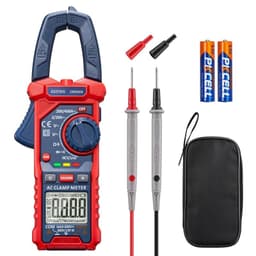
Set the dial to current, AC or DC to match the cable. Fluke’s UK guidance is to close the jaw on empty air and zero a DC reading first, then open the jaw, place one conductor in the centre, and close it fully. Keep the core off the jaw tips. On an AC-only meter, such as the AstroAI CM2K0R or the Fluke 302+, there is no DC current range. A battery cable reads zero because the sensor cannot see steady DC. The KC604 and the Crenova state AC and DC in the jaw; you still select the function. The jaw measures current. Voltage needs the probes. Choosing the meter is the clamp meter buying guide, not this procedure.
Fluke Fluke 302+ clamp meter

Testsieger

Fluke Fluke 302+ clamp meter
8.4/10about £123.06

Zeroing DC, and when the jaw cannot see DC

Hall jaws pick up stray fields, so the display is often off zero before you start. Close the empty jaw, press zero, and let it settle. On the HT206D, UK reviewers saw about 0.2 A on an empty jaw until that step. A reviewer also says useful DC on that model stops around 60 A, so a starter motor is the wrong job for the 600 A title. If the listing is AC-only, zeroing will not create a DC range. The AstroAI tip says the meter cannot test DC current. The Fluke 302+ datasheet lists 400 A AC and no DC range. Solar DC or a car lead needs a jaw that states DC, such as the KC604 or the Crenova, and you still zero it. The two sensors are set out on the AC or DC clamp meter page.

Leads, NCV, and when to stop

Current in the jaw does not prove a circuit dead. Proving dead is a voltage test with an indicator you prove before and after. HSE GS38 asks for finger barriers, an exposed tip no more than 4 mm, and 2 mm where practicable, with the leads on the meter before they touch the circuit. Regulation 14 allows work on or near live conductors only when it is unreasonable for them to be dead, reasonable to work live, and suitable precautions are in place. A clamp around insulation does not meet those three conditions by itself. Stop for the service head, a consumer unit you cannot prove dead, an RCD trip with heat or a shock, or a high-voltage solar string. A figure for a BS 7671 certificate is an electrician’s measurement.

Common questions

Why does the meter read zero when the appliance is on?
A healthy flex carries current out and back. With live and neutral both in the jaw, the fields cancel and a load clamp reads about zero. Separate one insulated conductor. If the cable is DC and the meter is the AstroAI or the Fluke 302+, the jaw cannot see that current. A zero on a whole mains cord is not, by itself, a fault in the appliance.
Where do I put the jaw on twin-and-earth?
Put it around one insulated core, not around the sheath that holds live and neutral together. Use a core that is already accessible, such as a single tail, without cutting a live cable. If you would have to open a live consumer unit, stop and make the circuit dead, or leave it. Clamping the whole cable measures the net field, which on a healthy circuit is about zero.
How do I zero a DC clamp?
Close the jaw with nothing inside, press zero, and wait until the display settles. Fluke’s UK how-to puts that step before a DC measurement. On the HT206D, reviewers still saw about 0.2 A until they zeroed, and the offset can return. Zero again. Doing this on an AC-only meter does not add a DC range.
Is NCV enough to prove the board is dead?
Non-contact voltage is not a prove-dead test. A Crenova reviewer calls the indication too ambiguous to rely on. Proving dead uses a voltage indicator, proved before and after, on the conductors. HSG85 treats that testing as live work until the circuit is shown dead. A clamp’s NCV light does not replace that sequence, and a current reading does not either.
What if the reading changes when I move the meter?
Centre one conductor and close the jaw fully. If the number still changes as you move the meter, do not treat it as a stable load. The stored UK reviews of the ACM91 describe a reading that changed with position, and a display that wandered after zeroing. That is a reason to retire the meter for the job, not to average two drifting numbers.

Related pages

Sources

Public UK sources from the research digest, last checked on 16 October 2026. Shelf prices and star lines are the amazon.co.uk figures in the display file.

  1. HSE: GS38, electrical test equipment for use on low voltage electrical systems (retrieved 16 October 2026)
  2. Electricity at Work Regulations 1989 (retrieved 16 October 2026)
  3. IET Wiring Matters, May 2021: earth leakage (retrieved 16 October 2026)
  4. Martindale: choosing a clamp meter (retrieved 16 October 2026)
  5. Fluke: how to measure current (retrieved 16 October 2026)
  6. Fluke 302+ datasheet (retrieved 16 October 2026)
  7. GOV.UK: Electrical Equipment (Safety) Regulations 2016 (retrieved 16 October 2026)
  8. Elec-Mate: UK clamp meter guide (retrieved 16 October 2026)