Independent comparisons. We may earn from shop links. More info

Best clamp meter UK

Updated: October 2026

The best clamp meter in this set depends on whether the jaw has to read DC. For one AC and DC load meter with CAT III 600 V stated, the KAIWEETS KC604 is the top pick. If you only measure mains AC, the AstroAI CM2K0R is the best value, and the listing says the jaw cannot test DC current. The [current clamp comparison](/hub/pliers/current-clamp) keeps all twelve amazon.co.uk listings, from £18.99 to £123.06. The Products Compared editorial team used those listings and the stored UK reviews. There was no laboratory test. Updated 16 October 2026. A qualifying purchase can earn a commission at no extra cost to you. A higher star line without a job attached is not the pick.

The best clamp meter in this set depends on whether the jaw has to read DC. For one AC and DC load meter with CAT III 600 V stated, the KAIWEETS KC604 is the top pick.

Our top picks

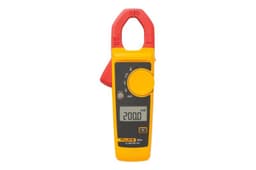
Fluke Fluke 302+ clamp meter

Best overall

Fluke Fluke 302+ clamp meter
8.4/10about £123.06
On this page

Best for a general AC and DC jaw

The KC604, at £30.39, states 400 A AC/DC, True RMS, CAT III 600 V, low-impedance voltage, a low-pass filter and a 2.8 cm jaw. The star line is 4.6 from 1,993 reviews, and all 50 stored bodies are from the United Kingdom. Reviewers bought it because another clamp was AC-only. They mention a one-handed dial, and one check against a calibrated instrument was called reasonably accurate. An orange backlight warns above 80 V or 1 A. That screen is a warning, not an extra safety category. Skip it for the origin of the installation, because CAT IV is not stated, and skip it for a 9 mA leakage decision. The order of those decisions, before any brand, is the clamp meter buying guide.

Best value when you only need AC current

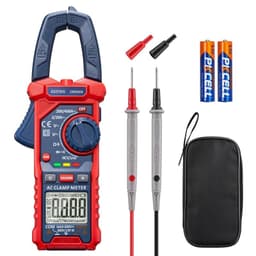
The AstroAI CM2K0R at £18.99 is the best value when the current is alternating. It is 4.5 from 8,794 reviews, the safety line is surge category III 600 V, and the display is 2,000 counts with non-contact voltage. Reviewers use it for DIY and, in one case, generator loading on a motorhome. The jaw cannot test DC current, and several UK reviewers say the advert had suggested otherwise. A solar string or a battery lead can read zero while current is flowing. True RMS is not stated. If the job might be DC, read the AC or DC clamp meter page first.
Fluke Fluke 302+ clamp meter

Testsieger

Fluke Fluke 302+ clamp meter
8.4/10about £123.06

When the Fluke 302+ is the one to pay for

The Fluke 302+ at £123.06 is the pick when the printed category matters more than DC. It states CAT IV 300 V and CAT III 600 V, the jaw is AC only to 400 A, and the star line is 4.7 from 2,549 reviews. Only four of 50 stored reviews are from the United Kingdom, and those call it accurate and well made. The box is the meter and TL75 hard-point leads. A review mentions a 30 mm jaw, which is not in the specification block. The bullets do not claim True RMS, and the jaw does not measure DC amps. Taking the reading is on the how to use a clamp meter page.

Listings that are not the pick

The HT206D is 4.5 from 11,767 reviews at £42.49, and the title says 600 A AC/DC. It is not the pick: the specification block has no CAT pair, and a reviewer puts useful DC nearer 60 A than a starter motor. The Elitech bullets claim 1,000 A at £29.99, with 3.8 from six reviews. The one stored UK review calls it reasonable for occasional DIY and not a professional tool. The UP1 is a scope probe, 5.0 from four reviews, one of them British. The U0 fork has one stored review. None of those is the top pick or the best value. The main comparison still lists their prices if you want the full table.

Common questions

What is the best clamp meter in this set, and for whom?
For a general AC and DC jaw, the KAIWEETS KC604 at £30.39. It states 400 A AC/DC, True RMS and CAT III 600 V, with 4.6 from 1,993 reviews in a UK-labelled sample. It suits mains plus domestic solar or battery current. It does not suit a service head that needs CAT IV, and 400 A has not measured a few milliamps of leakage. The case lines on the listing disagree, so check the box.
What is the best value if I only measure AC?
The AstroAI CM2K0R at £18.99, with 4.5 from 8,794 reviews and CAT III 600 V. UK reviewers use it for DIY and, in one note, a motorhome generator. The listing says the jaw cannot test DC current. Buy it for mains AC when you can separate one core. Leave it for a battery lead or a solar string, where a zero would be the meter.
Why not choose the Fluke on stars alone?
The Fluke 302+ is 4.7 from 2,549 reviews and states CAT IV 300 V and CAT III 600 V, at £123.06. Only four of 50 stored reviews are from the UK. The jaw is AC only, and True RMS is not claimed. Choose it when that category line is the point. Choose the KC604 when the jaw also has to read DC, at £30.39, with CAT III 600 V and no CAT IV mark.
Is the HT206D best because of 11,767 reviews?
It has the largest file, 4.5 from 11,767, and UK reviewers use it on cars and solar. The specification block states no CAT pair. Reviewers describe an empty jaw around 0.2 A and useful DC around 60 A, not starter current. Review count is one signal. It does not replace a printed category or a DC range you can trust at the 600 A title.
Should I buy a 1 mA BSIDE as the leakage meter?
Neither BSIDE is the leakage pick. The UX1 is 3.2 from five reviews, and one UK review says it does not measure 1 mA. The ACM91 has three stored UK texts that describe drift and a reading that moves with the meter. A leakage clamp such as the Megger DCM300E, at 0.01 mA, is outside this basket. Do not quote 9 mA from either listing.

Related pages

Sources

Public UK sources from the research digest, last checked on 16 October 2026. Shelf prices and star lines are the amazon.co.uk figures in the display file.

  1. HSE: GS38, electrical test equipment for use on low voltage electrical systems (retrieved 16 October 2026)
  2. Electricity at Work Regulations 1989 (retrieved 16 October 2026)
  3. IET Wiring Matters, May 2021: earth leakage (retrieved 16 October 2026)
  4. Martindale: choosing a clamp meter (retrieved 16 October 2026)
  5. Fluke: how to measure current (retrieved 16 October 2026)
  6. Fluke 302+ datasheet (retrieved 16 October 2026)
  7. GOV.UK: Electrical Equipment (Safety) Regulations 2016 (retrieved 16 October 2026)
  8. Elec-Mate: UK clamp meter guide (retrieved 16 October 2026)