Independent comparisons. We may earn from shop links. More info

AC DC clamp meter

Updated: October 2026

An AC DC clamp meter is the one you need when the cable might be a solar string or a battery lead, not only a mains flex. An AC-only jaw sits at zero on steady DC, and that zero is not a flat battery. This page separates the two sensors, then matches them to the listings in the [current clamp comparison](/hub/pliers/current-clamp). The Products Compared editorial team used those amazon.co.uk pages, the stored UK reviews, Fluke’s account of the two jaws, and the 302+ datasheet. There was no laboratory test. Updated 16 October 2026. A qualifying purchase can earn a commission at no extra cost to you. The choice here is whether the jaw can see DC at all.

An AC DC clamp meter is the one you need when the cable might be a solar string or a battery lead, not only a mains flex. An AC-only jaw sits at zero on steady DC, and that zero is not a flat battery.

Our top picks

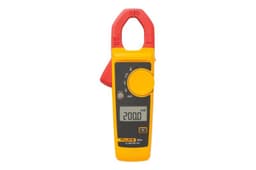
Fluke Fluke 302+ clamp meter

Best overall

Fluke Fluke 302+ clamp meter
8.4/10about £123.06
On this page

Two different jaws

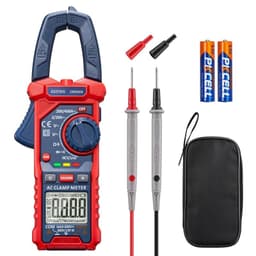
A current-transformer jaw reads alternating current, because that current induces a signal in the clamp. Steady DC does not, so the display stays at zero however large the DC load is. A Hall-effect jaw responds to the field of AC and of DC. Elec-Mate’s UK guide treats the Hall jaw as the usual choice for solar, batteries and charge points. Zero the clamp closed and empty, because the sensor also sees stray fields. Voltage on the probes can still be marked AC/DC on an AC-only current clamp. The AstroAI CM2K0R is the example: probes to 600 V, and an important tip that the jaw cannot test DC current. Read the current line, not the words AC/DC in the title.

When AC-only is enough

AC-only is enough when every current you care about is alternating: a kettle lead you can separate, a single insulated tail on a shower circuit, or the AC socket on the output of an inverter. In this set that is the AstroAI at £18.99, CAT III 600 V, and the Fluke 302+ at £123.06, CAT IV 300 V and CAT III 600 V, 400 A AC. DC into the inverter needs a Hall jaw. The AC socket on the far side is mains again, so an AC clamp can read it. The BSIDE U0 claims AC and DC in the fork, with one stored UK review and no CAT pair, so it is not the simple AC bargain. Sure of mains AC only: the AstroAI is the cheaper of the two, and the Fluke is the CAT IV line. Each condition is on the best clamp meter page.
Fluke Fluke 302+ clamp meter

Testsieger

Fluke Fluke 302+ clamp meter
8.4/10about £123.06

When you need DC in the jaw

You need DC in the jaw for a solar string on the panel side, a leisure battery, a caravan feed, or a vehicle lead. The KC604 at £30.39 states 400 A AC/DC, True RMS and CAT III 600 V, with 4.6 from 1,993 reviews. The Crenova at £29.99 states 600 A AC/DC, a 25 mm jaw, True RMS and CAT III 600 V, with 4.4 from 414 reviews. Either is a clearer DC choice than a thin 1,000 A claim. The Elitech bullets say up to 1,000 A AC/DC at £29.99, with 3.8 from six reviews. The HT206D title says 600 A AC/DC, yet a UK reviewer says useful DC stops around 60 A. The Neoteck bullets say 800 A AC/DC, and one UK reviewer could not find DC current at all. For a DC job you can check on a known load, take the KC604 or the Crenova. Zeroing is on the how to use a clamp meter page.

What the titles in this set actually say

Two listings are AC current only: the AstroAI, with the tip in writing, and the Fluke 302+, whose datasheet lists 400 A AC and no DC range. Listings that state AC and DC in the jaw include the KC604 at 400 A, the Crenova at 600 A, the Kethvoz from 10 mA to 400 A, and the Elitech bullets at 1,000 A. The UP1 is a scope probe from 10 mA to 100 A, not a handheld screen. House AC, with no DC cable: the AstroAI, or the Fluke if you want CAT IV 300 V and an AC-only jaw. Solar, battery or vehicle DC: the KC604 or the Crenova, ahead of a six-review 1,000 A claim. A title that only puts AC/DC next to the voltage is how the AstroAI confused its reviewers. The other specs are in the clamp meter buying guide.

Common questions

What is the difference between an AC clamp and an AC/DC clamp?
An AC clamp uses a current transformer and reads alternating current. An AC/DC clamp uses a Hall sensor and reads AC and steady DC, after you zero the empty jaw. Here the AstroAI CM2K0R and the Fluke 302+ are the AC-only jaws. The KC604 and the Crenova state AC and DC current. An AC/DC label on the probe voltage does not change the jaw.
Why does my clamp read zero on a battery cable?
Steady DC does not induce a current in a transformer jaw, so an AC-only meter stays at zero on a battery lead. That is the AstroAI listing’s own limit. If the meter does state DC and still reads zero, zero the empty jaw and clamp one conductor. A go-and-return pair cancel, and the display should sit near zero.
Does the Fluke 302+ measure DC current?
The listing and the datasheet give the jaw 400 A AC and no DC current range. The safety line is CAT IV 300 V and CAT III 600 V. Reviewers note the missing DC amps, and the bullets do not claim True RMS. At £123.06 it is an AC clamp with a stronger category mark than the £18.99 AstroAI. It is not a solar DC meter.
Does the AstroAI CM2K0R measure DC current?
The important tip says it cannot test DC current. Several stored UK reviews say the advertising had suggested otherwise. It does state CAT III 600 V and 2,000 counts, at £18.99, with 4.5 from 8,794 reviews. Use it on mains AC. For a battery or a solar string, choose a current range that says DC.
Why must I zero a DC reading?
A Hall sensor also sees stray magnetic fields, so the display often sits off zero. Close the empty jaw and press zero. On the HT206D, UK reviewers saw about 0.2 A until they did that, and the offset can return. Zeroing an AC-only meter does not add a DC range. The AstroAI still reads zero on a battery cable after any zero step.

Related pages

Sources

Public UK sources from the research digest, last checked on 16 October 2026. Shelf prices and star lines are the amazon.co.uk figures in the display file.

  1. HSE: GS38, electrical test equipment for use on low voltage electrical systems (retrieved 16 October 2026)
  2. Electricity at Work Regulations 1989 (retrieved 16 October 2026)
  3. IET Wiring Matters, May 2021: earth leakage (retrieved 16 October 2026)
  4. Martindale: choosing a clamp meter (retrieved 16 October 2026)
  5. Fluke: how to measure current (retrieved 16 October 2026)
  6. Fluke 302+ datasheet (retrieved 16 October 2026)
  7. GOV.UK: Electrical Equipment (Safety) Regulations 2016 (retrieved 16 October 2026)
  8. Elec-Mate: UK clamp meter guide (retrieved 16 October 2026)