Independent comparisons. We may earn from shop links. More info

Clamp meter buying guide

Updated: October 2026

You are looking at clamp meters on amazon.co.uk, and the titles sound alike until one jaw cannot see a battery cable. This clamp meter buying guide sorts the decision: what the jaw measures, which CAT voltage is printed, whether True RMS is stated, and whether the resolution matches the current. The [current clamp comparison](/hub/pliers/current-clamp) holds the twelve listings, from the AstroAI CM2K0R at £18.99 to the Fluke 302+ at £123.06. The Products Compared editorial team used those listings, the stored UK review notes, HSE GS38 and Martindale’s clamp notes. There was no laboratory test. Updated 16 October 2026. A qualifying purchase can earn a commission at no extra cost to you.

You are looking at clamp meters on amazon.co.uk, and the titles sound alike until one jaw cannot see a battery cable.

Our top picks

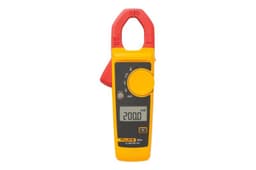
Fluke Fluke 302+ clamp meter

Best overall

Fluke Fluke 302+ clamp meter
8.4/10about £123.06
On this page

What the jaw actually measures

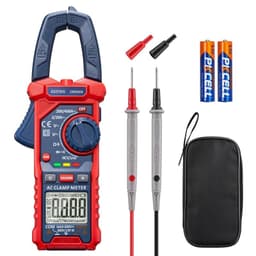
An AC-only jaw is a current transformer. It reads alternating current and sits at zero on steady DC. In this set that is the AstroAI CM2K0R, whose listing tip says it cannot test DC current, and the Fluke 302+, rated 400 A AC. An AC/DC jaw uses a Hall sensor, so it can read a solar string or a car lead, and you zero it empty before you trust the number. The KAIWEETS KC604 states 400 A AC/DC. The Crenova 606C+ states 600 A AC/DC and a 25 mm jaw. The BSIDE U0 is an open fork. The BSIDE UP1 is a BNC probe for an oscilloscope, from 10 mA to 100 A, with no screen of its own. A title that says AC/DC voltage has not promised DC current in the jaw. That split is the AC or DC clamp meter page.

The CAT marking, not the CE mark

CAT II is socket outlets and plug-in equipment. CAT III is distribution boards and fixed wiring. CAT IV is the origin of the installation. A CE mark, which Great Britain still accepts under the Electrical Equipment (Safety) Regulations 2016, is not a CAT rating. The Neoteck CM-3002, the HT206D, the UX1, the ACM91, the U0 and the UP1 do not state a CAT pair in the specification block. Where a pair is printed, read both numbers. The AstroAI, the Crenova and the KC604 state CAT III 600 V. The Fluke 302+ states CAT IV 300 V and CAT III 600 V, which is why £123.06 still buys an AC-only jaw. The Kethvoz states CAT II 600 V and CAT III 300 V, so its distribution category stops lower. Who should pay for the Fluke is on the best clamp meter page.
Fluke Fluke 302+ clamp meter

Testsieger

Fluke Fluke 302+ clamp meter
8.4/10about £123.06

True RMS, resolution and jaw size

True RMS describes the wave, not the safety category. Martindale says an average-responding clamp can read about half the true current on a distorted waveform, such as an inverter or an LED driver. That is their statement, not a test we ran. The KC604, the Crenova, the Neoteck bullets and the Kethvoz state True RMS. The AstroAI, the HT206D and the Fluke 302+ do not. A missing line is a reason to skip that meter for inverter current. A 400 A meter showing 0.0 A has not measured a few milliamps of leakage. Jaw size decides the fit: Crenova 25 mm, KC604 2.8 cm, Kethvoz 26 mm. The milliamp job is the earth leakage clamp meter page.

Leads, NCV and what you can skip

HSE GS38 is about the probes. Finger barriers should be fitted, the exposed tip should be no more than 4 mm, and 2 mm where practicable, and you connect the leads to the meter first. The Fluke includes TL75 hard-point leads. The KC604 bullets list two sets of leads and a case, while the included-components field says no, so check the parcel. One AstroAI review found the leads too loose to use. Non-contact voltage is not a prove-dead test. A Crenova reviewer calls it too ambiguous to rely on. Skip Bluetooth and a thermocouple until the jaw, the CAT pair and the resolution match the job. A clamp on insulation is not a waiver of the Electricity at Work Regulations 1989, which still limit live work.

Common questions

What should I check first on a clamp meter?
Check the jaw, then the CAT voltage, then True RMS if the load is electronic. The AstroAI CM2K0R at £18.99 is AC current only, CAT III 600 V, and the listing says it cannot test DC current. The KC604 at £30.39 states 400 A AC/DC and CAT III 600 V. Stars come after those lines. A CE mark alone, as on the Neoteck, answers neither question.
Is CAT III 600 V enough for a UK consumer unit?
CAT III is the category used for distribution boards and fixed wiring, and CAT III 600 V is printed on the AstroAI, the Crenova and the KC604. CAT IV is the origin of the installation, which the Fluke 302+ states at 300 V alongside CAT III 600 V. Opening a live consumer unit is still live work under the Electricity at Work Regulations 1989. The mark does not make that work reasonable.
Do I need True RMS for ordinary house wiring?
You need it when the waveform is distorted. Martindale says an average-responding clamp can read about half the current on electronic loads. A simple resistive heater is a weaker case. The KC604 and the Crenova state True RMS. The Fluke 302+ bullets do not. True RMS is not a safety rating, and it does not fill in a CAT line the listing omitted.
Does AC/DC on the title mean the jaw measures DC?
Only when the current range says AC and DC in the jaw. Several UK reviewers of the AstroAI say the advert suggested DC current, while the listing tip says the jaw cannot test it. The Fluke 302+ is 400 A AC. The KC604, Crenova, Kethvoz and Elitech bullets do state DC in the jaw. AC/DC on the probe voltage is a different measurement.
How small a current must the jaw resolve?
Match the last digit to the decision. A 400 A clamp showing zero has not measured leakage around 9 mA, the 30 per cent of a 30 mA RCD in BS 7671 regulation 531.3.2. The Kethvoz range starts at 10 mA. The UX1 and ACM91 claim about 1 mA, and UK reviews dispute it. A Megger DCM300E at 0.01 mA is a leakage clamp, and it is not in this set.

Related pages

Sources

Public UK sources from the research digest, last checked on 16 October 2026. Shelf prices and star lines are the amazon.co.uk figures in the display file.

  1. HSE: GS38, electrical test equipment for use on low voltage electrical systems (retrieved 16 October 2026)
  2. Electricity at Work Regulations 1989 (retrieved 16 October 2026)
  3. IET Wiring Matters, May 2021: earth leakage (retrieved 16 October 2026)
  4. Martindale: choosing a clamp meter (retrieved 16 October 2026)
  5. Fluke: how to measure current (retrieved 16 October 2026)
  6. Fluke 302+ datasheet (retrieved 16 October 2026)
  7. GOV.UK: Electrical Equipment (Safety) Regulations 2016 (retrieved 16 October 2026)
  8. Elec-Mate: UK clamp meter guide (retrieved 16 October 2026)