



One accessory you can isolate
You are changing a light, a socket or a plug on a circuit you can isolate and prove dead. You want a mid-price self-adjusting stripper, tried first on an offcut. The KAIWEETS strips, cuts and crimps at about £12.74.
The best wire strippers, compared.
Top pick: Mkscxjs 012-A 10–22 AWG hole stripper Best value: KAIWEETS KWS-103 3-in-1 wire stripper – About £12.74, 4.5 from 6,813 reviews, with strip, cut and crimp and a stated 0.2–5.27 mm² range. Updated October 2026.

A wire stripper is the hand plier that takes insulation off a conductor. On a UK job that is usually 1.0, 1.5 or 2.5 mm² twin and earth, or flex and thinner cores. Look for a stated square-millimetre or range, a jaw that leaves the conductor intact, and amazon.co.uk reviews that name the cable. A title is a rough guide, not a promise about flat 2.5 mm² sheath. The [wire stripper buying guide](/hub/pliers/wire-stripper/sub/wire-stripper-buying-guide) puts cable first, then the mechanism, then the review file. It is not a drill-powered scrap machine, and it is not a ratchet crimper. On the public record, quality is a stated mm² or range, a jaw that does not nick the copper, and reviews that name the cable.
A wire stripper is the hand plier that takes insulation off a conductor. On a UK job that is usually 1.0, 1.5 or 2.5 mm² twin and earth, or flex and thinner cores.

28 products checked · 58 hrs invested · +18,600 readers
Swipe for more
1-2 of 8


Personal buying guide
Question 1 of 2
What are you stripping most?
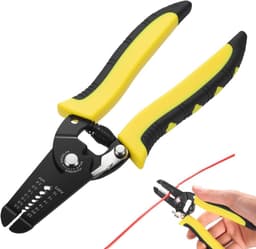
The Mkscxjs 012-A is £4.49 and 140 g, with a star line of 5.0 from three reviews. The only review text on file is in German and dated in Germany, so this comparison has no United Kingdom review body for nicks, holes or the lock. The listing does print the holes: 0.8, 1.0, 1.3, 1.6, 2.0, 2.4 and 2.8 mm, beside 10–22 AWG, and those millimetres are diameters. A highlight calls the tool crimping pliers, while the bullets describe stripping and do not describe a crimp die. The German note says it sits in a large hand, cuts and strips as expected, and the safety latch closes the tool. That is one person’s occasional use, not a file you can set beside 12,650 Stanley reviews. Rank 12 in Wire Strippers is the placement on this listing. The 5.0 is a thin listing, and the holes are only useful after you have checked them on scrap.
Pros
Cons
Best for: A buyer who wants listed hole diameters and a lock, and who will judge the tool on scrap rather than on the star line.
Less suitable: Anyone treating 5.0 from three as a top pick, or a job that needs UK reviews naming the cable.
Specifications
Common questions
Which wire sizes do the holes cover?
10–22 AWG and 0.8–2.8 mm solid and stranded. The holes listed are 0.8, 1.0, 1.3, 1.6, 2.0, 2.4 and 2.8 mm. Those figures are diameters.
Does it have a safety lock?
The bullets say yes. The only review text says the catch runs freely and closes the pliers. That review is in German.
How many UK reviews are in the sample?
None. The listing shows 5.0 from 3 reviews, and the sample contains one review written in Germany.
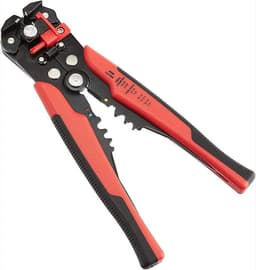
The Stanley FatMax FMHT0-96230 is the automatic stripper with the longest amazon.co.uk record in this set: 4.6 from 12,650 reviews, rank 1 in Wire Strippers, at £21.61 and 340 g. Reviewers describe clean core ends on twin and earth, and a job that used to need a knife finished in one squeeze, including house rewires and motorcycle cable. The amazon bullets state 0–6 mm² and a crimp for cable shoes, while Stanley’s own UK page states 0.2–6 mm² for a single cable, up to 10 mm² for several cables, and a stop of 6–18 mm. The written complaints are specific: thin instructions, a cutter that misses some outer sheaths, 1.5 mm round twin that would not enter the jaws, flex that one person could not strip, and small audio wire cut through. Scrap insulation jams the jaws until it is tapped out, and a few reviews say the jaws slip even with the fine screw wound in. The specification line is CE only, which is not a photograph of a 1000 V double triangle, so this remains a tool for cable you have already proved dead. At £21.61 it is the dearest row here, and the review file is still the one that describes the job in enough detail to carry the top pick.
Pros
Cons
Best for: Someone repeating 1.0, 1.5 and 2.5 mm² cores who wants the longest UK review file and can pay £21.61.
Less suitable: Anyone whose cable is mainly flex or fine audio wire, or whose budget stops under £15.
Specifications
Common questions
What cable size do the bullets print?
0–6 mm². The title says 10–22 AWG. Crimp sizes for the cable shoes are not printed. Stanley’s UK page states 0.2–6 mm² for a single cable and up to 10 mm² for several cables.
Is a separate cutter specified?
No. The bullets name stripping, a fine adjustment screw and pressing insulated and non-insulated cable shoes. Cutting width in the table is 0.15 cm.
What warranty is stated?
12 months, and EU spare-part availability of 1 year.
Across 6,813 amazon.co.uk reviews the KAIWEETS KWS-103 sits at 4.5 stars and £12.74, rank 2 in Wire Strippers, as a 320 g tool that strips, cuts and crimps. The bullets print 0.2–5.27 mm² (10–24 AWG) while the title says AWG 10–22, so the square-millimetre figure is the one to use for UK cable. Reviewers strip a grey twin-and-earth sleeve, including several inner cores at once, and one notes AWG 24 single core once the rotary knob is learned. Turn that dial too far toward plus and the handles lock; too far toward minus and the wire slips. The length stop is called fragile, and joint play means smaller cables are not gripped. One review title says the tool cannot handle the 1.5 mm and 2.5 mm three-core that person had, so a sheath strip is not a promise. The table names CE, DIN ISO 5743, IEC 60900 and UL, which is listing text rather than a mark photographed on the tool. At this price and review count it is the best value in the set, with the stop and the dial as the reasons to leave it.
Pros
Cons
Best for: A homeowner doing lighting and socket cores who wants strip, cut and crimp under £15 with a large review file.
Less suitable: Anyone who needs a tough length stop, or who is stripping only fine stranded wire.
Specifications
Common questions
What strip range is printed?
The bullets say 0.2–5.27 mm² (10–24 AWG) and tell you not to exceed that. The title says AWG 10–22. The crimp range is 0.32–5.27 mm² (10–22 AWG).
Does it come with a case?
The listing does not say. The bullets do not list a case.
What standards does the table name?
CE, DIN ISO 5743, IEC 60900 and UL. That is the table text, not a photo of a mark on the tool.
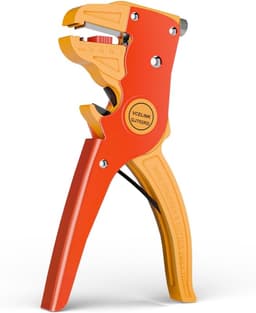
The black VCELINK GJ702 is the £8.99, 230 g stripper-cutter with 4.5 from 2,238 reviews, and it is a separate listing from the red GJ702. The bullets split the range into solid 0.2–3.3 mm², stranded 0.2–5.5 mm² and ribbon 0.2–0.5 mm², with a rear pressure knob, a length slider and a 65Mn cutter. UK reviewers report a clean strip on 1.0 and 1.5 mm² stranded without nicking the copper, and one person reached about 1,000 ends. Another got 26 AWG electronics wire through, and the eagle-nose head is why people choose it for a tight box. The same reviews say the tool cut cores on stranded wire while solid core was fine, that thick insulation is a struggle, and that one reviewer found no way to cut an outer sleeve. The inch and metric marks are black on black, and one delivery was a used item. The table says VDE, which is a certification name on the page, not evidence that you can strip a live 230 V cable.
Pros
Cons
Best for: Fine stranded and electronics wire, including work in a tight box, if you try an offcut first.
Less suitable: Flat twin-and-earth sheath, or anyone who needs a crimp notch in the same tool.
Specifications
Common questions
Will the listing say it strips flat cable?
The bullets name ribbon cable at 20–24 AWG (0.2–0.5 mm²), plus speaker and lighting wire. They do not claim a grey twin-and-earth sheath.
Is it meant for a back box?
The bullets say the eagle-nose jaw reaches back boxes, consumer units and distribution boards.
What does the handle table say?
The bullets say recyclable PA nylon. The specification table says aluminium.
The red VCELINK GJ702 is the other £8.99 listing, at 210 g and 4.5 from 1,393 reviews, and it is not the black ASIN. The printed ranges match: solid 0.2–3.3 mm², stranded 0.2–5.5 mm² and ribbon 0.2–0.5 mm², with an eagle nose, a length slider and an 18-month warranty line. Reviewers describe clean strips on fine lighting cable and narrow solar-light wires, and one pair was still in use after a year. The length adjuster is called fiddly, the front teeth block thin inner wires when the jacket is thick, and 1 mm twin and earth with the grey sheath would not fit the shears. The lowest pressure setting still cut the conductor for one person. Another found the cutters too blunt for 0.5 mm lamp wire, with stripping stopping after five minutes on 2.5 mm. No standards line is printed, so there is nothing on the page to read as a live-work rating. It is the lighter red twin of the black GJ702, and the shorter review file is the reason to prefer the black listing when the two prices match.
Pros
Cons
Best for: Occasional fine lighting cable, if you accept a light tool and a fiddly stop.
Less suitable: Grey twin-and-earth sheath, or a buyer who wants the longer black-listing review file at the same £8.99.
Specifications
Common questions
Does the listing say it strips speaker wire?
Yes. The bullets say it is suitable for speaker cables.
Is there a length stop?
Yes. The bullets describe a length adjustment slider and a rear pressure knob.
Which standards are named?
None. This red listing has no specification-met line. The warranty line says 18 months.
The WORKPRO W091034A is a 330 g 3-in-1 at £14.99, with 4.5 from 495 reviews and rank 13 in Wire Strippers. The bullets print 0.2–6.0 mm² (24–10 AWG) and an SK5 cutter, which is the widest single square-millimetre span in this set. The table names ASTM F1505-01, CE, DIN ISO 5743, GS and IEC 60900, and that remains table text rather than a photograph of a mark. UK reviewers describe a smooth action on stiff PVC, about 100 lengths of 1.0 mm flex, and a crimp used under 0.5 mm. The rest of the reviews are harder: soft 1 mm² flex was not stripped and strands were nicked, the jaw was not wide enough for 13 A round multi-core, and sheath scrap builds up in the tool. Review notes include a pair that broke on first use, one that stopped gripping after fewer than 20 uses, and jaws that came loose after about a month. Forty-nine of the fifty reviews on file are dated in the United Kingdom, with one written in German. At £14.99 it costs more than the KAIWEETS and rests on a much shorter file, so the extra millimetre on the bullet is not by itself a reason to prefer it.
Pros
Cons
Best for: Stiff PVC and a stated 6.0 mm² ceiling, if you can return a pair that will not grip.
Less suitable: Soft flex, a 13 A round multi-core, or anyone choosing mainly on review volume.
Specifications
Common questions
Can it strip aluminium wire?
The bullets say it strips and cuts aluminium wire, as well as copper, armoured core and electrical cable.
Does it come with a case?
The listing does not say. The bullets do not list a case.
What is the body made of?
The bullets name an SK5 blade, steel jaws and a TPR handle. The table says zinc and plastic.
The LJAPPLIED 7 inch hole plier is £4.99 and 140 g, with 4.5 from 65 reviews and only 13 review texts on file, most of them one line that never names a cable. The range is printed as 10–22 AWG and 0.6–2.6 mm, a diameter rather than a cross-section, and the individual hole sizes are not listed. UK comments call it a cheap toolbox spare and a stop-gap while another stripper was missing, and they call stripping the stronger of the two jobs. One review says the clamp is not much good when reconnecting. The title claims a safety lock, the bullets do not describe it, and no review on file mentions the lock. A rank line says 3 in Wire Strippers, the same rank printed on the Amazon Basics page, and CE and RoHS are not a 1000 V mark. At this price it is a spare with numbered holes, not the only tool for a socket ring.
Pros
Cons
Best for: A second pair in a toolbox for occasional cores inside 0.6–2.6 mm, tried on scrap.
Less suitable: The only stripper for 2.5 mm² twin and earth, or anyone who needs a review that names the cable.
Specifications
Common questions
Can it strip thick wire?
The printed range is 10–22 AWG and 0.6–2.6 mm solid and stranded wire. Those millimetres are diameters, not a 2.5 mm² cross-section.
Is it steel?
The bullets say PVC and steel. The handle material is PVC.
Does it have a safety lock?
The title claims one. The bullets do not describe how it works, and none of the 13 UK reviews describe using it.
The Amazon Basics DS-SWP is £11.69 and 360 g, with 4.4 from 4,901 reviews. The listing prints rank 3 in Wire Strippers, and the same rank line also appears on the LJAPPLIED listing, so the placement is not clean. The bullets give 10–24 AWG and no square millimetres at all, with a 2 inch jaw, an adjustable stopper, and crimps for 10–22 AWG plus 7–9 mm ignition terminals. UK reviewers say it is cleaner than a knife, and several line the stop up with a Wago length mark for plugs, lights and loft wiring. The same reviews will not grip after the jaws are adjusted, struggle on thick 2.5 cable, and leave the outer sleeve of 3-core and 5-core. One pair stopped stripping after the fourth use, another jammed after the first cut, and one of two pairs would not grip in any screw position. The layout is described as right-handed. Without a millimetre range on the page, a 2.5 mm² core is something the reviews argue about rather than a size the listing confirms.
Pros
Cons
Best for: Occasional flex and accessory leads where you can match a Wago gauge and you do not need a printed mm² range.
Less suitable: A ring final in 2.5 mm², or anyone who needs the listing to state square millimetres.
Specifications
Common questions
Is a millimetre strip range printed?
No. Stripping is given as 10 to 24 AWG. Crimping is 10–22 AWG insulated and non-insulated wire, plus 7–9 mm ignition terminals.
What is it made of?
The bullets say durable corrosion-resistant alloy steel, with secure-grip handles.
How long a strip can you set?
There is a built-in adjustable stopper for the length of the core strip. No millimetre stop range is printed.
Eight wire strippers on amazon.co.uk were scored on 16 October 2026 from listing facts, not from a strip test. Stars, review volume, listing detail, UK review fit and price are weighted 35, 25, 20, 10 and 10. Deductions then come off for a thin review file, early failure, a conductor cut at the lowest pressure, a fragile stop, or a short UK sample. Each star line stays the amazon.co.uk figure. The 0–100 score is not the stars times 20.
Stars
35%The amazon.co.uk star average sets the starting point, on a 0–35 scale. The points are the stars divided by five, times 35, rounded half up. A 5.0 from three reviews is not treated as a cleaner strip than 4.6 from 12,650.
Review volume
25%Up to 25 points for how many amazon.co.uk reviews sit behind the star line. 5,000 or more scores 25. The bands then step down through 1,000, 400 and 20 reviews. Under 20 scores 2, before the thin-file deduction.
Listing detail
20%Up to 20 points for what the listing actually states: mm² or only AWG, the mechanism, an adjuster, a length stop, a cutter, a crimp, and whether the title agrees with the bullets. A standards cell does not add points.
UK review fit
10%Up to 10 points from the UK review notes. The high end is house cable described, with the misses named. The low end is notes that never name a cable, or no UK review body at all.
Price
10%Up to 10 points for what the shelf price buys in this set. About £13 with strip, cut, crimp and a long file scores higher than a short file under £5, or the dearest row where the listing still has a gap.
Start with the cable you actually have, then with the jaw, then with whether a review names that cable. Price comes after those three. The notes below follow that order for these eight amazon.co.uk listings, checked on 16 October 2026. None of the scores is a strip test.
A wire stripper in this comparison is a hand plier that takes insulation off a conductor. It is not a drill-powered scrap machine, and it is not a ratchet crimper. UK buyers are mostly terminating 1.0, 1.5 and 2.5 mm² twin and earth, or stripping flex and thin cores. On the public record, quality is a stated mm² or AWG range, a jaw that does not nick the copper, and reviews that name the cable. Cable comes first.

The hole pliers print diameters: 0.6–2.6 mm, or holes from 0.8 mm to 2.8 mm. A 2.5 mm² conductor is not a 2.5 mm hole. House cable in BS 7671 is sized in square millimetres.
A 10–22 AWG title is roughly 0.3–5 mm² as a rule of thumb. It is not a promise that the jaw will take a flat 2.5 mm² sheath. UK reviews already split on that sheath.
Too tight nicks the copper or locks the handles. Too loose lets the insulation slide. Set the screw on an offcut. Baring more copper than the terminal hides, or using the crimp notch as a sized die, is the same class of mistake.
House wiring in the UK is specified in square millimetres. BS 7671 uses mm², so a title that only says 10–22 AWG is a rough guide. A published conversion chart puts 10 AWG at about 5.26 mm², 14 AWG at about 2.08 mm² and 22 AWG at about 0.33 mm². Treat that as a rule of thumb, not as the listing’s own range. In this set the stated spans differ, and the title does not always match the bullets. KAIWEETS prints 0.2–5.27 mm² while the title says AWG 10–22.
Self-adjusting tools squeeze and pull. Fixed-hole pliers need the matching hole. Every automatic here still has a pressure screw, apart from the Amazon Basics bullets, which do not name one. Too far toward plus on the KAIWEETS dial locks the handles. The lowest pressure on the red VCELINK still cut a conductor for one person. Too loose and the insulation slides. A length stop is useful when the accessory prints a strip length. Stanley’s UK page states 6–18 mm.
Three typical situations, each with a recommendation from this comparison.
You are changing a light, a socket or a plug on a circuit you can isolate and prove dead. You want a mid-price self-adjusting stripper, tried first on an offcut. The KAIWEETS strips, cuts and crimps at about £12.74.
You keep meeting 1.0, 1.5 and 2.5 mm² cores and you want the longest UK review file in this set. The Stanley FatMax is about £21.61, with 4.6 from 12,650 reviews. Flex and fine audio wire are the misses in those notes.
Some 3-in-1 reviews say thin wire is cut through. The black VCELINK prints stranded cable to 5.5 mm², at about £8.99, with an eagle-nose jaw. Try an offcut. It has no crimp station.
In this set of eight amazon.co.uk listings, the top pick is the Stanley FatMax FMHT0-96230. It is about £21.61, with 4.6 from 12,650 reviews and rank 1 in Wire Strippers. UK notes include clean twin-and-earth cores, and also a sheath the cutter misses, flex that failed, and jaws that slip. The best value is the KAIWEETS KWS-103 at about £12.74, with 4.5 from 6,813 reviews, strip, cut and crimp, and a stated 0.2–5.27 mm² range. The length stop is called fragile and the dial can lock the handles. The other six have no award. None of these scores is a lab test, and none of these tools is rated here for live 230 V work.

KAIWEETS KWS-103 3-in-1 wire stripper
About £12.74, 4.5 from 6,813 reviews, with strip, cut and crimp and a stated 0.2–5.27 mm² range.
Editorial

Products Compared publishes British-English buying guides based on amazon.co.uk listings and public UK sources. We do not run a lab and we do not invent test scores.
Guides on what to look for, how to use a product, and common mistakes.
Public UK sources from the research digest, last checked on 16 October 2026. Shelf prices and star lines are the amazon.co.uk figures in the display file.
This page contains affiliate links to amazon.co.uk. If you buy through them, we may earn a commission at no extra cost to you. Prices, stars and review counts are from the UK listings checked on 16 October 2026. We did not lab-test these wire strippers.