Wire stripper buying guide
You are about to buy one stripper for a light and a socket, and the amazon.co.uk title is in AWG while the cable in your hand is marked in mm². This wire stripper buying guide is the check before the [wire stripper comparison](/hub/pliers/wire-stripper): cable first, then the mechanism, then whether the listing prints mm². The eight tools run from £4.49 to £21.61, and none includes a case. A qualifying purchase can earn us a commission at no extra cost to you. This page does not name a top pick.
You are about to buy one stripper for a light and a socket, and the amazon.co.uk title is in AWG while the cable in your hand is marked in mm².
You are about to buy one stripper for a light and a socket, and the amazon.co.uk title is in AWG while the cable in your hand is marked in mm². This wire stripper buying guide is the check before the wire stripper comparison: cable first, then the mechanism, then whether the listing prints mm². The eight tools run from £4.49 to £21.61, and none includes a case. A qualifying purchase can earn us a commission at no extra cost to you. This page does not name a top pick.
Our top picks
| Badge | Product | Stated range | Mechanism | amazon.co.uk reviews | Note | Price | Offer |
|---|---|---|---|---|---|---|---|
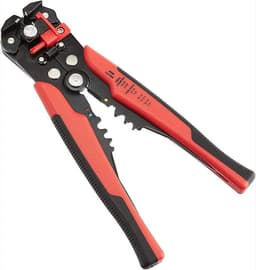
| Best overall |  STANLEY FATMAX Stanley FatMax FMHT0-96230 automatic stripper | 0–6 mm² | Self-adjusting 3-in-1 | 4.6 from 12,650 | 9.4 | about £21.61 | View offer |
| Preis-Tipp |  KAIWEETS KAIWEETS KWS-103 3-in-1 wire stripper | 0.2–5.27 mm² | Self-adjusting 3-in-1 | 4.5 from 6,813 | 9.2 | about £12.74 | View offer |
| Alternative |  Amazon Basics Amazon Basics DS-SWP self-adjusting stripper | 10–24 AWG, no mm² | Self-adjusting | 4.4 from 4,901 | 7.7 | about £11.69 | View offer |


On this page
Start with the cable, in mm²
Three mechanisms, not eight brands
The screw, the stop, and the extra jaw
What this comparison does not replace
Common questions
Do I buy by AWG or by mm²?
Will a 10–22 AWG tool take 2.5 mm² twin and earth?
What is the pressure screw for?
Do I need the crimp notch?
Is a £4.49 hole plier enough for a ring final?
Does IEC 60900 on the listing mean I can strip a live cable?
Related pages
Sources
Public UK sources from the research digest, last checked on 16 October 2026. Shelf prices and star lines are the amazon.co.uk figures in the display file.
- Stanley Tools UK: FatMax automatic wire stripper FMHT0-96230 (retrieved 16 October 2026)
- RS: Wire strippers guide (retrieved 16 October 2026)
- HSE: INDG354, Electricity at Work, safe working practices (retrieved 16 October 2026)
- Electrical Safety First: Best Practice Guide 2, isolation (retrieved 16 October 2026)
- BEAMA: Consumer unit terminations (retrieved 16 October 2026)
- Sandwich Electrical: Strip and terminate twin and earth (retrieved 16 October 2026)
- Cable Services: Twin and earth cable, 6242Y (retrieved 16 October 2026)
- Maun Industries: VDE and IEC 60900 (retrieved 16 October 2026)