Independent comparisons. We may earn from shop links. More info

Automatic or manual wire stripper

Updated: 16 October 2026

You are choosing between a jaw that closes in one squeeze and a plier with numbered holes. An automatic or manual wire stripper is a mechanism choice, not a brand contest. Self-adjusting still needs a screw. A hole still needs the right diameter, and the wrong one nicks the copper. The two cheap pliers are not a cheap Stanley. The [wire stripper comparison](/hub/pliers/wire-stripper) holds all eight. A qualifying purchase can earn us a commission at no extra cost to you.

You are choosing between a jaw that closes in one squeeze and a plier with numbered holes. An automatic or manual wire stripper is a mechanism choice, not a brand contest. Self-adjusting still needs a screw.

Our top picks

On this page

One squeeze, then a screw

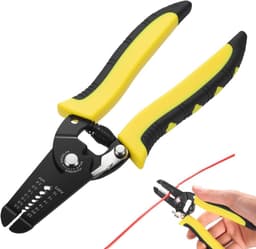
A self-adjusting stripper pulls the insulation off in one squeeze. You do not pick a hole. In this set that is Stanley, KAIWEETS, WORKPRO, Amazon Basics and both VCELINKs. RS describes the same jaw. Automatic does not mean no setting: Stanley has a fine screw, KAIWEETS a rotary knob, and both VCELINKs a rear knob. Amazon Basics does not name a screw, and reviewers still describe an adjustment. The squeeze suits cores that change from 1.0 mm² to 2.5 mm². The mm² check is the buying guide. A clean tube on the first scrap means the screw is right.

Where the automatic jaw cuts the core

UK reviews say an automatic stripper does nick, on thin and soft cable. Stanley’s notes include small audio wire cut through. WORKPRO’s notes include soft 1 mm² flex that lost strands. The black VCELINK both stripped 1.0 and 1.5 mm² stranded cleanly and cut stranded cores, depending on the review. Its bullets state solid 0.2–3.3 mm², stranded 0.2–5.5 mm² and ribbon 0.2–0.5 mm², with no crimp station. Mixed house cores point at the 3-in-1. Stanley against KAIWEETS is the best wire stripper UK page. Fine wire starts on the VCELINK range, on an offcut.

A hole is a diameter you choose

A manual stripper here is a plier with fixed holes and no length stop. A hole that is too small cuts the copper. A hole that is too large leaves the insulation on. LJAPPLIED prints 0.6–2.6 mm without listing each hole. Mkscxjs prints 0.8, 1.0, 1.3, 1.6, 2.0, 2.4 and 2.8 mm. Those are diameters. A 2.5 mm² core is not a 2.5 mm hole, and a 2.8 mm hole is not the grey sheath. The same solid core, all day, is where a learned hole nicks less than a jaw. The safety lock only keeps the jaws shut.

The two hole pliers in this set

Only the LJAPPLIED and the Mkscxjs are this type. The LJAPPLIED is £4.99, 4.5 from 65 reviews, and the 13 UK lines mostly do not name a cable. Reviewers call it a spare. The lock is in the title and not in the bullets. The Mkscxjs is £4.49, 5.0 from three reviews, and the only stored text is in German. The holes are printed. A highlight says crimping, and the bullets do not describe a die. Mixed 1.0 to 2.5 mm² cores point at a self-adjusting tool. Neither plier replaces a sheath tool.

Common questions

Why does an automatic tool still have a screw?
Because the bite has to match the insulation. Too tight nicks the copper or, on the KAIWEETS, locks the handles. Too loose lets the jaws slip, which Stanley and Amazon Basics reviewers report even after adjustment. The screw is the setting. “Self-adjusting” on the title means you are not picking a hole, not that every cable strips on the factory position.
Are the £4.99 pliers the manual version of the Stanley?
No. The LJAPPLIED is a fixed-hole plier at £4.99 with 65 reviews and 13 short UK notes that do not name a cable. The Stanley is a self-adjusting 3-in-1 at £21.61 with 12,650 reviews, a length stop and a crimp notch. They share the word stripper. They do not share the mechanism, the review file, or the jobs reviewers describe.
What do 0.8 mm and 2.8 mm mean next to 10–22 AWG?
They are hole diameters on the Mkscxjs, not square millimetres of cable. LJAPPLIED’s 0.6–2.6 mm is the same kind of number, without each hole listed. A 2.5 mm² core is a cross-section. 10 AWG is about 5.26 mm² and 22 AWG is about 0.33 mm² on a published chart. Do not read a 2.8 mm hole as 2.8 mm² twin and earth.
Which of these eight are manual?
The LJAPPLIED and the Mkscxjs 012-A. The other six are self-adjusting jaws: Stanley, KAIWEETS, WORKPRO, Amazon Basics, and the black and red VCELINK. The two manuals are £4.49 and £4.99. The automatics in this set run from £8.99 to £21.61.
Can I crimp with the hole pliers?
Not from anything these two listings actually describe. The Mkscxjs highlight says crimping pliers, and the bullets do not describe a die. The LJAPPLIED bullets say strip and cut. A crimp notch appears on some of the self-adjusting 3-in-1 tools, and even there it is not a ratchet crimper with sized dies.
Do I need both?
You need both only if you strip two different kinds of cable and one mechanism keeps failing an offcut. Mixed house cores suit the self-adjusting jaw once the screw is set. A repeated solid core can suit a printed hole. Fine wire that the jaw keeps cutting is a reason to change mechanism or to move to the VCELINK’s stated fine range, still on scrap, not a reason to own every ASIN in the table.

Related pages

Sources

Public UK sources from the research digest, last checked on 16 October 2026. Shelf prices and star lines are the amazon.co.uk figures in the display file.

  1. Stanley Tools UK: FatMax automatic wire stripper FMHT0-96230 (retrieved 16 October 2026)
  2. RS: Wire strippers guide (retrieved 16 October 2026)
  3. HSE: INDG354, Electricity at Work, safe working practices (retrieved 16 October 2026)
  4. Electrical Safety First: Best Practice Guide 2, isolation (retrieved 16 October 2026)
  5. BEAMA: Consumer unit terminations (retrieved 16 October 2026)
  6. Sandwich Electrical: Strip and terminate twin and earth (retrieved 16 October 2026)
  7. Cable Services: Twin and earth cable, 6242Y (retrieved 16 October 2026)
  8. Maun Industries: VDE and IEC 60900 (retrieved 16 October 2026)