


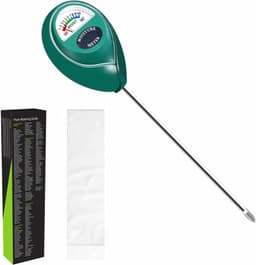





Winter houseplants
You overwater in winter and want a second check beside a finger a few centimetres down. The XLUX T10 is the dial to push in, read, and remove within 5 minutes.
The best watering indicators, compared.
Top pick: GLDFYYDS two-pack dial Best value: Yizerel two-pack dial – Two dials at £8.49 with a stated 7 inch probe and 1,300 reviews on this ASIN. Updated October 2026.

A watering indicator shows whether a pot needs water. It does not add water while you are away. A dial is a 1-to-10 colour scale driven by soil conductivity, not a percentage of water. A turns white when the maker says available water is low, and the fibre core is a refill. The pair is a buoy for a waterline, not a soil meter. A device that puts water into the pot is a different comparison: a [watering system for indoor plants](/hub/garden-watering/watering-system-for-indoor-plants). The ten amazon.co.uk listings are analogue dial meters, leave-in sticks, and one float gauge.
A watering indicator shows whether a pot needs water. It does not add water while you are away. A dial is a 1-to-10 colour scale driven by soil conductivity, not a percentage of water.

36 products checked · 54 hrs invested · +18,500 readers
Swipe for more
1-2 of 10


Personal buying guide
Question 1 of 2
Will you leave it in the pot?
The GLDFYYDS two-pack is two analogue dials, 25 cm long, at £9.99, with red, green and blue on ten scales and bullets that say no battery. The amazon.co.uk line is 5.0 from one review, and that review only says the meters work well at a good price. A single five-star review is not evidence you can set beside 1,300 Yizerel reviews or the shared XLUX file. The technical-details line says Solar Powered, while the bullets do not mention solar, so the power claim clashes. Probe length is not stated separately from the 25 cm product length, and the seller does not claim you can leave the probe in the pot. Buy a pair like this only after you have read the current listing, not because the star is the highest in the table.
Pros
Cons
Best for: A spare pair of colour dials if you accept that one review is the whole public file.
Less suitable: Anyone using a 5.0 to outrank a meter with hundreds or thousands of reviews.
Specifications
Common questions
Is this meter solar powered?
The technical-details line says Solar Powered. The bullets say no batteries and do not mention solar.
What do the colours mean?
The seller says red is dry, green is moist, and blue is wet.
How many reviews are on this listing?
The amazon.co.uk line is 5.0 from 1 review. That review says it works well at a good price.
The XLUX T10 is a single green dial, about 26 cm high and 70 g, that shows dry, moist or wet as soon as the probe goes in, with no battery. At £9.99 it is our top pick for a spot check you will remove, on 4.4 from 65,286 reviews, though that text is shared with the four-pack. United Kingdom reviewers used it when the surface felt dry but the compost below was wet, on houseplants, large outdoor pots, bay trees, bonsai and roses. The seller says not more than 5 minutes in the soil, or the metal tip corrodes, and reviews add rust if you do not wipe the probe. It is bulky in a small pot, and one meter failed after about six months. The catalogue also prints humidity and temperature lines that are not a percentage of water.
Pros
Cons
Best for: Houseplants and larger outdoor pots when you want one dial, will take it out within 5 minutes, and will wipe the tip.
Less suitable: A tiny pot, a leave-in reminder, or anyone treating the shared 65,286 count as unique to this ASIN.
Specifications
Common questions
Can you leave the XLUX T10 in the pot?
No. The seller says not more than 5 minutes, or the metal tip will gradually corrode.
Does the T10 need a battery?
No. The title says no batteries are required.
What should you not test?
The seller says not to test very hard soil, water, or other liquids, and to wipe the probe afterwards.
The XLUX four-pack is four blue dials at £19.99, with the same limit as the single: the seller says not more than 5 minutes in the soil, or the metal tip corrodes. The 4.3 from 65,335 reviews is shared text with the £9.99 single, plus one review that asks why a four-pack exists if you cannot leave the meters in the pots. Reviewers still praise an instant dry, moist or wet reading and a probe that is easy to wipe, and some boxes include a printed houseplant guide. The four-pack bullets do not say no battery, though United Kingdom reviews do. One meter in the shared file failed after about six months, and another stopped as soon as it got wet. At twice the single's price you are buying spares, not four leave-in gauges.
Pros
Cons
Best for: Someone who already likes the XLUX spot check and wants spare probes to wipe and store.
Less suitable: A buyer who hoped four meters meant one left in each pot, or who only needs a single probe.
Specifications
Common questions
Why are there four if you cannot leave them in?
The seller says not to leave a meter in the soil for more than 5 minutes. One United Kingdom review asks why a four-pack exists if the meter cannot stay in the pot.
Does the four-pack say no battery?
The four-pack bullets do not say that. United Kingdom reviews say no batteries are needed. The single XLUX title does say no batteries.
Is the review count only for this four-pack?
The listing line is 4.3 from 65,335. The same review text is on the XLUX single, listed at 4.4 from 65,286.
The Dazzlingyyh dial is a single no-battery spot check: you push the probe deeper than 4 inches and read a ten-scale face. At £7.69 it is the cheapest row in this comparison, on a 4.3-star line from 27 amazon.co.uk reviews. United Kingdom reviewers used it on a rubber plant that was being overwatered and on acers, and some saw the needle move as soon as the probe met moisture. One reviewer found the needle stuck on dry after about a month stored in a drawer. Another saw little water indicated when the pot was full to the top. The seller says to take it out and wipe the probe, and one United Kingdom review limits that stay to a few minutes. Colours are not named, and the probe length is not stated, so this is a thin-evidence bargain rather than a leave-in gauge.
Pros
Cons
Best for: A first cheap spot check on indoor or outdoor pots, if you will remove it and wipe the probe.
Less suitable: Anyone who wants a leave-in cue, a named red-green-blue scale, or a large review file.
Specifications
Common questions
Does this dial need a battery?
No. The listing says the meter works without batteries.
Can you leave it in the pot?
No. The seller says to remove it and wipe the probe, and not to leave it in the soil for a long time. One United Kingdom review says no more than a few minutes.
How deep should the probe go?
The seller says more than two thirds of the depth, and deeper than 4 inches.
The small SUStee five-pack is five green sticks about 12 cm long, and this listing does name the colours: white means the plant needs water and blue means it has been watered. At £23.00 the line is 4.2 from 2,913 reviews shared with the medium five-pack. Reviewers liked a small cue they could leave in the pot, including on calatheas and in pots without drainage holes, and some preferred it to a plant-care app. The same file says sticks stay blue when the pot is dry, that four of five failed by month four for one buyer, and that plants wilted before the stick turned white. The seller's about 6–9 months is a listing claim, and the box list does not include a spare core. One reviewer said the small stick only reads the top of the compost.
Pros
Cons
Best for: A windowsill of small succulent pots, if you will replace cores and not wait for white before you look at the plant.
Less suitable: One or two pots, where the £8.70 two-pack is the smaller outlay, or a deep pot that needs a longer stick.
Specifications
Common questions
What do white and blue mean?
The seller says white means the plant needs water and blue means it has been watered.
How long does the seller say a stick lasts?
About 6–9 months, with a refillable core. The box list does not include a spare core.
Is this review count unique to the small five-pack?
The listing line is 4.2 from 2,913. The same review text is on the medium five-pack, listed at 4.2 from 2,912.
The medium SUStee five-pack is five 180 mm sticks for pots about 4.7–7 inches across, left in place, with no battery. At £24.30 it is the dearest row in this comparison, on 4.2 from 2,912 reviews that share their text with the small five-pack. The seller says each stick lasts about 6–9 months and that you leave it in the pot for roots about 2 inches deep. These bullets do not name white or blue, so the colour key lives on the small five-pack listing rather than here. Shared reviews describe cores that stay blue, arrive not working, or stop within weeks to about four months. A five-pack only makes sense if you have several medium pots and will replace the cores. It is not a different sensor from the two-pack.
Pros
Cons
Best for: Several medium pots at once, if you already know the white-and-blue key from the smaller listing.
Less suitable: A single plant, a pot outside 4.7–7 inches, or a buyer who wants the colour meanings printed on this page of the listing.
Specifications
Common questions
Which pots is the medium five-pack for?
The seller says pots with a 4.7–7 inch diameter, for roots about 2 inches deep.
Do you leave these sticks in the pot?
Yes. The seller says to leave the stick in place and that each stick lasts about 6–9 months.
Does this listing name the colours?
No. These bullets do not say white or blue. The small five-pack listing does.
The small SUStee two-pack is a pair of 120 mm polycarbonate sticks for pots under 10 cm, left in the compost so the window moves from blue to white. At £8.70 it is the leave-in option for a tiny pot, on a 4.1-star line from 2,229 reviews shared with the medium two-pack. Reviewers used them on monstera, bonsai and succulents including aloe, and some dropped a calendar or an app. The same shared file says sticks stay blue when the compost is bone dry, that one of a pair never changes colour, and that the inner fibre goes brown. Refill cost surprised buyers, and these two-pack bullets do not list a spare core. A size bullet limits this pack to under 10 cm even though another bullet talks about all pot sizes.
Pros
Cons
Best for: Several small houseplant pots under 10 cm, if you will replace the core and still check the compost yourself.
Less suitable: Pots of 10 cm and wider, and anyone who wants a 1-to-10 spot reading they take out after a few minutes.
Specifications
Common questions
Which pot is the small SUStee for?
This listing's size guide says small is for a pot diameter under 10 cm. Medium is 10–18 cm and large is over 18 cm.
What do the colours mean?
The seller says the stick turns from blue to white when the plant needs water. You leave it in the pot.
Does it need a battery?
The catalogue power source is manual. The bullets do not mention a battery.
The medium SUStee two-pack is two 180 mm leave-in sticks for pots of about 10–18 cm, in polycarbonate, turning from blue to white. At £10.80 it sits just above the small two-pack, with the same 4.1 from 2,229 reviews and the same review text. Reviewers liked a cue they could leave near the root ball, including on monstera, bonsai and succulents. The shared criticism is a stick that stays blue in bone-dry compost, a stick that never changes, and fibre that turns brown and sticks. Adjustable appears only on a catalogue line, not in the bullets. The printed weight of 5.9 g looks implausibly light for an 180 mm stick, so treat that figure as the catalogue line.
Pros
Cons
Best for: Two medium houseplant pots, about 10–18 cm across, if you will still look at the compost when the window is slow.
Less suitable: Pots under 10 cm, pots over 18 cm, and anyone who needs a numbered dial rather than a colour window.
Specifications
Common questions
Which pot is the medium SUStee for?
This listing says medium is for a pot diameter between 10 cm and 18 cm.
Do you leave it in the compost?
Yes. The seller says to leave it in the pot. It turns from blue to white when the plant needs water.
Is the stick adjustable?
Adjustable appears only on a catalogue line. The bullets do not describe an adjustment.
The Yizerel two-pack gives you two analogue dials with a stated 7 inch probe, a red-dry, green-moist and blue-wet scale, and no battery. At £8.49 it is the best-value listing here, on 4.0 from 1,300 reviews that belong to this ASIN rather than a shared text. Reviewers used the pair in winter when a watering rota was unclear, and some still checked the compost with a finger. One buyer reported a meter lasting 18 months, and another said both meters agreed when tried in the same pot. The same file includes a needle that never reached wet in soaking compost, a unit dead within days, and probes that stuck on dry after weeks if they were left in the soil. The dials are bulky in small pots, so this pack is a spot check you wipe and put away.
Pros
Cons
Best for: A winter spot check on larger indoor or outdoor pots, when you want two dials and will wipe them after each use.
Less suitable: Tiny pots, and anyone who wants a stick left in the compost rather than a probe you must remove.
Specifications
Common questions
Does the Yizerel meter need a battery?
No. The seller says no battery is needed.
What do the colours mean?
The seller says red is dry, green is moist, and blue is wet, on ten scales.
Can you test water with it?
No. The seller says not to test water or other liquids, and to avoid very hard soil and stones.
The Healeved pair is a float gauge, not a soil dial: the seller says a 36 cm buoy floats when the water is high and sinks when it is low. At £12.59 the listing shows 2.6 from 5 reviews, and the three United Kingdom reviews in the file all say the pair does not work. One buyer called it too big for their houseplant pots and asked to return it. None of those reviews describes the buoy actually floating or sinking. The technical-details line says ac, which the bullets do not support with a plug, a battery, or a mains warning. At 36 cm it is the wrong shape if you wanted a 1-to-10 reading in compost.
Pros
Cons
Best for: Only a buyer who specifically wants a water-line buoy and will check it works on arrival.
Less suitable: Houseplant pots, soil moisture checks, and anyone expecting a dial or a SUStee stick.
Specifications
Common questions
Is this a soil moisture dial?
No. The seller describes a buoy that floats when the pot has enough water and sinks when the water is low.
Does it plug in?
The technical-details line says ac. The bullets do not mention mains power or a battery.
What do the United Kingdom reviews say?
Three United Kingdom reviews are in the file. All three say it does not work. One says the pair is too big for their houseplant pots.
For this comparison we read 10 amazon.co.uk watering-indicator listings captured on 15 October 2026, plus the public UK sources below. The score is an editorial 0–100 figure from stars, review volume, listing clarity, practical fit and price, with deductions. It is not the star rating times 20. A 5.0 from 1 review does not outrank a 4.0 from 1,300 reviews on that ASIN. We did not run a garden trial or a laboratory test.
Stars
35%Amazon stars on that listing, scaled to 35 points. The star line stays the amazon.co.uk average. It is not treated as a laboratory accuracy score.
Review volume
25%A count of 1,000 or more on this ASIN scores higher than the same size of file shared with another ASIN in the set. A handful of reviews scores low.
Listing clarity
20%Named mechanism, colour or float reading, leave-in rule, power, and pot size or probe length. A solar or mains line the bullets do not support loses points.
Practical fit
10%United Kingdom reviews that describe a real pot or plant, with points taken off when stuck readings, dead units, or “does not work” dominate the file.
Shelf price
10%The amazon.co.uk price on 15 October 2026. Under £9 scores higher than a five-pack around £23–£25. Price does not override a listing that the reviews say does not work.
Choose the mechanism for the job, then the pot. A dial is a spot check you wipe. A SUStee is a leave-in colour cue with a core you replace. A float gauge is not a soil meter, and a high star from one review is not a better sensor.
A watering indicator shows whether a pot needs water. It does not put water into the compost, and it is not a device for while you are away. In this comparison the ten amazon.co.uk listings are analogue dial meters, SUStee leave-in sticks, and one float gauge. Prices, stars and counts are the lines captured on 15 October 2026. Buy the job, not the star rating. A dial is a 1-to-10 colour scale driven by soil conductivity. It is not a percentage of water.
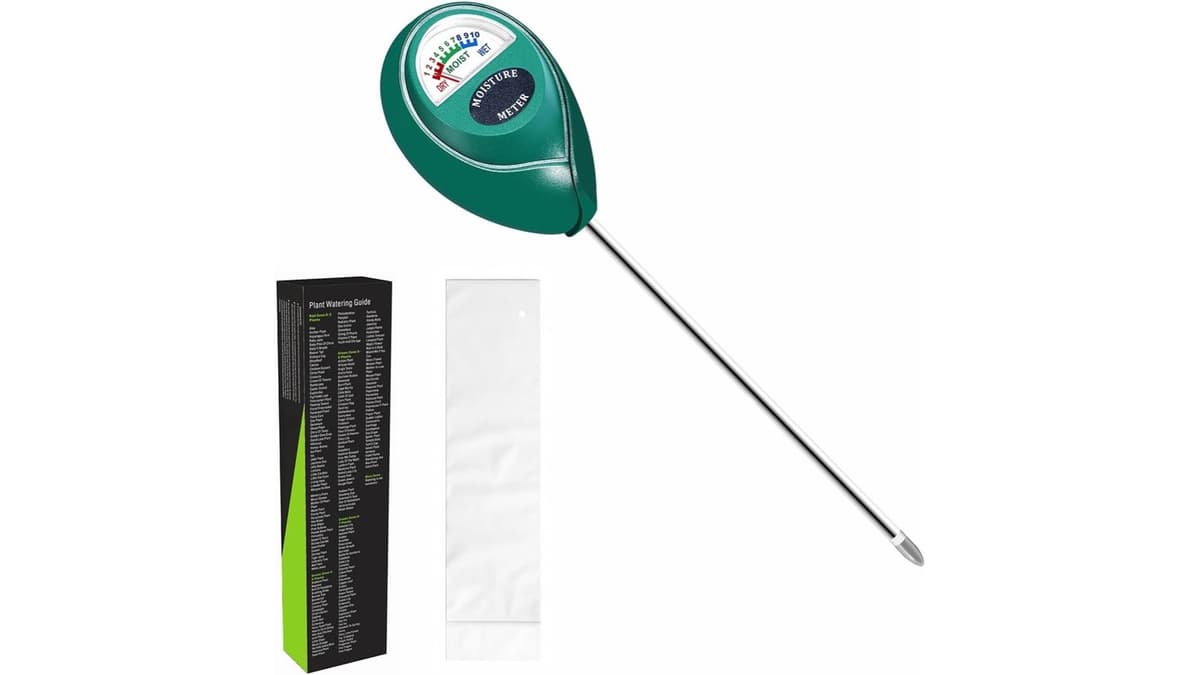
XLUX says not more than about 5 minutes, or the metal tip corrodes. Yizerel reviews include probes that stuck on dry after weeks if they were left in. Take the dial out and wipe it.
GLDFYYDS is 5.0 from one review. XLUX and SUStee counts are shared across ASINs. A higher star line here is not a better sensor, and the needle is not a percentage of water.
SUStee reviews include sticks that stay blue when the pot is dry, and plants that wilted before the stick turned white. Look at the plant and the compost. The core is a refill, not a guarantee.
Mechanism is the first cut because a star rating does not tell you what the tool does. A dial is a 1-to-10 colour scale driven by soil conductivity, and you remove it. SUStee is a leave-in stick whose window moves between blue and white. The Healeved pair is a buoy for a waterline, not a soil probe. Large SUStee sticks, for pots over about 18 cm, are not in this set. Pot size is the second cut. SUStee small is under about 9–10 cm.
How you read the tool has to be printed on the listing you are buying. Dials that state colours use red for dry, green for moist and blue for wet. The Dazzlingyyh listing does not name its colours. SUStee listings that state the key use white for water and blue while the compost still holds water. The medium five-pack bullets do not name those colours. The needle is not a percentage of water. Fertiliser salts can push it toward wet. Do not leave a dial in the pot.
Three typical situations, each with a recommendation from this comparison.
You overwater in winter and want a second check beside a finger a few centimetres down. The XLUX T10 is the dial to push in, read, and remove within 5 minutes.
A dry crust hides damp compost underneath. The Yizerel two-pack states a 7 inch probe for a larger pot. You still wipe it and put it away.
You want a white-or-blue cue left in each pot under about 10 cm, and you will replace the core. The small SUStee two-pack is the leave-in option at £8.70.
For a spot check you will take out and wipe, the top pick is the XLUX T10 at £9.99: no battery, a stated 5-minute limit, and 4.4 from 65,286 reviews shared with the four-pack. It is bulky in a small pot. If you want two dials, a stated 7 inch probe and a review count that belongs to that ASIN, the best value is the Yizerel two-pack at £8.49. The £7.69 Dazzlingyyh dial is cheaper and is not that pick. The other eight have no award.

Yizerel two-pack dial
Two dials at £8.49 with a stated 7 inch probe and 1,300 reviews on this ASIN.
Editorial

Peter F. is the editor for DIY & tools at productscompared.co.uk. Comparisons in this category are checked against amazon.co.uk listings, review evidence and public UK sources.
Guides on what to look for, how to use a product, and common mistakes.
Sources checked for this comparison; listings captured on 15 October 2026.
This page contains affiliate links to amazon.co.uk with the tag pcuk26-21. If you buy through them, we may earn a commission at no extra cost to you. Prices, stars and review counts come from the amazon.co.uk listings. We did not run a laboratory test, and we do not promise the cheapest price.