Independent comparisons. We may earn from shop links. More info

Bug hotel filling comparison 2026

The best bug hotel fillings, compared.

Top pick: POPETPOP 100 reed tubes, 15 cm Best value: MAGICLULU 100 reed tubes, 15 cm – The cheaper of the two 100-piece reed packs that are not described as open both ends, at about £9.99. Updated October 2026.

Bug hotel filling is the loose material you pack into a house, a tin or a plant pot. UK packs in this category are mostly hollow reed, wheat-stalk or bamboo tubes for cavity-nesting bees. The Bumblebee Conservation Trust counts over 270 bee species here, with close to 250 solitary. Buglife notes that about four in five native bee species nest in the ground, so tubes suit only that cavity-nesting minority. You judge a tube by the hole, the length and the back. UK guides cluster on an internal bore of about 2–10 mm. Red mason bees are often given about 7–8 mm, and leafcutters about 6–8 mm. Holes wider than 10 mm miss many UK bees, and a 3–5 mm pack suits smaller stems. Aim for at least about 15 cm, one closed end, and tubes set back from the rain. The wall should be dry, and you should be able to remove used tubes after the adults emerge. Bore, length and a closed back are set out in the [bug hotel filling buying guide](/hub/garden-supplies/bug-hotel-filling/sub/bug-hotel-filling-buying-guide).

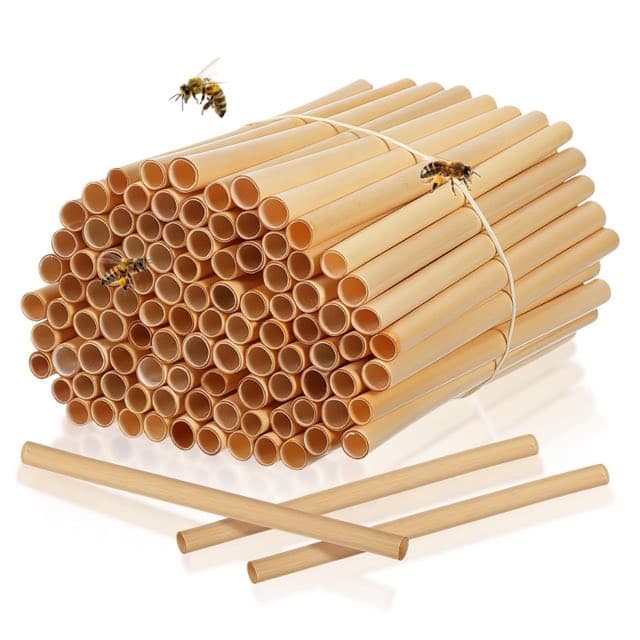
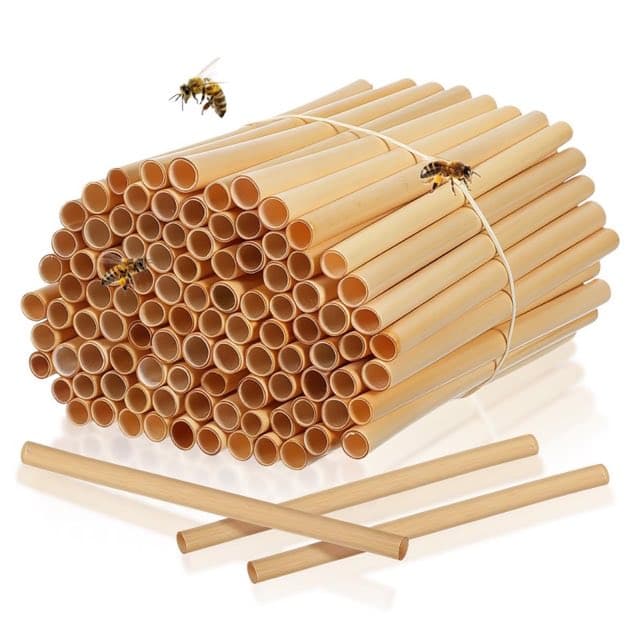
Bug hotel filling is the loose material you pack into a house, a tin or a plant pot. UK packs in this category are mostly hollow reed, wheat-stalk or bamboo tubes for cavity-nesting bees.

POPETPOP 100 reed tubes, 15 cm

Best overall

POPETPOP 100 reed tubes, 15 cm
5.7/10∼ £14

18 products checked · 56 hrs invested · +16,800 readers

5 of 5: Best bug hotel fillings compared

Swipe for more

1-2 of 5
Best overall
POPETPOP 100 reed tubes, 15 cm
TOYANDONA 100 reed tubes, 15 cm
Best value
MAGICLULU 100 reed tubes, 15 cm
JACKANNA 200 bamboo tubes, 20 cm
BOBOZHONG 300 tubes, 20 cm
5.7/10
7.8/10
6.7/10
4.0/10
3.6/10
∼ £14
∼ £10
∼ £10
∼ £23
∼ £9
4.5(2)
4.2(4)
3.9(8)
3.3(3)
3.0(1)
View offer
View offer
View offer
View offer
View offer

Personal buying guide

Question 1 of 2

What size hole are you filling?

The best bug hotel fillings in detail

POPETPOP 100 reed tubes, 15 cm

Rank 1

POPETPOP 100 reed tubes, 15 cm

∼£14

Our view

The POPETPOP pack is 100 natural reed tubes at about £13.99, listed at 15 cm, with product dimensions of 15 × 0.8 × 0.8 cm and a weight of 120 g. On amazon.co.uk it is 4.5 from 2 reviews. A UK review measured about 6 mm inside and about 8 mm outside, which sits in the 6–8 mm leafcutter band, and said the edges seemed smooth. The same review says the tubes are open at both ends. The Bumblebee Conservation Trust says bees will not use nesting tubes that are open at both ends, so this pack needs a back you add yourself. That review also says the reeds are slippery, need to sit inside something to stay dry, and were held with an elastic band and then string in a bundle about 9 cm across. Two reviews cannot carry a 4.5 as a settled rank. It costs about £4 more than the £9.99 reed pack, and the open ends are why it is not the top pick.

Pros

  • A UK review measured about 6 mm inner and about 8 mm outer
  • That review says the edges seemed smooth
  • 100 tubes at 15 cm, listed weight 120 g

Cons

  • Open at both ends, in the UK review
  • Slippery, and the same review held them with a band and string
  • 4.5 from only 2 reviews
  • About £13.99 for the same piece count as cheaper reed packs

Best for: You will add a solid back and a dry case, and you want a review measurement near 6 mm inside.

Less suitable: You need a closed tube out of the packet, or you are paying about £13.99 for a back the listing does not include.

Specifications

Model
POPETPOP 100 reed tubes, 15 cm
Brand
POPETPOP
Price
∼£14
Customer rating
4.5/5(2)
Material
Reed
Pieces
100
Length
15 cm
Bore
About 6 mm inner
Ends
Open both ends
Weight
120 g

Common questions

Are the tubes closed at one end?

A UK review says they are open at both ends. The bullets do not describe a node or a back board.

What size did the UK review measure?

The review says about 6 mm inner and about 8 mm outer, 15 cm long, 100 tubes. The specification line is 15 x 0.8 x 0.8 cm and 120 g.

Do they need a case?

The same UK review says the reeds need to sit inside something to stay dry, and that a band and string were used to hold a bundle about 9 cm across.

TOYANDONA 100 reed tubes, 15 cm

Rank 2

TOYANDONA 100 reed tubes, 15 cm

∼£10

Our view

The TOYANDONA pack is 100 natural reed tubes at about £10.49. Each tube is listed at 15 cm with an inner diameter of 0.5–0.8 cm, which is 5–8 mm, and the item dimensions are 15 × 0.8 × 0.8 cm at 90 g. That inner band sits inside the 2–10 mm spread UK nest-box guides publish, and it overlaps the 6–8 mm leafcutter size and the 7–8 mm red-mason size those guides name. On amazon.co.uk it is 4.2 from 4 reviews. The only United Kingdom text says the bees took to the new tubes straight away. A German review, which is not a UK opinion, says about 10 of the 100 tubes were crushed in a paper bag, so the pack can arrive damaged. The listing does not say whether a node or a solid back is present, and the box does not include a hotel. It is the top pick in this set because the inner bore is printed and a UK review reports bees using the tubes, and you still close any end that arrives open.

Pros

  • Inner diameter stated as 0.5–0.8 cm
  • 100 natural reed tubes, 15 cm, at about £10.49
  • A UK review says the bees took to the new tubes straight away
  • 15 cm meets the length UK guides treat as a working minimum

Cons

  • The listing does not say whether the back is closed
  • A German review says about 10 of 100 tubes were crushed in a paper bag
  • 4.2 from only 4 amazon.co.uk reviews

Best for: You already have a dry box and you want 15 cm reeds with a printed inner bore of 5–8 mm.

Less suitable: You need the listing to confirm a closed back, or you are treating four reviews as a large sample.

Specifications

Model
TOYANDONA 100 reed tubes, 15 cm
Brand
TOYANDONA
Price
∼£10
Customer rating
4.2/5(4)
Material
Reed
Pieces
100
Length
15 cm
Bore
Inner 5–8 mm
Ends
Not stated
Weight
90 g

Common questions

What is the tube made of, and how many are in the pack?

The bullets say natural reeds and a count of 100. Length is 15 cm and the stated inner diameter is 0.5–0.8 cm.

Does the listing say the tubes are closed at the back?

No. The listing does not say whether a node or a solid back is present.

What is in the UK review?

The UK text says the bees took to the new tubes straight away. A German review, not a UK one, says about 10 of 100 tubes were crushed in a paper bag.

MAGICLULU 100 reed tubes, 15 cm

Rank 3

MAGICLULU 100 reed tubes, 15 cm

∼£10

Our view

The MAGICLULU pack is 100 natural reed tubes at about £9.99, listed at 15 cm and 5–8 mm, with a weight of 100 g. The bullet does not say whether 5–8 mm is the hole or the outside of the cane, so you cannot read it as the bore a bee enters. On amazon.co.uk it is 3.9 from 8 reviews, the largest count in this set, and still a small sample. Two UK reviews call the tubes too small, and one of those says some bees have used them. Another UK review praises clean tubes with no splinters or cracks. A separate UK review says blue tits keep pulling the tubes out of the bug hotel, and the listing does not mention a mesh guard. A storage holder is named in the included line and is not described further, and the ends are not stated. At 50p under the 100-piece reed pack that prints an inner diameter, it is the best value in this set if you measure the hole before you pack the box.

Pros

  • 100 natural reed tubes at about £9.99
  • 15 cm long, listed weight 100 g
  • 3.9 from 8 amazon.co.uk reviews, the largest file here
  • A UK review praises clean tubes with no splinters or cracks
  • One UK review says some bees have used them

Cons

  • 5–8 mm is not labelled as inner or outer
  • Two UK reviews call the tubes too small
  • A UK review says blue tits pull the tubes out, and no mesh is listed
  • Ends are not stated, and the storage holder is not described

Best for: You want a 15 cm reed refill near this price, and you will measure the hole before the tubes go into the box.

Less suitable: You need a printed inner diameter, or you have no way to stop birds pulling loose tubes out.

Specifications

Model
MAGICLULU 100 reed tubes, 15 cm
Brand
MAGICLULU
Price
∼£10
Customer rating
3.9/5(8)
Material
Reed
Pieces
100
Length
15 cm
Bore
5–8 mm
Ends
Not stated
Weight
100 g

Common questions

What size does the listing state?

Each tube is 15 cm long with a 5–8 mm diameter. The bullet does not say whether 5–8 mm is the hole or the outside.

What do the UK reviews say about the bore?

Two UK reviews call the tubes too small. One of those says some bees have used them. Another review praises clean tubes with no splinters or cracks.

Does a review mention birds?

One UK review says blue tits keep pulling the tubes out of the bug hotel. The listing does not mention a mesh guard.

JACKANNA 200 bamboo tubes, 20 cm

Rank 4

JACKANNA 200 bamboo tubes, 20 cm

∼£23

Our view

The JACKANNA pack is 200 natural bamboo tubes at about £22.75, about 200 mm long, and it is the only bamboo in this set. One bullet prints an inner diameter of 6–8 mm, and if that inner line is the one you trust, it matches the leafcutter and red-mason end of the 2–10 mm range UK guides use. The same listing prints an outer diameter of 5–10 mm, and those two ranges cannot all be true on one tube. The listing says the tubes are open on both sides, and included components are none, so there is no back board in the box. On amazon.co.uk it is 3.3 from 3 ratings. The two texts in the file are from Germany, not the United Kingdom: they describe hard, even tubes, with little visible fibre, and one says a saw will cut them. A German species line on the listing is not the UK bee count, the carton size is 20 × 9 × 9 cm, and item weight is not stated. It is the bamboo option when you will close the open ends and you can ignore a diameter line that contradicts itself.

Pros

  • 200 bamboo tubes at about 20 cm
  • Inner diameter printed as 6–8 mm
  • German reviews describe hard, even tubes
  • A German review says a saw will cut them

Cons

  • Open on both sides, and no components in the box
  • Outer 5–10 mm conflicts with inner 6–8 mm
  • 3.3 from 3 ratings, and the texts are German rather than UK
  • About £22.75, the highest price in this set

Best for: You want about 20 cm bamboo, you will close one end, and you have a saw if a cane needs shortening.

Less suitable: You need a UK review, a closed node in the packet, or a diameter line that agrees with itself.

Specifications

Model
JACKANNA 200 bamboo tubes, 20 cm
Brand
JACKANNA
Price
∼£23
Customer rating
3.3/5(3)
Material
Bamboo
Pieces
200
Length
About 20 cm
Bore
Inner 6–8 mm
Ends
Open both sides

Common questions

What bore does the listing print?

One bullet says inner diameter 6–8 mm and outer diameter 5–10 mm. Those ranges cannot all be true for the same tube. Length is about 200 mm.

Are the bamboo tubes closed?

The listing says the tubes are open on both sides. Included components are listed as none, so no back board is in the box.

Are the written reviews from the UK?

The two texts in the file are from Germany. They describe hard, even tubes. There is no United Kingdom review text. The score is 3.3 from 3 ratings.

BOBOZHONG 300 tubes, 20 cm

Rank 5

BOBOZHONG 300 tubes, 20 cm

Our view

The BOBOZHONG pack is 300 tubes at about £9.39, listed at 20 cm with an inner diameter of 3–5 mm and a weight of 90 g. The title says natural reed, while a bullet says natural wheat stalks and wheat straw, and the colour field says natural wheat yellow, so the material is not settled from the page. An inner bore of 3–5 mm is the small end of the 2–10 mm spread UK nest-box guides publish. It is tighter than the 7–8 mm red-mason size named by BWARS, and it can suit smaller stem-nesters. The bullet says the stalks can be cut, with 10–15 cm as the example. The file does not say whether the tubes are open or closed, and assembly required is set to yes. On amazon.co.uk it is 3.0 from 1 review, and there is no review text, so nothing in the file describes a bee using these stems. At about 3p a piece it is the cheapest pack by count, and that price is not evidence the stems match a reed title or a mason-bee hole.

Pros

  • 300 pieces at about £9.39
  • Inner diameter printed as 3–5 mm
  • 20 cm, and the listing says they can be cut
  • Listed weight 90 g

Cons

  • Title says reed and a bullet says wheat stalks
  • 3–5 mm is tighter than the usual 7–8 mm red-mason size
  • Ends are not described
  • 3.0 from 1 review, with no review text

Best for: You want a large pack of 20 cm stems at a printed inner bore of 3–5 mm, and you will check reed or wheat when the parcel arrives.

Less suitable: You are filling for red mason bees at about 8 mm, or you need a review that describes bees using the tubes.

Specifications

Model
BOBOZHONG 300 tubes, 20 cm
Brand
BOBOZHONG
Price
∼£9
Customer rating
3.0/5(1)
Material
Reed or wheat
Pieces
300
Length
20 cm
Bore
Inner 3–5 mm
Ends
Not stated
Weight
90 g

Common questions

Does the listing say reed or wheat?

The title says natural reed tubes. A bullet says natural wheat stalks and wheat straw. Both lines are on the page, so the material is not settled.

What bore and length are printed?

The bullet prints an inner diameter of 3–5 mm and a length of 20 cm. It also says the stalks can be cut, with 10–15 cm as the example.

Are the tube ends described?

The listing does not say whether the tubes are open or closed. Assembly required is set to yes, and there is no review text.

How we compared

Five amazon.co.uk listings were scored from the shelf prices, star lines and review notes in the display file. There is no laboratory test. A star rating on one to eight reviews is not treated as a large UK sample. Conservation guides explain the bore, the length and a closed back. They are not a measurement of these packs. The highest score is the top pick, once. Best value is the cheaper of the two 100-piece reed packs that are not described as open both ends, once the clearest printed inner bore has taken the top score. The weights below sum to 100.

1

Amazon evidence

30%

Stars divided by 5, times 22, rounded to the nearest whole number. Then +6 at 8 reviews, +3 at 4 reviews, +1 at 2 or 3 reviews, and +0 at 1 review. Minus 6 when the file has no review text. Minus 4 when the written reviews are not from the United Kingdom.

2

Listing fit

35%

Ends not stated, −8. Ends stated as open both ways, −14. Bore not identified as the hole, −8. Inner bore stated only as 3–5 mm, −6. Title and bullet disagree on the material, −8. Inner and outer ranges that cannot both be true, −8. A side dimension, where a UK review then measures the hole, is −4 rather than −8.

3

Review outcome

20%

A UK text that describes bees using the tubes scores higher than a file with no text, a German-only file, or a UK text that says the tubes are open at both ends.

4

Value

15%

Shelf price against a 15 cm reed whose hole is in or near 5–8 mm. The lowest price per stem does not win when the bore is the small end, the material lines clash, or the only rating has no text. An open-ended pack does not win on a higher star line.

Independent review
Last updated: October 2026
8 sources checked

Bug hotel filling buying guide

Buy filling for a box you already have. A roof, a stand and a pre-filled house are a different product. The split is the hole a bee enters, a length of at least about 15 cm, and a closed back. Piece count and a low price per stem come after those three. Stars on one to eight reviews do not settle the bore. None of the scores is a laboratory test.

What is bug hotel filling?

Bug hotel filling is the loose material you pack into a house, a tin or a plant pot. A roof, a stand and a pre-filled house belong with finished insect hotels. In the United Kingdom the packs that match this category are mostly hollow reed, wheat-stalk or bamboo tubes for cavity-nesting bees. Cardboard tubes exist on amazon.co.uk and are outside this set. Drilled untreated wood is a hotel you make, not a refill bag. Cones, bark, straw and dry leaves fill other compartments.

Best for

  • Gardeners refilling a bee section they already own
  • A balcony or school pot, if an adult measures the hole

Not ideal for

  • Most UK bees, which nest in the ground
  • Ladybirds and lacewings, which need cones and dry leaves

Mistakes to avoid

  1. 1

    Buying a hotel instead of a refill

    A roof, a stand and a pre-filled house are a different product. This comparison is the loose tubes you pack into a box, a tin or a pot you already have. Cones and dry leaves are a ladybird filling, not a mason-bee tube.

  2. 2

    Reading the outside as the hole

    UK guides cluster on an internal bore of about 2–10 mm. A 5–8 mm line that does not say inner or outer is not yet the hole a bee enters. A 3–5 mm inner bore suits smaller stems and misses the usual 7–8 mm red-mason size. Holes over 10 mm are too wide for many UK bees.

  3. 3

    Leaving both ends open

    The Bumblebee Conservation Trust says bees will not use tubes open at both ends. Cut bamboo just beyond a node, or block the rear, and keep the tubes shorter than the box so rain misses the holes. Damp kills larvae. Replace used canes after the adults emerge.

What to weigh up

Bore and length

High

Start with the hole a bee enters, not the outside of the cane. Buglife, the Bumblebee Conservation Trust, BWARS, the RHS, the Natural History Museum and NatureScot cluster on about 2–10 mm inside. Red mason bees are often given 7–8 mm, and NatureScot says ideally about 8 mm. Leafcutters are given about 6–8 mm. Holes over 10 mm are too wide for many UK bees. A pack printed only as 3–5 mm inside suits smaller stems and misses that red-mason size.

Closed back and a removable tube

High

The Bumblebee Conservation Trust says bees will not use tubes open at both ends. BWARS and the Natural History Museum say cut bamboo just beyond a node, or block the rear. Several packs do not describe the ends. Others say the tubes are open both ways, including a UK review that measured about 6 mm inside and found both ends open. You then add the back yourself. A higher star line does not repair an open tube. The wall should breathe. Avoid plastic and glass.

Which option suits you?

Three typical situations, each with a recommendation from this comparison.

Refilling a bee section

You already own a dry box and you need a printed hole more than a new house. The TOYANDONA pack is 100 natural reed tubes at about £10.49, listed at 15 cm with an inner diameter of 0.5–0.8 cm. It is 4.2 from 4 amazon.co.uk reviews. The listing does not confirm a closed back, so you still check the ends.

A pot or a balcony

You want a small 100-piece bundle for a pot or a school project, and you will measure the hole. The MAGICLULU pack is 100 reed tubes at about £9.99, listed at 15 cm and 5–8 mm, with 3.9 from 8 reviews. The listing does not say whether 5–8 mm is the hole or the outside. One UK review says blue tits pull the tubes out.

Bamboo you will close

You want about 20 cm bamboo, you will close one end, and an adult can shorten a cane with a saw. The JACKANNA pack is 200 bamboo tubes at about £22.75, with an inner line of 6–8 mm. The listing says the tubes are open on both sides, and the outer line of 5–10 mm conflicts with that inner line. The written reviews are German, and the score is 3.3 from 3 ratings.

Common questions about bug hotel fillings

Which bug hotel filling is the top pick in 2026?
The top pick is the TOYANDONA pack of 100 natural reed tubes at about £10.49, listed at 15 cm with an inner diameter of 0.5–0.8 cm (5–8 mm). amazon.co.uk shows 4.2 from 4 reviews, and the United Kingdom text says the bees took to the new tubes straight away. The listing does not say whether the back is closed. A German review says about 10 of 100 tubes were crushed in a paper bag. Four reviews are a small sample.
Which bug hotel filling is the best value?
The best value is the MAGICLULU pack of 100 reed tubes at about £9.99, listed at 15 cm and 5–8 mm. It is the cheaper of the two 100-piece reed packs that are not described as open at both ends. amazon.co.uk shows 3.9 from 8 reviews, the largest count here, and still a small sample. The 5–8 mm line is not labelled inner or outer. Two UK reviews call the tubes too small, one says some bees have used them, and one says blue tits pull the tubes out.
How much does bug hotel filling cost on amazon.co.uk?
In this set the shelf prices run from about £9.39 to about £22.75. A rule of thumb from these listings is about £9–£14 for a 100-piece reed refill near 15 cm, and the low £20s for a 200-piece bamboo pack near 20 cm. The 300-piece pack is about £9.39 and prints an inner bore of 3–5 mm. The 100-piece reed packs sit at about £9.99, £10.49 and £13.99. Review counts on these pages run from 1 to 8. These are the captured shelf prices, not a later re-check.
What bore and length should bug hotel tubes have?
Buglife, the Bumblebee Conservation Trust, BWARS, the RHS, the Natural History Museum and NatureScot cluster on an internal bore of about 2–10 mm. Red mason bees are often given 7–8 mm, ideally about 8 mm. Leafcutters are given about 6–8 mm. Holes over 10 mm are too wide for many UK bees. A 3–5 mm pack suits smaller stems. Length should be at least about 15 cm, with the tubes set shorter than the box so rain misses the holes. Read the hole, not the outside of the cane.
Do bug hotel tubes need a closed end?
Yes. The Bumblebee Conservation Trust says bees will not use nesting tubes that are open at both ends. BWARS and the Natural History Museum say cut bamboo just beyond a node, or block the rear. Some listings in this set do not describe the ends. Others say the tubes are open both ways. A UK review on one 100-piece reed pack measured about 6 mm inside and found both ends open, so that pack needs a back you add. Avoid plastic and glass nest walls.
Does a tube pack help all UK bees?
No. Buglife notes that about four in five native bee species nest in the ground, so a tube pack does not replace bare soil for mining bees. The Bumblebee Conservation Trust counts over 270 bee species in the UK, with close to 250 solitary. Tubes suit cavity-nesters such as red mason bees and leafcutters. Pine cones and dry leaves suit ladybirds and lacewings. A finished house with a roof is a different product, covered in the insect hotel comparison.
When should you replace bug hotel tubes?
Replace used canes after the adults emerge. The Bumblebee Conservation Trust’s interval for a full tube swap is at least every couple of years, and Buglife points to late spring. Damp kills larvae, so bring an exposed hotel into a cool dry shed from autumn and put it out in spring. Site the box sunny, south or south-east, fixed, clear of plants and dry, about a metre up. Mesh can stop tits and woodpeckers pulling tubes out.

Our verdict

The top pick is the TOYANDONA pack of 100 natural reed tubes at about £10.49, listed at 15 cm with an inner diameter of 0.5–0.8 cm (5–8 mm). It leads on score: 4.2 from 4 amazon.co.uk reviews, and the United Kingdom text says the bees took to the new tubes straight away. The listing does not say whether the back is closed, and a German review says about 10 of 100 tubes were crushed in a paper bag. The best value is the MAGICLULU pack of 100 reed tubes at about £9.99, listed at 15 cm and 5–8 mm, with 3.9 from 8 reviews. That 5–8 mm line is not labelled inner or outer. Two UK reviews call the tubes too small, one says some bees used them, and one says blue tits pull the tubes out.

Best overall
POPETPOP 100 reed tubes, 15 cm

POPETPOP 100 reed tubes, 15 cm

View offer
Best value
MAGICLULU 100 reed tubes, 15 cm

MAGICLULU 100 reed tubes, 15 cm

The cheaper of the two 100-piece reed packs that are not described as open both ends, at about £9.99.

View offer

Editorial

Peter F. - DIY & tools editor
DIY & tools editor
Bug hotel fillingGarden suppliesamazon.co.uk listings

Peter F. is the editor for DIY & tools at productscompared.co.uk. Comparisons in this category are checked against amazon.co.uk listings, review evidence and public UK sources.

Updated: October 2026
8 sources checked

Guides to bug hotel fillings

Guides on what to look for, how to use a product, and common mistakes.

Related comparisons

Sources

Public UK sources for this comparison. Prices, stars and review counts are the amazon.co.uk listings in this set. Page updated 22 October 2026.

  1. Bumblebee Conservation Trust: solitary bee nest boxes (retrieved 22 October 2026)
  2. Bumblebee Conservation Trust: solitary bees (retrieved 22 October 2026)
  3. Buglife: bee-hotel guide (PDF) (retrieved 22 October 2026)
  4. Buglife: how to be the best bee hotel manager (retrieved 22 October 2026)
  5. Natural History Museum: how to make a bee hotel (retrieved 22 October 2026)
  6. NatureScot: solitary bees and bee houses (PDF) (retrieved 22 October 2026)
  7. BWARS: bee hotels information sheet (PDF) (retrieved 22 October 2026)
  8. RHS: habitats for wild bees (retrieved 22 October 2026)

Expert source (DIY & tools): Lee Burkhill (Garden Ninja) (external profile) – public expert commentary used as a research source, not as a contributor to our pages.

This page contains affiliate links to amazon.co.uk. If you buy through them, we may earn a commission at no extra cost to you. Prices, stars and review counts are from the amazon.co.uk listings. This is not a laboratory test.