


One compost bin
You sift one heap or stony soil at about 10 mm and you want a fixed plate with a long review line. The Spear & Jackson riddle is about £14.95, 586 g, with 4.6 from 1,806 reviews. There is no second mesh.
The best compost sieves, compared.
Top pick: Two stainless compost scoops Best value: ADEPTNA five-mesh sieve – Five stated meshes at about £14.95, the next highest value part after the top pick. Updated October 2026.

A compost sieve, also called a garden riddle, lets finished compost, soil, or leaf mould fall through a mesh and holds back stones, roots, and sticks. In the UK the two names are the same tool. Judge one by hole size, the diameter in centimetres, and whether the mesh is fixed or a loose insert. About 10–12 mm is the everyday grade for a heap and for stones. A useful hand riddle here is about 30–40 cm across. A 20 cm pan is a pot or a lawn-patch tool. The listing and the maker’s page disagree on diameter. Mesh and frame are set out in the [compost sieve buying guide](/hub/raised-beds-greenhouses-and-compost/compost-sieve/sub/compost-sieve-buying-guide).
A compost sieve, also called a garden riddle, lets finished compost, soil, or leaf mould fall through a mesh and holds back stones, roots, and sticks. In the UK the two names are the same tool.

42 products checked · 64 hrs invested · +18,600 readers
Swipe for more
1-2 of 12


Personal buying guide
Question 1 of 2
What are you sieving?
This listing is two stainless scoops, 27 × 10 × 5 cm and 100 g together, at about £9.99, with holes of 3.8 mm and 5 mm. On amazon.co.uk it is 4.7 from 25 reviews, and a UK review used them on homemade compost. The title also names cat litter, sand, and reptile sand, so the page is not only a garden tool. They are deep mesh shovels, not a frame you set on a barrow. Twenty-five reviews is a thin line next to riddles with several hundred ratings at a similar price. Corrosion resistance is claimed, and this file does not show a rust cluster. A 5 mm scoop can take a small dry handful, and it will not stand in for a 30 cm riddle on a bin.
Pros
Cons
Best for: You want a small stainless scoop for a dry handful of compost, soil, or litter, and you already own a proper riddle for the heap.
Less suitable: You are grading a bin, a barrow, or stony topsoil.
Specifications
Common questions
Is this a frame riddle?
No. The listing is two deep mesh scoops, 27 × 10 × 5 cm and 100 g together.
What hole sizes are listed?
3.8 mm and 5 mm. A UK review used them on homemade compost.
Does the listing mention cat litter?
Yes. The title and bullets also name cat litter, sand, and reptile sand.
The Spear & Jackson garden riddle is a chrome-plated steel plate with fixed 10 mm square holes, at about £14.95 and 586 g. On amazon.co.uk it is 4.6 from 1,806 reviews, and that record is why it is the top pick here. The bullet says 315 mm, the technical line says 31.5 × 31.5 × 7 cm, and the maker’s page says 330 mm, so those figures are not one diameter. Reviews describe holes of about 1 cm and say small stones can pass, which is what a 10 mm plate does, and there is no second mesh. Some reviewers say the chrome will not rust, and one plans to check after a year. The file shows no cluster of rust failures, which is not a lifetime guarantee. It does the everyday heap and stone job, and it cannot switch to 3 mm.
Pros
Cons
Best for: You sift one compost bin or stony soil at about 10 mm and you want a fixed plate with a long review line.
Less suitable: You need 3 mm or 6 mm as well, or you need a single agreed diameter before you buy.
Specifications
Common questions
What mesh does this riddle have?
The bullets say 10 mm square holes. Reviews describe holes of about 1 cm and say small stones can pass.
How wide is it on this listing?
The bullet says 315 mm. The technical line says 31.5 × 31.5 × 7 cm. The weight is 586 g. There is no second mesh.
Do reviews mention rust?
Some say the chrome finish will not rust. One says they will check after a year. The file does not show a cluster of rust failures.
The moonateen set is three galvanised sifters at about £23.99 and 1.13 kg, with meshes at 10, 6, and 3 mm. The bullets size them for what they call a standard 5-gallon bucket: 30 cm across the top, 22 cm at the bottom, and 6 cm high. On amazon.co.uk it is 4.6 from 225 reviews. The screen is described as integrated, and the raw reviews do not describe one falling out. A bullet says the mesh can handle up to 50 kg without bending, which is a listing claim, not a load we measured. One review that is not from the UK says a sifter rusted outdoors, so galvanised is not a promise against a wet winter. The total score ties the about £14.95 five-mesh pan, and the higher price is why this set is not the best value.
Pros
Cons
Best for: You already sieve into a bucket of about 30 cm at the rim and you want the screen fixed to the ring.
Less suitable: You work over a barrow, or you want the same three grades for closer to £15.
Specifications
Common questions
Will these sit on a bucket?
The bullets say they fit a standard 5-gallon bucket, with a 30 cm top, a 22 cm bottom and a 6 cm height.
Is the screen loose?
The bullets say the bottom screen is integrated so it does not detach. The raw reviews do not describe a screen falling out.
What is the load claim?
A bullet says the mesh can handle up to 50 kg without bending. That is a listing claim, not a measured test in this file.
The Flatro sieve is a stainless frame at 29.5 × 29.5 × 7.5 cm and 655 g, at about £14.95, with inserts at 3, 5, 8, 10, and 12 mm. On amazon.co.uk it is 4.6 from 28 reviews, a lighter stated weight than the other five-mesh pan’s 890 g at the same price. One review says small ridges hold the sieves tightly, and the UK texts here do not describe an insert falling out. Two reviews call it a bit flimsy or delicate. Buyers mention gravel and soil in patio borders, and one graded seed for chicken feed. Twenty-eight reviews is a short record for a 4.6, and the listing was first available on 8 January 2026. Weatherproof is a claim, so dry the frame before you store it.
Pros
Cons
Best for: You want the same five grades as the heavier pan, you prefer a lighter frame, and you will not bounce it on stone.
Less suitable: You need hundreds of reviews, or a single fixed plate that cannot be called delicate.
Specifications
Common questions
How does this differ from a single 10 mm riddle?
This listing includes five inserts, 3 mm through 12 mm, in a 29.5 cm frame weighing 655 g.
Do reviewers say the inserts fall out?
Not in the UK reviews in the raw file. One says small ridges hold the sieves tightly. Two reviews call it a bit flimsy or delicate.
What did buyers sift?
Reviews mention gravel and soil in patio borders, and one buyer graded seed for chicken feed.
The KOOLPUG sieve is a 30 cm metal frame at about £24.99, with inserts at 3, 6, and 12 mm and two crossed rods under the mesh. On amazon.co.uk it is 4.5 from 388 reviews. The product line says 740 g and a display-weight line says 550 g, so the file has two weights. UK reviews praise the rods and also say the insert falls out when the sieve is tipped, and one buyer received two inserts rather than three. Stackable storage and weather resistance are claims. At this price it costs about £10 more than five-mesh pans in the set that also include a 10 mm grade. The long review line is why it stays in the comparison. Tip it only after you have felt whether the insert is seated.
Pros
Cons
Best for: You want 3, 6, and 12 mm on a 30 cm frame and you will hold the insert while you empty it.
Less suitable: You tip the sieve to empty it, or you want 10 mm and a lower shelf price.
Specifications
Common questions
What holds the mesh?
The bullets describe two crossed steel rods under the mesh. UK reviews both praise those rods and say the insert still falls out when the sieve is tipped.
Did every buyer get three meshes?
The listing says three, at 3 mm, 6 mm and 12 mm. One review says only two inserts arrived.
How heavy is it?
The product line says 740 g. A display-weight line says 550 g. The diameter on the bullets is 30 cm.
The ADEPTNA five-mesh sieve is a 29.5 cm stainless pan at 890 g and about £14.95, with inserts at 3, 5, 8, 10, and 12 mm. On amazon.co.uk it is 4.5 from 40 reviews. It is the best value because five stated grades at that price score the highest value part once the Spear & Jackson riddle has taken the top pick. One UK review says the inserts fit snugly, and another says the smallest mesh was about 5 mm rather than 3 mm and that wires buckled. The bullets also name sand, gravel, and cat litter, and reviews mention old soil and potting compost. Forty reviews is a modest sample. Check the fine disc with a ruler if 3 mm is the grade you came for, and treat rust resistance as a claim.
Pros
Cons
Best for: You want several hole sizes in one pan at about £15 and you will check the 3 mm disc before you rely on it.
Less suitable: You only ever sift a heap at about 10 mm, or you need a review line in the hundreds.
Specifications
Common questions
Which mesh sizes are listed?
3 mm, 5 mm, 8 mm, 10 mm and 12 mm, in a 29.5 cm pan weighing 890 g.
Do the inserts stay in?
One UK review says the five inserts fit snugly. Another says the smallest mesh was about 5 mm rather than 3 mm and that wires buckled.
Is it meant only for compost?
The bullets also name sand, gravel, stones, weeds and cat litter. Reviews mention old soil, potting compost and a bucket.
The Suwimut set is a stainless frame listed at 9.5 inches and 570 g, at about £15.99, with press-in screens at 3, 6, and 9 mm, plus a shovel and a stated volume of 2.5 litres. On amazon.co.uk it is 4.4 from 39 reviews. The raw file has 19 review texts and only one is marked United Kingdom, and that review says the diameter is small. The bullets say you tap a screen out and press the next one in until it sits. One review calls the plastic shovel handy, and another calls it unwanted plastic. A 9.5 inch pan is a pot and trug tool, closer to 24 cm than to a 40 cm frame. Do not read the 4.4 as a British sample when one UK text is all the file holds.
Pros
Cons
Best for: You sieve small amounts at 3, 6, or 9 mm and you have seen that 9.5 inches is the frame.
Less suitable: You want a 30–40 cm riddle, or you treat the 4.4 as a UK review sample.
Specifications
Common questions
How do you change the mesh?
The bullets say tap the screen off with the frame upside down, then press the next screen in until it sits.
How many of the reviews are from the UK?
The listing score is 4.4 from 39 reviews. The raw file has 19 review texts and only one is marked United Kingdom. That review says the diameter is small.
Is a shovel included?
Yes. One review in the file calls the plastic shovel handy, and another calls it unwanted plastic.
This ADEPTNA riddle is a powder-coated steel frame listed at 40 × 30 × 20 cm and about £14.95, with loose discs at 1/4 inch, 3/8 inch, and 1/2 inch. On amazon.co.uk it is 4.3 from 25 reviews, and no item weight is printed. Those inch marks are about 6 mm, 10 mm, and 13 mm, so one frame covers a finer grade, a heap grade, and a coarse grade. More than one UK review says the disc slips or falls out because the rim is slightly too big. Other reviewers say the meshes change easily and the frame is a good weight. A 40 cm frame suits a barrow, and a disc that walks out when you tip it is the fault to budget for. Rust resistance is claimed, and 25 reviews do not show a wet winter.
Pros
Cons
Best for: You want a rectangular frame near 40 cm and you will seat each disc before you tip it.
Less suitable: You tip the sieve hard, or you want millimetre sizes printed on the title.
Specifications
Common questions
What mesh sizes are included?
The title lists 1/4 inch, 3/8 inch and 1/2 inch, about 6 mm, 10 mm, and 13 mm. The frame dimensions are 40 × 30 × 20 cm.
Do the mesh discs stay in place?
More than one UK review says the disc slips or falls out because the rim is slightly too big. Others say the meshes change easily and the frame is a good weight.
Is a weight listed?
No item weight is in the technical details.
The Haxnicks Easy Riddle is a green UV poly-mesh sieve listed at 40.5 × 31 × 24 cm and 250 g, at about £9.99. On amazon.co.uk it is 4.2 from 411 reviews, the strongest count under £10 in this set. The bullets claim a rocking action, UK reviews say it folds, and the listing says made in the UK. The amazon page does not print a millimetre hole size, while Haxnicks’ own page states 10 mm × 10 mm. Some reviewers call it light and useful on compost. Others say the mesh tore within a day, within hours, or after about a year, and that it is a poor match for rocky soil. At 250 g it hangs in a shed easily, and it is the wrong tool for sharp stone.
Pros
Cons
Best for: You sift light, dry compost, you want the sieve to fold, and you will not load it with sharp stone.
Less suitable: You are riddling stony topsoil, or you need the hole size printed on the amazon page before you buy.
Specifications
Common questions
Does this Haxnicks riddle fold?
The bullets say it is flexible and that mesh on the base and sides allows a rocking action. UK reviews say it folds for storage.
What mesh size is on the amazon.co.uk listing?
The listing does not state a millimetre hole size. A marketplace line lists a maximum flow of 50 cubic feet per hour, which is not a mesh size.
What do UK reviews say about durability?
Some call it light and useful on compost. Others say the mesh tore within a day, within hours, or after about a year, and that it is a poor match for rocky soil.
This round stainless sieve is listed at 30 × 6 cm and 260 g, at about £12.99, with a fixed mesh the bullets call 8 mesh and 3 mm. On amazon.co.uk it is 4.1 from 79 reviews, and reviewers call that mesh fine, some of them finer than they wanted. The pack line is 31.9 × 31.1 × 7.8 cm. One review says large is misleading and calls the pan medium, and another says it bends easily. There is no second mesh. A 3 mm plate is for a small, dry batch, because fine holes clog on a damp heap. Stainless is stated, and this file does not show a rust cluster or a promise that a wet sieve stays bright.
Pros
Cons
Best for: You already have a coarser riddle and you want one fixed fine mesh for a small, dry batch.
Less suitable: You are sieving a damp heap, or you wanted a 10 mm stone riddle and read large as that tool.
Specifications
Common questions
How fine is the mesh?
The bullets say 8 mesh and a 3 mm hole. Reviews call that fine, and some say it is finer than they wanted.
Is it as large as the title says?
The bullets say 30 × 6 cm and the pack is 31.9 × 31.1 × 7.8 cm. One review says large is misleading and calls it medium or lightweight. Another says it bends easily.
Are there extra meshes?
No. This listing is one fixed mesh.
The Armo pan is listed at 20 × 20 × 1 cm and 180 g, at about £6.99, and the title still calls it large. On amazon.co.uk it is 3.4 from 109 reviews, and UK reviews say that wording overstates the size, including one description that claimed 30 cm. No millimetre mesh is printed, so you cannot match a heap or a stone job from the page. One review says the holes are too small, and another used it for lawn repairs. The listing says plastic and BPA-free, with a handle, which suits a pot or a patch rather than a barrow. A 20 cm line beside the word large is a description conflict under the Consumer Rights Act 2015, not a large riddle.
Pros
Cons
Best for: You are sieving a pot or a small lawn patch and you have checked that 20 cm is the size you mean.
Less suitable: You want a heap riddle around 30 cm, or a stated hole size for stones.
Specifications
Common questions
How big is this Armo sieve on the listing?
The technical line says 20 × 20 × 1 cm and 180 g. The title also says 20 cm and calls it large. UK reviews say that wording overstates the size, and one says a description claimed 30 cm.
What mesh size does the listing give?
No millimetre mesh size is printed. One review says the holes are too small. Another used it for lawn repairs.
Is it stainless steel?
No. The listing says plastic and BPA-free, with a handle.
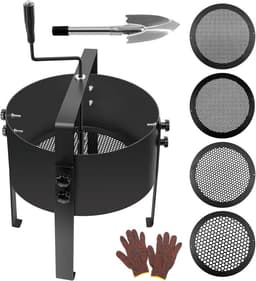
The LIROPAU listing is a hand-crank sieve at about £52.99, with a 30 cm drum, a stated weight of 5 kg, and meshes at 3, 6, 9, and 12 mm. On amazon.co.uk it is 2.0 from 2 reviews, and the raw file contains one review text. That UK review says the instructions were unclear, a bearing had to be bored out, and the spindle then wobbled and jammed. A bullet says fill it no more than two-thirds, and the speed claims on the page, including a drop toward 10 minutes, have no test in this file. Reinforced iron is the material line, with a stainless screed claimed. Two ratings are this product’s record, not a verdict on every rotary sieve. Assembly is required, and the only written review did not get a drum that turned cleanly.
Pros
Cons
Best for: You are comparing rotary listings and you will wait for a longer review line before you buy this one.
Less suitable: You want a sieve this week for one compost bin, or you cannot lift 5 kg plus a load.
Specifications
Common questions
Does it need assembly?
Yes. The only UK review in the raw file says the instructions were unclear, a bearing had to be bored out, and the spindle then wobbled and jammed.
How full should it be, according to the listing?
A bullet says fill it no more than two-thirds. The weight is 5 kg and the drum diameter is 30 cm.
How many reviews support the star rating?
The listing line is 2.0 from 2 reviews. The raw file contains one review text.
Twelve amazon.co.uk listings, captured on 19 October 2026, are on this page. There is no laboratory mesh test. Amazon evidence is 40 points, fit for the job is 35, and value is 25. A 4.7 from a few dozen ratings does not outrank 4.6 from 1,806. Repeated complaints come off the evidence block. On the cards the top pick is the Spear & Jackson riddle and the best value is the ADEPTNA five-mesh sieve.
Amazon evidence
40%Star rating scaled by review count. A long UK review line scores above a 4.7 from a few dozen ratings. Torn mesh, inserts that fall out, a size line that fights the title, and a jammed assembly come off this block.
Fit for the job
35%A stated hole size you can match to compost or stones, one clear grade or a real set of grades, a frame you can load, and a material claim the reviews do not already contradict.
Value
25%GBP shelf price against a stated mesh and a real review line. The lowest price does not win when the centimetre line and the word large disagree. Two ratings do not win on the dearest listing.
Match the hole size to the job, then read the centimetre line. A long review sample matters more than a high star on two ratings.
A compost sieve, also called a garden riddle, lets finished compost, soil, or leaf mould fall through a mesh and holds back stones, roots, and sticks. In the UK the two names are the same tool. You judge a listing by the hole size in millimetres, the diameter in centimetres, and whether the mesh is a fixed plate or a loose insert. Twelve amazon.co.uk listings are on this page, from about £6.99 to about £52.99. Mesh comes first.

A 20 cm pan is a pot or lawn-patch tool. Read the centimetre line. A title that says large while the technical line says 20 cm is a description problem under the Consumer Rights Act 2015.
Fine holes clog. A 3 mm mesh is for a small, dry batch. About 10–12 mm is the everyday grade for a heap and for stones.
The LIROPAU listing is 2.0 from 2 reviews, and the only written review describes a jammed spindle. That record is this product’s, not a verdict on every crank sieve. One compost bin does not need a drum.
About 10–12 mm is the everyday grade for a compost heap and for stones. Gardeners’ World describes about 1 cm mesh on a barrow-width frame. About 5–6 mm is the finer grade, including the RHS 5 mm sieve before loam is heated for a John Innes mix: moist soil no deeper than 8 cm, at 71–79 °C for 10 minutes. Do not merge that figure with other oven times. A 3 mm mesh is only for a small, dry batch, because finer holes clog. Sieving does not make the result seed compost.
A useful hand riddle in this set is about 30–40 cm across. A 20 cm pan and a 9.5 inch frame are pot tools. A fixed plate cannot fall out and does one job. Inserts cover 3 mm to 12 mm, and UK reviews on more than one listing say the disc drops out when you tip the sieve. Use rigid steel or stainless for stones, and poly mesh or a thin plastic pan for light, dry compost. Dry metal before storage. Chrome, stainless, and galvanised are not a promise against rust.
Three typical situations, each with a recommendation from this comparison.
You sift one heap or stony soil at about 10 mm and you want a fixed plate with a long review line. The Spear & Jackson riddle is about £14.95, 586 g, with 4.6 from 1,806 reviews. There is no second mesh.
You want 3 mm through 12 mm in one pan and you will check the fine disc before you rely on it. The ADEPTNA five-mesh sieve is about £14.95, 29.5 cm, with 4.5 from 40 reviews. One review measured the finest mesh at about 5 mm.
You sift light, dry compost and you want the sieve to fold. The Haxnicks Easy Riddle is about £9.99 and 250 g, with 4.2 from 411 reviews. UK reviews also report torn mesh, including within a day, and a poor match for sharp stone.
Twelve sieves are on this page, from about £6.99 to about £52.99, and none was mesh-tested in a lab. The Spear & Jackson garden riddle, about £14.95, is the top pick: 4.6 from 1,806 amazon.co.uk reviews on a fixed 10 mm plate. The listing and the maker’s page still disagree on diameter. The ADEPTNA five-mesh sieve, about £14.95, is the best value: five stated grades from 3 mm to 12 mm, with 4.5 from 40 reviews. moonateen ties that pan on the total score and loses the value mark at about £23.99. A 3 mm mesh is for a small dry batch, and two rotary ratings are not a verdict on every crank sieve.

ADEPTNA five-mesh sieve
Five stated meshes at about £14.95, the next highest value part after the top pick.
Editorial

Peter F. is the editor for DIY & tools at productscompared.co.uk. Comparisons in this category are checked against amazon.co.uk listings, review evidence and public UK sources.
Guides on what to look for, how to use a product, and common mistakes.
Public UK and manufacturer sources, last checked on 19 October 2026. ASIN prices and stars are from the amazon.co.uk listings in this comparison.
This article contains affiliate links. If you buy through these links, we may earn a commission at no extra cost to you. The cards use amazon.co.uk listing data and public UK sources. They are not a laboratory test.