Independent comparisons. We may earn from shop links. More info

Rotary soil sieve vs riddle

Updated: 21 October 2026

You have more than one compost bin, or a stony allotment bed, and a crank sieve looks as if it would save your back. A rotary soil sieve versus a riddle is a storage and volume decision, not a star-rating contest. A hand riddle is the default for one bin. A drum is worth considering when the material is dry, the job is large, and you can lift and store the machine. The hand tools in this set are on the [compost sieve comparison](/hub/raised-beds-greenhouses-and-compost/compost-sieve). Peter F. compared the two classes on 19 October 2026. We did not time a cubic metre. If you buy through our links, we may earn a commission at no extra cost to you.

You have more than one compost bin, or a stony allotment bed, and a crank sieve looks as if it would save your back. A rotary soil sieve versus a riddle is a storage and volume decision, not a star-rating contest.

Our top picks

On this page

They are different tools

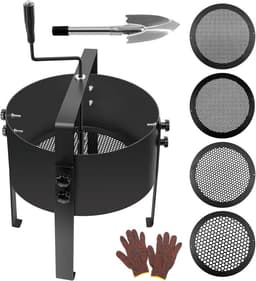
A hand riddle is a mesh you shake or rock. A round plate, a folding poly sieve, or a bucket sifter all work that way. You load a thin layer, the fines drop, and you tip the overs out. Prices for those hand tools in this amazon.co.uk set run from about £7 to £25, and you do not assemble them. They are slower when the volume is measured in barrows rather than buckets, because each load is a small one. A rotary sieve is a drum on a frame. You put material inside, turn a handle, and the fines fall through the curved mesh. An allotment thread records one user who found a rotasieve easier on the back, and slower because the legs dumped onto a sheet. A drum still needs dry compost. This page is about which machine you stand next to.

Stay with a hand riddle

Stay with a hand riddle for one bin, a single border, or a shed with no floor space. A fixed 10 mm plate around 30 cm, or a folding riddle you can hang up, finishes that job without a 5 kg frame in the way of the mower. The best garden riddle page sorts those hand picks by job. You can sieve a few buckets on a dry afternoon and put the sieve back on a nail. Holding a loaded sieve out from the body tires your shoulders. Rest the riddle on the barrow and keep the layer thin. If the heap is one bin, a crank spends as much time in the shed as it saves on the plot. The steps are on the how to use a garden riddle page.

Consider a crank when the volume is dry

Consider a crank when you regularly sift a dry heap bigger than a few buckets, and you can store the frame and lift it. Clarke’s CRS400 sheet, for a rotary model that is not an ASIN in this set, says to place the sieve over the barrow, keep the material from being too wet, fill it about half full, turn until the fines drop, and return the rest to the heap. A trade page puts that model near 5.8 kg. Do not copy 5.8 kg onto a different listing. The principle is the useful part: half full, dry, overs returned. Crafty Cabbage recorded a rotary sieve that jammed on wet compost and worked when the compost was dry and not overfilled. It still left woody bits. The LIROPAU bullets say fill to no more than two-thirds, and they claim a drop from about an hour to 10 minutes. Those speed lines have no test in this file.

This listing is not the whole type

The only rotary sieve in the comparison is the LIROPAU, at about £52.99. The drum is stated at 30 cm, the weight at 5 kg, and the meshes at 3, 6, 9, and 12 mm. amazon.co.uk shows 2.0 from two reviews. The raw file has one review text. That UK review says the instructions were unclear, a bearing had to be bored out, and the spindle then wobbled and jammed. A hand riddle in the same shed does not ask for that. Two ratings are not a verdict on every rotary sieve. This listing is a weak example of the type, because the only written review did not get a drum that turned cleanly, and because about £52.99 is a large step up from a £15 plate. If you cannot lift 5 kg plus a load of compost, skip a drum of this weight whether or not the bearing fits.

Skip both for the wrong soil

Neither tool belongs on soil that may contain oil, asbestos, or unknown builders’ waste. Leave the ground and get advice from someone who deals with contaminated soil, rather than grading it finer. Both tools also leave living roots. Bindweed, horsetail, and ground elder are not sieved out of existence. The Royal Horticultural Society tells you to exclude those weeds when you make a potting mix, which means you pull them while you can see them. A mesh, flat or curved, only sorts particle size. For a normal heap, the condition stays the same: a hand riddle, unless the dry volume is large, you can store the frame, and you can lift about 5 kg before you add the compost.

Common questions

When is a hand riddle enough?
A hand riddle is enough for one compost bin, a border, or a few barrows a year, if you can rest it on the barrow and keep each layer thin. The hand tools here cost about £7 to £25 and need no assembly. They are the slower option once the job is many dry barrows. They are the better option when the shed has nowhere for a drum. One bin does not justify a crank.
When is a crank sieve worth storing?
It is worth storing when you often sift a dry heap larger than a few buckets, and you have floor space and the strength to lift the empty machine plus the load. Clarke’s sheet for a different rotary model says about half full and not too wet. The LIROPAU listing says no more than two-thirds. Use whichever limit is printed on the sieve you own. A crank that lives behind the mower and comes out once a year is a storage problem, not a time saving.
Can I rotary-sift wet compost?
You will clog it. Crafty Cabbage recorded a rotary sieve that jammed on wet, sticky compost and worked once the compost was dry and not overfilled. Clarke’s operating sheet says the material should not be too wet. The same limit applies to a hand riddle, which blinds rather than jams a spindle. Dry the heap first. Turning the handle harder packs the mesh. It does not dry the compost.
How full should the drum be?
Follow the sheet for that model. Clarke’s CRS400 sheet says about half full. The LIROPAU bullets say no more than two-thirds. Do not treat those as the same instruction on the same machine, and do not import Clarke’s weight onto the LIROPAU. Overfilling is how a drum clogs and how the handle becomes a fight. Fines should drop while you turn. If they stop, empty it and put less in.
Does a rotary sieve replace a fine mesh?
No. A drum still leaves woody bits, and a finer grade is a second pass if you need it. Crafty Cabbage noted that after using a rotary sieve. The LIROPAU listing includes 3, 6, 9, and 12 mm meshes, so the fine grade is a different screen, not an automatic result of cranking. Sieving, by hand or by drum, does not make homemade compost into seed compost.
Is one listing with two reviews a reason to avoid every rotary sieve?
No. It is a reason to avoid treating this listing as the verdict. The LIROPAU is about £52.99 and 2.0 from two reviews, with a UK review that describes a bored-out bearing and a jammed spindle. Another rotary sieve can be a fair buy for a large, dry heap. Judge that other model on its own weight, fill limit, and review line. Two stars on one page do not describe the whole type.
Who should not lift one?
Do not lift a drum if you cannot manage the empty weight plus the compost. The LIROPAU listing states 5 kg empty. Clarke’s CRS400 is described near 5.8 kg on a trade page, and that figure is not this ASIN. A loaded drum is heavier than either number. If that lift is uncomfortable, keep the hand riddle on the barrow and take thin layers. A crank is not a lighter tool. It is a different posture, with a heavier object to move first.

Related pages

Sources

Public UK and manufacturer sources, last checked on 19 October 2026. ASIN prices and stars are from the amazon.co.uk listings in this comparison.

  1. RHS, How to make your own potting mix (retrieved 19 October 2026)
  2. RHS, Four steps to perfect compost (retrieved 19 October 2026)
  3. RHS, John Innes potting compost (retrieved 19 October 2026)
  4. RHS, Peat-free compost choices (retrieved 19 October 2026)
  5. Gardeners' World, How to make a soil sieve (retrieved 19 October 2026)
  6. Haxnicks, Easy Riddle (retrieved 19 October 2026)
  7. Spear & Jackson, Garden riddle (retrieved 19 October 2026)
  8. Consumer Rights Act 2015, sections 9 and 11 (retrieved 19 October 2026)