Legionella thermostatic mixing valve: keep the cylinder hot
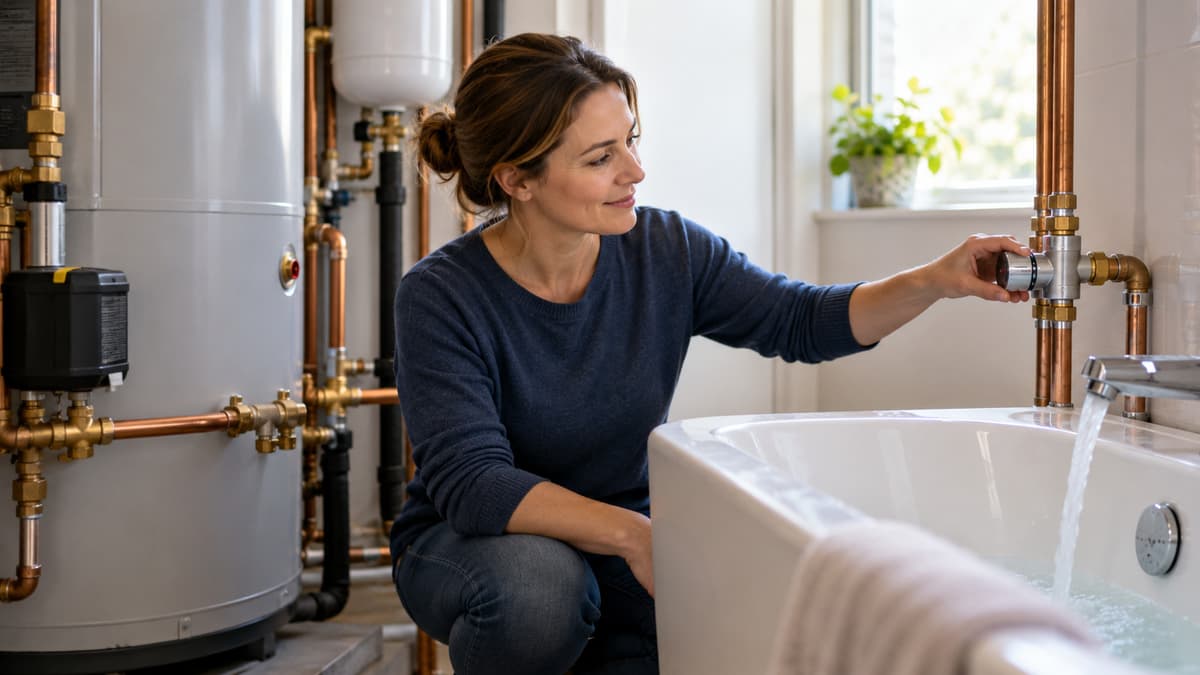
A legionella thermostatic mixing valve does not cool the cylinder. Keep stored water at 60°C or above, and keep the blended pipe as short as guidance allows.
On this page
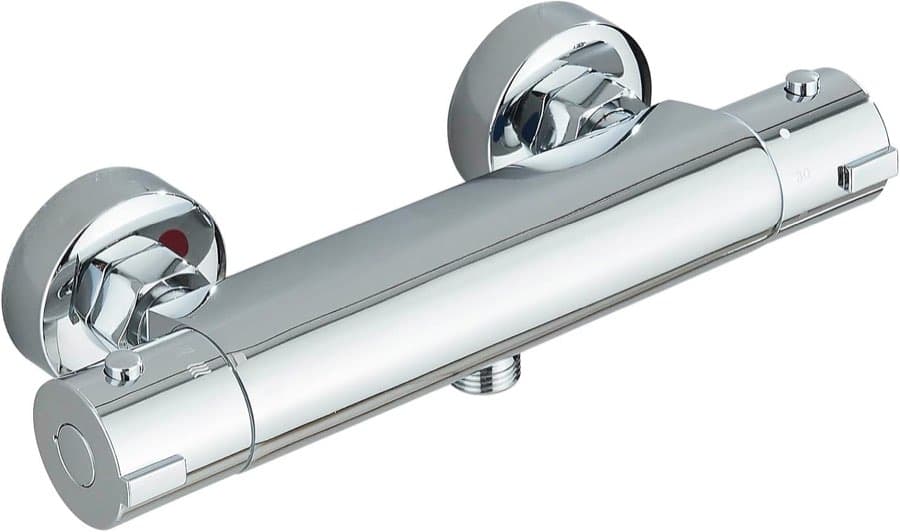
Someone has told you to turn the cylinder down so the bath is safe. A legionella thermostatic mixing valve is the opposite arrangement. The store stays hot enough that the bacteria are discouraged, and a second device at the outlet does the cooling people actually touch. One knob cannot be both temperatures.
The listings in our thermostatic mixing valve comparison are retail bodies. None of them states TMV2 or TMV3, and none of them is a licence to run the cylinder at bath temperature. A qualifying purchase through the comparison can earn us a commission, at no extra cost to you. Products Compared has not sampled a system for Legionella. The figures below are HSG274, the HSE’s scalding note, BEAMA’s code, and Approved Document G, as of October 2026.
In short
Store hot water at least at 60°C, and let distribution reach 50°C within a minute, or 55°C in healthcare. Blend at the outlet, and keep that blended pipe as short as you can. HSG274 says “as close as possible”. About two metres is what BEAMA’s code recommends in the cases it covers. It is not a law that every valve may use two metres of lukewarm pipe.
Why the store stays hot
HSG274’s storage line is easy to soften and should not be softened. Hot water is stored at least at 60°C. It is distributed so that it reaches 50°C within one minute at the outlets, and 55°C within one minute in healthcare. Those are the temperatures the guidance uses against Legionella in the store and the hot distribution. “Warm is fine” is a different policy, and it is not this one.
The HSE’s scalding page says that where storage and distribution are kept hot for Legionella control, above 60°C stored and 50°C distributed, baths and showers for vulnerable people should have mixing valves so those outlets do not exceed 44°C. The 44°C figure belongs to those vulnerable outlets. It is not an instruction to set the cylinder to 44°C. The valve is what the skin meets.
A new-dwelling bath has its own temperature limit under Approved Document G, and that limit is the subject of the bath temperature page. This article does not re-argue 48°C. Whatever the outlet cap, the store is still a hot store. Dropping it to the temperature you want in the bath, and calling that drop a mixing valve, leaves you with no blend and with stored water in the range the guidance is trying to avoid.
What the blended pipe adds
Once water has passed through the mixing valve it is no longer the 60°C store. HSG274 paragraphs 2.74 to 2.76 say blended water downstream can suit Legionella. The preferred fix is to mix at the outlet and keep the valve close to the point of use. Every extra metre of pipe after the valve is a metre of water that has already been cooled into the awkward band, sitting until someone next opens the tap.
A spray outlet makes that pipe more important, not less. The bacteria matter when they are breathed in as droplets. A spray tap or a shower on a long blended leg is water from that leg, broken into a mist. The guidance does not invent a separate spray-tap distance. It says the blend should happen as close as possible to the outlet.
Approved Document G paragraph 3.68 asks for the pipe between the blending valve and the outlet to be kept short, and for an intermittent bath to be flushable hot without exposing someone. If the only way to clear the blended pipe is to run hot water over a person, the pipe is doing the thing the paragraph wants you to avoid. A valve buried where you cannot run it to waste fails that test even when the metre count looks tidy.
Who says two metres
BEAMA’s safe water temperatures code recommends a maximum run of about 2 metres from the mixing valve to the outlet, in the applications that code lists. Reliance’s own guidance also states two metres. Both are industry or manufacturer speakers. They are useful when you are asking whether a run is already long. They are not HSG274, and HSG274 does not say “two metres is permitted”.
HSG274 says as close as possible. The HSE’s “things to consider” note pairs storage at 60°C with a short run after the valve. “Short” and “as close as possible” are the official wording. A merchant blog that says the regulations stipulate two metres for every valve has joined BEAMA’s number to HSG274’s duty. Keep the speakers apart when you write a specification, or when you argue with a fitter who has allowed a cupboard valve and a long feed to a distant shower.
As close as possible might be 300 mm in a basin pedestal and longer where the bath pipes are fixed. Two metres is a ceiling in a code, not a target to aim for. If you can put the valve at the outlet, do that. WaterSafe’s consumer note treats a tap with a built-in mixing valve as better practice because the blended leg disappears. A £16 inline body ten metres away is the opposite of that practice.
One valve for many outlets
One mixing valve feeding many taps can raise the risk. HSG274 says so. Each extra basin adds pipe that carries blend, and the valve is no longer at any one of them. A cloakroom with three basins on one hidden blender is a shared lukewarm system afterwards. The preferred picture is a valve at each outlet, so the blended volume is the last few centimetres.
Paragraph 2.165 still wants the strainers maintained, and the scald protection maintained, but maintenance does not shrink a pipe you fitted too long. Fit short first. Service what you fitted.
Sampling follows the same split. When a Legionella sample is meant to represent the system, HSG274 paragraph 2.121 says take it from separate hot and cold outlets. Do not take it through a mixer, and do not take it downstream of a TMV. The blended tap tells you about the blend. The hot outlet, upstream of any valve, tells you about the store and the distribution. A mixed sample that feels safe on the hand can sit next to a store that is too cool.
Tempering above 80 degrees
A store above 80°C is a different problem from a store at 60°C. The device associated with that hotter store is a tempering valve to BS EN 15092. It is not Table 2 of D08, and it is not the point-of-use thermostatic mixing valve this comparison is about. Paragraph 3.64 in the guidance drawn on here keeps those devices apart. If your cylinder is that hot, you are in the tempering-valve specification, and a retail inline body is not a silent substitute.
D08 is the TMV3 healthcare scheme. TMV2 is the domestic or general scheme, tied to BS EN 1111 and BS EN 1287. The TMV2 and TMV3 page holds that distinction. Neither scheme is a tempering valve for an 80°C-plus store, and neither name is printed on the nine amazon.co.uk listings. Buying Zamery’s bar, the top pick for an exposed shower bar, or Wincal’s 190 g body, does not select BS EN 15092 and does not select D08. The price selects a form. The standard on the specification line selects the duty, when a standard is there at all.
Keep an ordinary store at 60°C or above, distribute it so the hot outlets reach the minute-test, and blend at the point of use with a valve kept close to that use. If the store is above 80°C, specify the tempering valve the document names, and still do not feed a long blended leg to a row of sprays. The comparison can show you what a retail mixing body looks like. It cannot show you that the cylinder may now run cool.
Common questions
If I fit a mixing valve, can the cylinder run cooler?
How long can the blended pipe be?
Is two metres a law or a guide?
Why is a spray tap on a basin a worse case?
Can one valve feed every basin in a cloakroom?
Where should a Legionella sample be taken if a TMV is fitted?
What is the difference between a tempering valve and a point-of-use TMV?

Products Compared publishes British-English buying guides based on amazon.co.uk listings and public UK sources. We do not run a lab and we do not invent test scores.
Related articles
Scalds in rented homes
A scalding tap is a hot-surfaces hazard. Turning the cylinder down is not the English repair duty.
How often to check a TMV
Strainers are a yearly hygiene job. Healthcare outlets are checked in weeks, not on the domestic clock.
When a valve passes full hot
If the blend has stuck on hot, stop using the outlet. Cooling the cylinder does not repair the element.