Independent comparisons. We may earn from shop links. More info

Bath thermostatic mixing valve at 48 degrees

Updated: 16 October 2026

You are replacing a bath, building a flat, or running water for someone who cannot pull away from heat. A bath thermostatic mixing valve at 48 degrees is the phrase people quote, often in the same breath as 44°C. The Products Compared editorial team wrote this page on 16 October 2026 from the English building regulation, the Part G FAQ, Approved Document G and NHS D08, then set those texts against our [thermostatic mixing valve comparison](/hub/medical-protection/thermostatic-mixing-valve). We did not laboratory-test those valves. A purchase through the comparison links may earn us a commission at no extra cost to you.

You are replacing a bath, building a flat, or running water for someone who cannot pull away from heat. A bath thermostatic mixing valve at 48 degrees is the phrase people quote, often in the same breath as 44°C.

Our top picks

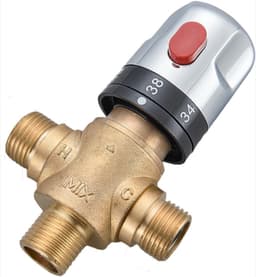
Coleniny Coleniny CN607

Best overall

Coleniny Coleniny CN607
9.2/10about £18.99
Bohaner Bohaner 04-502

Alternative

Bohaner Bohaner 04-502
8.8/10about £16.89
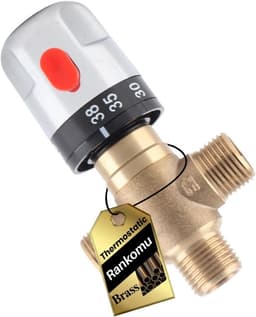
Rankomu Rankomu Rankomufmv79gowcg

Best value

Rankomu Rankomu Rankomufmv79gowcg
8.6/10about £15.99
On this page

When the 48°C bath rule applies in England

Requirement G3(4) says hot water to any fixed bath must be designed so the water delivered does not exceed 48°C. It applies when a dwelling is erected, or formed by a material change of use under regulation 5(a) or 5(b). Approved Document G points at an in-line blending valve shown against standards such as BS EN 1111:1999 or BS EN 1287:1999, failing safe and not easily altered. Scotland and Northern Ireland have their own building regulations.

A new bathroom in the house you already live in

The Part G FAQ says a new bathroom in an existing dwelling does not bring the 48°C duty with it. A like-for-like replacement sits outside that trigger. A contractor reading that treats every full refit as Part G is stronger than the FAQ. A listing near £16 does not perform the Approved Document route. Fitting checks are on the commissioning page. If you have not chosen a form yet, start with the buying guide.
Coleniny Coleniny CN607

Testsieger

Coleniny Coleniny CN607
9.2/10about £18.99

44°C is a different job

NHS D08 sets the healthcare bath maximum at 44°C, with 46°C only while a competent person supervises. A shower and a washbasin are 41°C. A bidet is 38°C. HSE uses 44°C where vulnerable people can be wholly immersed, and HSIS6 names Type 3. Using 48°C on a care bath would sit above the healthcare maximum. None of the nine listings states TMV3. Scheme names are on the TMV2 vs TMV3 page. Care-home service intervals belong in a competent person’s record.

What these listings do not show

None of the nine names BS EN 1111 or BS EN 1287. The fields say ASSE, CSA, BS EN 1074, CE, ASME, MSS, or nothing. A 38°C button around £16 is a handle stop, and no listing prints a cold-water fail volume. Bohaner’s button is described as about 50°C, above both caps. Dropping the cylinder so the bath stays under 48°C fights the guidance to keep hot water at 60°C or above. If the store can exceed 80°C, paragraph 3.64 is a BS EN 15092 tempering valve on the distribution, which is not the bath valve.

Which cap applies to you

If the dwelling is being erected in England, design the bath so delivered water does not exceed 48°C. If you already live there and the replacement is like for like, the Part G FAQ does not bring that duty in. If someone cannot pull away from heat, the healthcare figure is 44°C, and that specification is not in this set.

Common questions

Must I fit a TMV when I replace a bath in the house I already live in?
The Part G FAQ says a new bathroom in an existing dwelling does not bring in the 48°C duty. The duty applies when a dwelling is erected or formed by a change of use. A like-for-like replacement sits outside that trigger. You may still choose a valve for a child or an older person. A contractor line that every refit equals Part G is stronger than the FAQ.
Is 48°C the same as the care-home 44°C?
They are different caps. England’s G3(4) figure for a fixed bath in a new dwelling is 48°C. NHS D08’s healthcare bath maximum is 44°C, with 46°C only under competent supervision. HSE uses 44°C where vulnerable people can be immersed. A care bath at 48°C would sit above that healthcare maximum. This product set states neither TMV2 nor TMV3.
Does a 38°C button on a £16 valve satisfy Part G?
Several listings around £15.99 to £18.99 print a 38°C stop. Approved Document G describes a blending valve shown against BS EN 1111:1999 or BS EN 1287:1999, failing safe and not easily altered. None of these listings names those standards, and none prints a cold-water fail volume. The button on its own does not demonstrate that route for a new-dwelling bath.
What about a new-build flat in England?
A dwelling that is erected falls inside G3(4). A new-build flat in England is that case for any fixed bath: the water delivered is designed not to exceed 48°C. The FAQ’s answer of no is about an existing dwelling, not a flat created as a new home. These nine do not name BS EN 1111 or BS EN 1287.
Does this English rule cover Scotland?
The text here is England’s Requirement G3(4) and the English Approved Document. Scotland and Northern Ireland have their own building regulations, which this page does not set out. A bath there needs the local document. The healthcare 44°C figures from D08 and HSE are a separate duty, tied to vulnerability rather than to which nation’s new-build regulation you are reading.
Can I just turn the cylinder down instead?
HSG274 asks for hot water stored at 60°C or above. Dropping the cylinder so the bath stays under 48°C uses the store as the bath valve. The bath limit is a blend near the outlet, and the store stays hot. Above 80°C, paragraph 3.64 adds a BS EN 15092 tempering valve on the distribution.
What if the hot water can go over 80°C?
Paragraph 3.64 points at a BS EN 15092 tempering valve so distribution stays at or below 60°C when the store can exceed 80°C. Where G3(4) applies, the bath is still a separate 48°C blend. None of the nine listings is described as that tempering valve.

Related pages

Sources

Public UK sources named for this comparison. Updated 16 October 2026.

  1. NHS England, HTM 04-01 Supplement D08 (2017) (retrieved 16.10.2026)
  2. Approved Document G with 2024 amendments (retrieved 16.10.2026)
  3. Part G FAQ (retrieved 16.10.2026)
  4. The Building and Approved Inspectors (Amendment) Regulations 2009 (retrieved 16.10.2026)
  5. HSE, HSIS6 (retrieved 16.10.2026)
  6. HSE, HSG274 Part 2 (retrieved 16.10.2026)
  7. NSF, TMV2 and TMV3 (retrieved 16.10.2026)
  8. Kiwa, TMV testing (retrieved 16.10.2026)