Independent comparisons. We may earn from shop links. More info

How to commission a thermostatic mixing valve

Updated: 16 October 2026

The valve is on the bench, the handle points at 38, and it is tempting to treat that as finished. Commissioning is the next job: confirm the supplies, record the outlet with a thermometer, and see what happens when the cold feed is shut. This page, from the Products Compared editorial team on 16 October 2026, is that sequence for a household valve already chosen from the [thermostatic mixing valve comparison](/hub/medical-protection/thermostatic-mixing-valve). We did not laboratory-test the listings. A hospital outlet, and a failed cold-water check, are where you stop and call a competent person. A purchase through those links may earn us a commission at no extra cost to you.

The valve is on the bench, the handle points at 38, and it is tempting to treat that as finished.

Our top picks

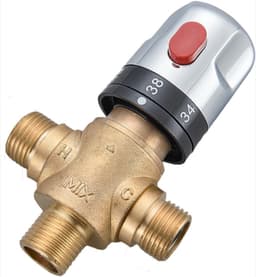
Coleniny Coleniny CN607

Alternative

Coleniny Coleniny CN607
9.2/10about £18.99
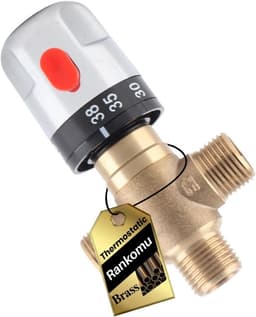
Rankomu Rankomu Rankomufmv79gowcg

Best value

Rankomu Rankomu Rankomufmv79gowcg
8.6/10about £15.99
On this page

Check the supplies before you set a number

Most inline bodies here are G1/2 or 15 mm. Bohaner says that thread is unsuitable for 3/4 inch pipe. Coleniny and kisimixer carry H and C marks. Zamery’s listing puts hot on the left and cold on the right. Coleniny and kisimixer state 60–85°C hot. Tremax bullets state 50–95°C hot. If the store can exceed 80°C, Approved Document G points at a BS EN 15092 tempering valve on the distribution. The other five listings print no inlet range. None of these inline boxes lists isolation or a strainer.

Set the mix for the outlet you have

The handle shows the listing’s stop, not the temperature at the tap. Coleniny and Rankomu print a 38°C stop. Bohaner’s button is described as about 50°C. Wincal and GETSHOWERSET print no stop. Measure the water that comes out. If the stop says 38°C and a jug reads 41°C, that gap is wider than the ±2°C movement Kiwa uses, on scheme guidance, as a reason for further service. Record the jug and leave the red button alone. A new-dwelling bath has a 48°C duty, and a care bath has a 44°C duty. Both sit on the bath temperature page. HSG274 wants the blend close to the outlet. Read the thermometer at the tap.

What a cold-water check is

Shut the cold feed and watch the mixed outlet. Stored hot water should not then arrive as though the cold pipe were still open. The pass limit is the figure in that valve’s own instructions. Horne’s instructions for one TMV3-style valve limit continued flow to 120 ml in 60 seconds. That figure belongs to Horne. Copying it onto these listings would invent a test they do not print. Bohaner and Rankomu mention a cold-side reaction and give no volume. If the outlet runs full hot, stop and isolate the valve. Which schedule belongs to which scheme is on the TMV2 vs TMV3 page.

When you stop

Stop if full hot water reaches the tap, if you have no isolation valve, or if storage can exceed 80°C. Paragraph 3.64 is a BS EN 15092 tempering valve, not one of these nine bodies. Also stop for a hospital, a care setting, or a new dwelling that must be signed off under G3(4). For an ordinary basin, the domestic note is a yearly look, and HSG274 asks for strainers to be cleaned at least annually. If the water climbs toward the cylinder, take the valve out of use. The buying guide is where you return if the body was the wrong form.

What you record, and when you call

Write down the thread, the thermometer reading at the tap, and what happens when the cold feed is shut. Call a competent person if the outlet runs full hot, if you cannot isolate, or if the job needs a Part G sign-off. A handle at 38 is the start of that note, not the end of it.

Common questions

What do I check before I open the water?
Confirm the thread, the H and C ports, and that you can isolate both supplies. Kiwa’s Type 2 note asks for isolation if the maker did not supply it, plus strainers. None of these inline boxes lists either part. Flush debris, then measure at the outlet rather than trusting the handle.
Which side is hot?
Coleniny and kisimixer carry H and C marks. Zamery’s listing puts hot on the left and cold on the right. The other files do not print a side. If the marks and the pipes disagree, have the supplies corrected before you trust the scale. The red button does not fix a crossed connection.
What is a cold-water isolation test in plain words?
You shut the cold feed and watch the mixed outlet. Stored hot water should not then run as if the cold were still open. The allowed trickle belongs in that valve’s own instructions. Horne’s 120 ml in 60 seconds is one maker’s limit, and these nine listings do not print it. If the outlet runs hot, stop and leave it isolated.
The handle says 38 but the water is not 38. What now?
Record the thermometer at the outlet and treat that as the number you have actually set. On Kiwa’s scheme guidance, a gap of more than about 2°C is a reason for further service, not a reason to push the override until the dial looks right. Rankomu prints ±2°C as a claim. If the water climbs toward the cylinder temperature, take the outlet out of use.
How close to the tap should the valve sit?
HSG274 wants the blend close to the point of use. A reviewer mentioning about a metre of pipe has not stated the rule. Put the valve near the tap and take the reading there. A distant cupboard with a long blended leg is a different installation from the one this guidance describes.
When do I stop and call someone?
Call a competent person if full hot water reaches the tap, if you cannot isolate the cold feed, if storage can exceed 80°C, or if the outlet is a care setting or a new dwelling that needs a Part G sign-off. Also call if the first reading is far from the stop after you have flushed.

Related pages

Sources

Public UK sources named for this comparison. Updated 16 October 2026.

  1. NHS England, HTM 04-01 Supplement D08 (2017) (retrieved 16.10.2026)
  2. Approved Document G with 2024 amendments (retrieved 16.10.2026)
  3. Part G FAQ (retrieved 16.10.2026)
  4. The Building and Approved Inspectors (Amendment) Regulations 2009 (retrieved 16.10.2026)
  5. HSE, HSIS6 (retrieved 16.10.2026)
  6. HSE, HSG274 Part 2 (retrieved 16.10.2026)
  7. NSF, TMV2 and TMV3 (retrieved 16.10.2026)
  8. Kiwa, TMV testing (retrieved 16.10.2026)