Wooden garden shed buying guide
You have a tape, a few long-handled tools, and listings that all say wooden garden shed. The word does not say whether the box is a reach-in cabinet or a building you can step into. This wooden garden shed buying guide is the order before a brand: the job, the internal depth, the roof claim, the treatment words the listing prints, then the closer and one review that measured something. The eight prices stay on the [wooden garden shed comparison](/hub/garden-supplies/garden-shed-wood). Peter F. read those amazon.co.uk listings and the public UK pages named below, and did not run a timber test. A qualifying purchase can earn us a commission at no extra cost to you.
You have a tape, a few long-handled tools, and listings that all say wooden garden shed. The word does not say whether the box is a reach-in cabinet or a building you can step into.
You have a tape, a few long-handled tools, and listings that all say wooden garden shed. The word does not say whether the box is a reach-in cabinet or a building you can step into. This wooden garden shed buying guide is the order before a brand: the job, the internal depth, the roof claim, the treatment words the listing prints, then the closer and one review that measured something. The eight prices stay on the wooden garden shed comparison. Peter F. read those amazon.co.uk listings and the public UK pages named below, and did not run a timber test. A qualifying purchase can earn us a commission at no extra cost to you.
Our top picks
| Badge | Product | Listed size | Weather words | Closer | Note | Price | Offer |
|---|---|---|---|---|---|---|---|
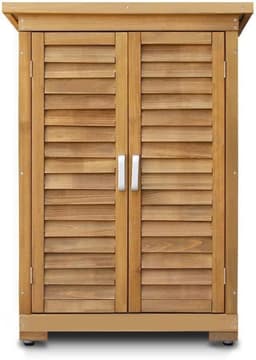
| Best overall |  Outsunny Outsunny fir cabinet, 96.5 cm | 87 × 46.5 × 96.5 cm | Water resistant | Handles | 8.4 | about £91.00 | View offer |
| Best value |  FEFE FEFE fir cabinet, 69 cm | 69 × 43 × 96 cm | Water resistant | Magnetic catches | 5.7 | about £119.99 | View offer |
 Generic HYGRAD-titled fir cabinet, 96 cm | 69 × 43 × 96 cm | Waterproof | Magnetic catches | 5.1 | about £104.99 | View offer |


On this page
What you are actually comparing
Size, door and roof
Treatment words these listings skip
Lock, shelves and when to leave the set
Common questions
Is a wooden garden shed on amazon.co.uk a building you can walk into?
What should you measure before the brand?
Does varnish mean the timber is pressure treated?
Pent or apex, when the cabinet is only about a metre tall?
What does a magnetic catch actually lock?
When is a 3×5 mower store the right comparison instead?
Related pages
Sources
Public UK sources for this comparison. Prices, stars and review counts are the amazon.co.uk listings in this set. Page updated 22 October 2026.
- Class E, Town and Country Planning Order 2015 (retrieved 22 October 2026)
- Planning Portal: outbuildings (retrieved 22 October 2026)
- Building Regulations 2010, Schedule 2 (retrieved 22 October 2026)
- LABC: outbuildings and building regulations (retrieved 22 October 2026)
- Edinburgh Council: sheds and ancillary buildings (retrieved 22 October 2026)
- BS 8417:2024, preservation of wood (retrieved 22 October 2026)
- Wood Protection Association: Use Class 3 (retrieved 22 October 2026)
- Consumer Rights Act 2015, section 9 (retrieved 22 October 2026)