Independent comparisons. We may earn from shop links. More info

Treat a wooden garden shed

Updated: 22 October 2026

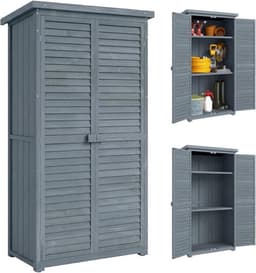
You have a flat-pack fir cabinet, and the page said varnish, a top coat, or water resistant. To treat a wooden garden shed you still coat the timber yourself, including every cut, because none of the eight listings in the [wooden garden shed comparison](/hub/garden-supplies/garden-shed-wood) states BS 8417, Use Class 3, or pressure treatment. Varnish is only a finish note. Peter F. read those amazon.co.uk listings and the public UK pages named below, and did not run a timber test. A qualifying purchase can earn us a commission at no extra cost to you.

You have a flat-pack fir cabinet, and the page said varnish, a top coat, or water resistant.

Our top picks

On this page

What these listings actually promise

The amazon.co.uk wording stops at a finish. The short Outsunny, B07NBYTW6W, listed at £91.00, talks about varnish, and a six-month warranty line that never says how the wood was preserved. The taller Outsunny, B0DKF7Z477, at 160 cm and listed at £137.00, pairs a top coat with a note to add treatment and limits the asphalt roof to light or medium rain. That rain line is a weather phrase, and “add treatment” means the factory coat is unfinished. BS 8417:2024 is the code of practice for preserving wood, and the Wood Protection Association treats it as an order you place with a desired service life. The six-month line on the short Outsunny stays a seller statement, so it cannot stand in for a 15-year treatment guarantee. If about 96 cm will not take the mower, the sizes are on the wooden garden shed buying guide.

Use class, cuts and ground contact

Use Class 3, on the Wood Protection Association’s note, is outdoor timber above the ground and out of the soil, which is where cladding sits when it is specified to BS 8417. Use Class 4 is a piece that stays in the ground, such as a bearer in the soil, and the WPA buyer guide keeps the two classes apart. A sawn end drinks faster than a face, which is the TRADA point about open end grain. Brush the panel you trimmed, the board ends that arrived sawn, and the joins, before the first wet week. York Timber want a protector on the joins and end grain of their tanalised wood, because tanalising is not the water seal. Pilot holes are bare timber as well, and the drill order sits on how to assemble a wooden garden shed. The same tin on a buried batten does not produce Use Class 4. Bearers kept clear of the soil stay closer to an above-ground job.

What yearly means on a UK maker sheet

A yearly coat on a maker’s sheet belongs to that maker’s building. Rowlinson’s Mini Store asks for a preserver within three months, then once a year, and the sentence covers that dipped shiplap store. It sits outside this set. Move that three-month clock onto B07NBYTW6W and you would be reading a varnish line as dip treatment. Power Sheds draw a similar line, and only for their own sheds. Dip-treated models on their help page want a coat inside and out each year. Their pressure-treated sheds still want a water-repellent coat, and these eight pages never state pressure treatment, so there is nothing here to skip.

Felt, vents and what not to invent

Loose felt on B07NBYTW6W is a fixing job, and it shows long before a face coat wears through. Leave asphalt that is stuck flat and intact, because peeling a sound factory sheet only opens dry timber. Call a roofer when the board is soft, the pitch is almost flat, or you cannot safely reach a walk-in roof, because a tear still wets the fir underneath. Louvre doors pass air, and they pass rain with it, so a preserver leaves the slats as a vent. If the tools have to stay dry, this shell was the wrong buy for that job, and who the £91 Outsunny suits is on the best wooden garden shed page. One FEFE buyer on B0BNL8YXBR used fence paint, and one BLUEBRIT buyer on B0D5VKH95K used boiled linseed oil. Each note is one review, with no use class and no word on the end grain, so neither is a treatment method.

Common questions

Do these cabinets arrive pressure treated?
No listing in this set states pressure treatment, dip treatment, BS 8417, or Use Class 3. Varnish, a top coat, or water resistant is as far as the amazon.co.uk wording goes. The taller Outsunny tells you to add treatment, which fits only if the factory coat is unfinished. Coat the faces and the end grain.
What is Use Class 3 in one sentence?
Use Class 3 is outdoor timber above the ground and out of the soil, specified to BS 8417 with a service life. These cabinets are sold without that description. Cladding falls in Class 3 only when a buyer orders it that way. A bearer in the soil is Use Class 4, and a brush-on tin does not move a fir cupboard into either class.
When do you coat the cut ends?
Coat every fresh cut before the cabinet stands in the wet, because end grain drinks faster than a face. The Wood Protection Association asks for preservative on every cut, and TRADA makes the same point about open ends. Include a panel you trimmed and the board ends that arrived sawn. Leave a split piece uncoated if you may return it.
Is a varnish line enough for a UK winter?
A varnish line names neither a use class nor a service life, so it is a thin winter specification on its own. Rain reaches end grain, joins, and loose felt before a face film fails. The short Outsunny’s six-month warranty line is a seller period, separate from any winter test. Coat the faces, joins, and cuts, and fix lifting felt, if the cabinet has to last a wet month.
What if the felt is already lifting?
Pull a lifting sheet taut from the low edge and fix through the overlap, on a dry day, so water runs off the felt. IKO’s note, for felt you are laying, wants a pitch and a day above 10°C. Leave a factory sheet that is already stuck flat. On B07NBYTW6W the fault to look for is a loose sheet. If the board is soft, or the roof is out of safe reach, use a fitter.

Related pages

Sources

Public UK sources for this comparison. Prices, stars and review counts are the amazon.co.uk listings in this set. Page updated 22 October 2026.

  1. Class E, Town and Country Planning Order 2015 (retrieved 22 October 2026)
  2. Planning Portal: outbuildings (retrieved 22 October 2026)
  3. Building Regulations 2010, Schedule 2 (retrieved 22 October 2026)
  4. LABC: outbuildings and building regulations (retrieved 22 October 2026)
  5. Edinburgh Council: sheds and ancillary buildings (retrieved 22 October 2026)
  6. BS 8417:2024, preservation of wood (retrieved 22 October 2026)
  7. Wood Protection Association: Use Class 3 (retrieved 22 October 2026)
  8. Consumer Rights Act 2015, section 9 (retrieved 22 October 2026)