Independent comparisons. We may earn from shop links. More info

How to use an electric planer

Updated: 22 October 2026

You have the planer out of the box and you want one flat pass without a scooped end. How to use an electric planer comes down to a shallow setting, full speed before the cutters meet the wood, and the sole staying supported. Prices are on the [electric planer comparison](/hub/tools/electric-planer). Carpet gaps and fire-door limits are on [how to plane a door with an electric planer](/hub/tools/electric-planer/sub/electric-planer-door-trimming). Peter F. wrote this from public UK guidance and the saved listings on 21 October 2026. We did not measure noise or vibration, so no decibel figure appears below. A qualifying purchase can earn us a commission at no extra cost to you.

You have the planer out of the box and you want one flat pass without a scooped end.

Our top picks

Ryobi Ryobi R18PL-0

Best overall

Ryobi Ryobi R18PL-0
8.5/10about £97.37
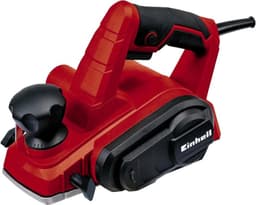
Einhell Einhell TC-PL 750

Rank 2

Einhell Einhell TC-PL 750
8.6/10about £39.78
Draper Draper Storm Force 57559

Best value

Draper Draper Storm Force 57559
8.2/10about £37.66
On this page

Set the depth and check the plug

Start shallower than the maximum printed on the tool. Listings here state anything from 0.4 mm to 3 mm, and that maximum is not a sensible first pass. BuildWiz UK, a practitioner guide rather than a British Standard, describes about 0.4–0.5 mm as a starting habit. If the saved Ryobi line already caps the tool at 0.4 mm, that cap is your pass. One KATSU review needed a rule to find zero, and one Draper 57564 review says the indicator did not match the cut. On mains, use a UK three-pin BS 1363 plug. Electrical Safety First says not to use a travel adaptor, to unwind an extension reel fully, and to use an RCD if the consumer unit does not already provide one. Pull nails before the cutters do. On a battery body, take the pack off before you use a spanner.

One pass without a dig-in

Let the motor reach speed before the cutters touch the timber. Starting on the wood leaves a dip. Keep the cable off the cut. At the start of the board, weight sits on the front shoe so the cutter cannot dive. Through the middle, both hands share the load. At the far end, weight moves to the rear shoe so the nose cannot drop as the front runs off. BuildWiz describes that sequence. It is a method, not a mark on the knob. Keep the pass moving. Dwelling in one spot cuts a hollow you will then chase. Go with the grain. If the first pass fuzzes, drop the depth and reverse direction. A fence keeps an edge square. It does not stop snipe, the scooped end. A thicknesser, with a bed and rollers, is a different machine.
Ryobi Ryobi R18PL-0

Testsieger

Ryobi Ryobi R18PL-0
8.5/10about £97.37

Corners, grain, and a fence

Corners split when the cutter runs off an unsupported end, especially across a door bottom. Work from each end toward the middle, so the last fibres are not blown out. That is a light pass, repeated, not one heavy cut at the listing's maximum. Stop while the sole is still planted. A side fence earns its place on a narrow edge. The Ryobi includes one. The Einhell includes a parallel stop, though one review found the guide bent or hard to fit, so check it against a square. The Draper 57559 includes a parallel guide. With no fence, a clamped batten can do the same job if it cannot slip into the cutter. Hands stay on the handles.

Dust, knives, and when to stop

Chips come off fast. The HSE treats wood dust as a hazard to extract, not to sweep, and at work that means a class M vacuum. At home, use the bag if the box has one, or a hose, and wear glasses, a dust mask, and hearing protection. A DEKOPRO review says that model is hard to put down without the blade touching, so wait until it stops. Unplug, or remove the battery, before you change a knife. One KATSU review returned the tool because the bolts would not undo. Stop when the piece is a fire door or a hollow rail is about to disappear. Bags and fences are on the electric planer buying guide. A lead or a pack is on corded or cordless electric planer.

Common questions

How deep should the first pass be?
Shallower than the maximum on the listing. A practitioner habit from BuildWiz UK is about 0.4–0.5 mm. Treat that as a starting habit, not as a figure every manufacturer prints. If the saved listing already caps the tool at 0.4 mm, that cap is your pass.
Which way do I push relative to the grain?
With the grain, so the cutter is not lifting the fibres. If the surface fuzzes, reduce the depth and try the other direction. On a door bottom, come in from each end toward the middle so the corner does not split.
Why is the end of the board scooped?
The front shoe ran off the wood while you were still pressing down, so the cutter dug in. That is handheld snipe. Shift your weight to the rear shoe as you leave the board, and keep the motor at speed only while the sole is supported.
Do I start the tool on the wood?
No. Let it reach speed in the air, with the sole just clear, then enter the cut. Starting in the timber loads the motor and marks the start of the pass. The same idea applies at the end: leave the wood cleanly, then release the trigger once the cutter is clear.
How do I avoid splitting a corner?
Take a light pass and work from the ends toward the middle on a door edge, so you are not blowing unsupported fibres off the arris. A fence keeps the sole square. It does not replace that direction. If the corner has already split, do not chase it with a deeper pass.
When do I unplug?
Before you change a blade, clear a jammed chip with your fingers, or leave the tool to fetch a square. On a cordless body, remove the pack for the same jobs. Electrical Safety First also wants the tool unplugged for maintenance.
Is a thicknesser the same tool?
No. A thicknesser is a machine with a bed and rollers that dimensions the face of a board. A handheld electric planer skims an edge you present to it, such as a door bottom or a timber arris. Advice about aligning infeed tables does not apply.

Related pages

Sources

Public UK sources from the research digest, used for this page in October 2026. Prices, stars and review counts are from the twelve amazon.co.uk listings captured on 19 October 2026. HSE wood-dust limits apply at work. They are not a certificate for a domestic planer.

  1. HSE, Wood dust (retrieved 19 October 2026)
  2. HSE, WD0 (retrieved 19 October 2026)
  3. BSI, BS EN 62841-2-14:2015 (retrieved 19 October 2026)
  4. IEC 62841-2-14:2015 (retrieved 19 October 2026)
  5. GOV.UK, Designated standards: machinery (retrieved 19 October 2026)
  6. HSE, Vibration tool selection (retrieved 19 October 2026)
  7. BWF Fire Door Alliance, installation (retrieved 19 October 2026)
  8. Bosch Professional UK planers (retrieved 19 October 2026)